
The Hidden Impact of Ductwork on Your New AC Choice
Discover how your existing ductwork affects your ac choices for high-SEER units, heat pumps & efficiency. Evaluate, seal or replace for optimal AC performance!
Why How Your Existing Ductwork Affects Your AC Choices Matters More Than You Think
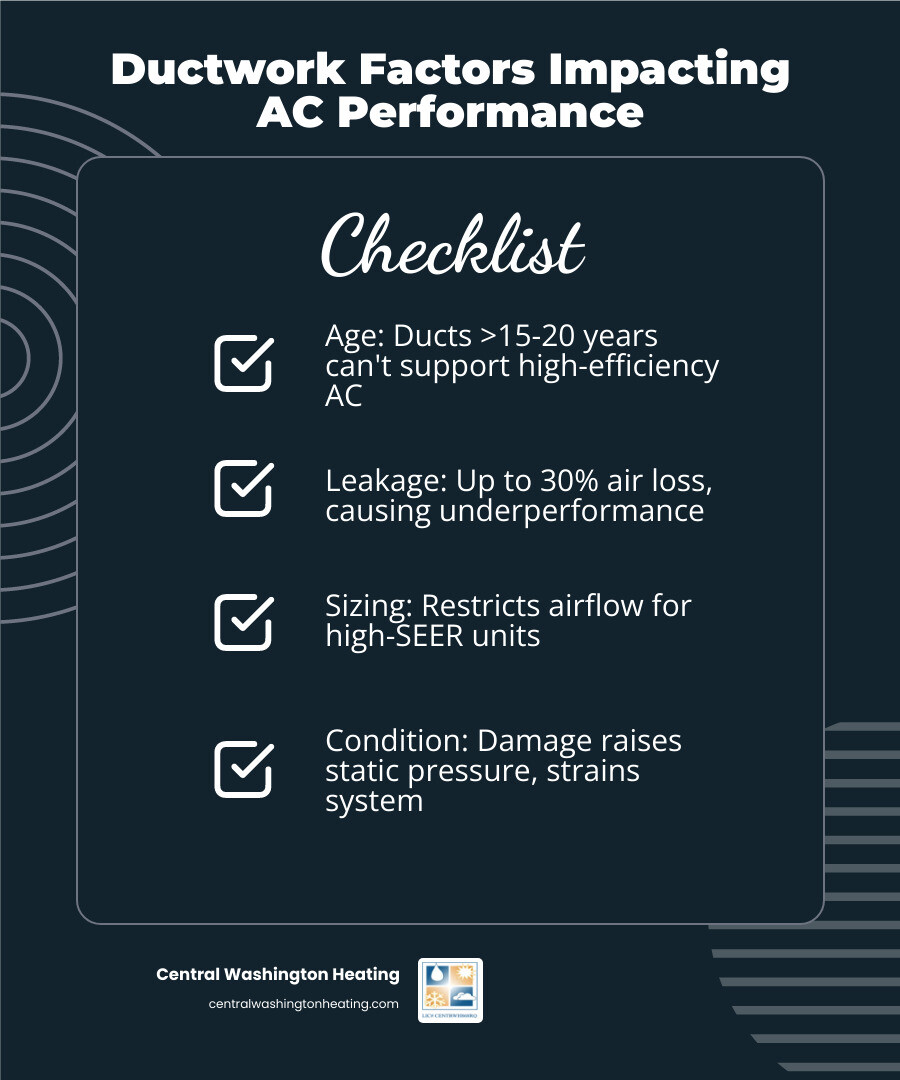
How your existing ductwork affects your AC choices comes down to a few key factors you can check before buying anything:
- Age: Ducts older than 15-20 years often can't support modern, high-efficiency systems
- Leakage: Leaky ducts can waste up to 30% of conditioned air, making even a brand-new AC underperform
- Sizing: Ducts built for older, low-efficiency units may restrict airflow for today's higher-SEER equipment
- Condition: Damaged, kinked, or deteriorating ductwork raises static pressure and forces your new system to work harder
- Layout: Too many sharp bends or undersized return vents can choke airflow regardless of how good your new AC is
Most homeowners in the Wenatchee Valley focus entirely on picking the right AC unit — and that makes sense. But here's the problem: even a top-of-the-line system will struggle, run constantly, and drive up your energy bills if the ducts behind your walls and above your ceilings aren't up to the job.
Think of it this way — upgrading your AC without checking your ductwork is like putting a high-performance engine into a car with worn-out, clogged fuel lines. The engine can't do what it was built to do.
Your ducts are the delivery system. They control how much cool air actually reaches each room, how hard your AC has to work, and whether your home ever feels truly comfortable on a hot Central Washington summer day. Getting this wrong doesn't just hurt your comfort — it shortens the life of your new equipment and keeps your utility bills high.
Before you commit to any new AC installation in Wenatchee or the surrounding area, understanding what your existing ductwork can and can't handle is the smartest first step you can take.
How Your Existing Ductwork Affects Your AC Choices and Efficiency
When we talk about how your existing ductwork affects your AC choices, we are really talking about the physics of airflow. Your air conditioner doesn't just "create" cold; it removes heat and moisture from your home and replaces it with cooled air. This exchange depends entirely on the health of your Ductwork.

One of the most critical technical factors is static pressure. Think of static pressure like blood pressure for your HVAC system. If the "arteries" (your ducts) are too small, clogged, or poorly designed, the pressure rises. High static pressure forces the blower motor to work significantly harder, which increases energy consumption and leads to premature system failure.
In April 2026, modern AC systems are designed to meet strict SEER2 (Seasonal Energy Efficiency Ratio) standards. These high-efficiency units require a specific volume of airflow to reach their rated efficiency. If your existing ducts are leaky, you could be losing up to 30% of your conditioned air to your attic or crawlspace. This doesn't just waste energy; it reduces "sensible cooling"—the actual temperature drop you feel on your skin. If your ducts aren't compatible with your new unit, you might buy a 4-ton system but only receive the cooling capacity of a 3-ton unit because the air simply can't get through the vents.
Understanding How Your Existing Ductwork Affects Your AC Choices for High-SEER Units
If you are eyeing a high-SEER unit (18 SEER or higher), your ductwork becomes even more vital. Modern high-efficiency evaporator coils are often larger and have a higher "fin density" than older models. This means the fins are packed tighter together to squeeze more cooling out of the refrigerant.
However, denses fins create more resistance to airflow. If you pair a high-SEER coil with a duct system designed in the 1990s for a 10-SEER unit, you may find that the blower motor can't push enough air through the dense coil. This leads to the coil freezing up or the motor burning out. This is why Air Duct Sealing and professional testing are non-negotiable for high-end upgrades. We often find that a 12.5% reduction in airflow can result in a staggering 24% loss in cooling capacity.
How Your Existing Ductwork Affects Your AC Choices for Electric Heat Pumps
For many homeowners in Leavenworth and Cashmere, switching to an electric heat pump is a popular way to handle both summer cooling and winter heating. Since heat pumps generally provide "warmer" cool air and "cooler" warm air than older heating systems, they often require a higher volume of airflow (measured in CFM, or cubic feet per minute) to keep you comfortable.
If your ducts are undersized, a heat pump might struggle to distribute heat evenly during a chilly Waterville night. In cases where the existing ductwork is simply too small or poorly routed to be salvaged, we often recommend a Ductless Mini-Split. These systems bypass the ductwork problem entirely, providing localized, high-efficiency cooling and electric heating without the energy loss associated with traditional vents.
Signs Your Current Ducts Are Incompatible with Modern Systems
How do you know if your ducts are crying for help? Sometimes the signs are subtle, and sometimes they are as obvious as a whistling teakettle.
Common warning signs include:
- Whistling Vents: This usually means your ducts are undersized for the amount of air the blower is trying to move.
- Hot and Cold Spots: If the bedroom is a sauna while the living room is a walk-in freezer, your duct layout is likely imbalanced or leaking.
- Excessive Dust: If you find yourself dusting every two days, your return ducts might be pulling in dirty air from your attic or crawlspace through cracks and gaps.
- Age: Ductwork materials like fiberglass and flexible plastic typically have a lifespan of 15 to 25 years. If your home was built before 2006, your ducts were designed for a completely different era of HVAC technology.
| Feature | Legacy Duct Standards (Pre-2006) | 2026 High-Efficiency Requirements |
|---|---|---|
| Typical SEER | 10 - 12 SEER | 14.3 - 20+ SEER2 |
| Insulation | R-4 or none | R-8 Minimum |
| Sealing | Duct tape (standard) | Mastic or Foil-backed tape |
| Static Pressure | Low tolerance | High sensitivity |
| Airflow Needed | ~350 CFM/ton | ~400 CFM/ton |
Evaluating Duct Sizing and Design for Variable-Speed Technology
One of the best advancements in AC technology is the variable-speed compressor. Unlike traditional units that are either "on" or "off," variable-speed systems ramp up and down to match your cooling needs exactly. However, these systems are "smart"—and they are very sensitive to duct design.
To ensure a variable-speed unit works correctly, we perform Manual J load calculations to see how much cooling each room needs, followed by Manual D calculations to design the duct paths. If the return air vents are too small, the system can't "breathe." This leads to noisy operation and prevents the unit from running at its lowest, most efficient speeds.
If you want that whisper-quiet operation that modern systems are famous for, your ducts must be sized to handle the velocity of the air without turbulence. When the ducts are properly matched to the unit, you won't even hear the system kick on. For homes where the layout makes resizing impossible, a Ductless AC Unit Complete Guide can show you how to get that same variable-speed comfort without the ductwork headache.
When to Choose Replacement Over Repair or Sealing
We always prioritize the most effective solutions for our customers by repairing or sealing existing ducts when possible. However, there are scenarios where replacement is the only logical choice.
- Material Decay: If your flexible ducts are kinking, sagging, or the outer plastic lining is "sun-rotted" and flaking off, sealing them is just a temporary fix.
- Mold and Air Quality: If moisture has entered the duct system and caused mold growth within fiberglass liners, replacement is necessary for your family's health. Indoor air pollution can be 2 to 5 times higher than outdoor levels, and old ducts are often the culprit.
- Asbestos: In some older homes in the Wenatchee area, ducts may be wrapped in asbestos insulation. In these cases, a professional abatement and replacement are required for safety.
- Major Layout Changes: If you’ve added a room or knocked down walls, your old duct layout is likely obsolete.
The Ductless AC Benefits become very clear when the condition of the existing system makes a full replacement the most effective option. Replacing your ducts, however, is an investment that pays off in lower energy waste and a significantly longer lifespan for your new AC.
Frequently Asked Questions about Ductwork and AC Upgrades
Can existing ductwork handle a higher SEER-rated AC unit?
Sometimes, but it requires testing. We check the static pressure and perform airflow tests to ensure the existing "pipes" can handle the resistance of a modern, denser cooling coil. If the ducts are too restrictive, the high-SEER unit will never actually achieve its rated efficiency, and you'll have wasted your investment.
When should you replace ductwork when installing a new AC system?
If your ducts are over 20 years old, have visible structural damage, or were sized for a much smaller, older unit, replacement is usually best. It’s much more efficient to replace the ducts while the technicians are already there installing the new indoor and outdoor units.
What if my existing ducts cannot be modified for a new AC?
You aren't stuck with a hot house! If your attic or crawlspace is too tight for modern ducting, or if you have a beautiful historic home in Wenatchee where you don't want to cut into the plaster, you can opt for an AC Without Ducts. Ductless mini-splits provide incredible cooling and heating efficiency with zero ductwork required.
Conclusion
At Central Washington Heating, we’ve spent over 30 years helping our neighbors in Wenatchee, East Wenatchee, Leavenworth, and beyond stay comfortable. As a family- and veteran-owned business, we know that a new air conditioner is a major investment. We don't want you to spend your hard-earned resources on a high-efficiency system only to have it throttled by old, leaky, or undersized ducts.
Whether you need a thorough duct inspection, customized ductwork for a quiet home, or a 24/7 emergency repair, our licensed technicians are here to ensure your system is designed for long-term comfort and peak efficiency. Don't let your ductwork be the "hidden" reason your energy bills stay high this summer.
Ready to see if your home is ready for a high-efficiency upgrade? Request Air Conditioning Services in Wenatchee, WA Today.

Written by the Central Washington Heating and Air team
The techs and comfort advisors who've kept the Wenatchee Valley heated, cooled, and breathing easy for 30+ years — family & veteran owned, with 40+ years of combined industry experience.
- Licensed & insured · LIC# CENTRWH742JN
- Daikin Comfort Pro certified
- Wenatchee, WA
Last updated July 29, 2026
Ready for comfort you can count on?
Schedule service, request a free estimate, or call now for 24/7 emergency help. Our team is standing by across the Wenatchee Valley.
Get started today
Free estimates on installs · no-pressure, written quotes
Schedule My ServiceCall (509) 776-0247Mon–Fri: 8:00 AM – 4:30 PM · 24/7 for emergencies
Already have a quote? Get a free second opinion →