
Emergency HVAC Repair What to Expect 2026
Wenatchee Valley's HVAC authority for over 30 years. Expert AC, electric air handler, heat pump, and mini-split installation, repair, and maintenance. Family & veteran owned. 24/7 emergency service.
Identifying a True HVAC Emergency in Central Washington
Emergency HVAC repair what to expect is something no homeowner wants to think about — until the heat stops working at midnight in January, or the AC gives out during a Wenatchee Valley heat wave in the middle of July. When that happens, stress sets in fast. You need answers, and you need them now.
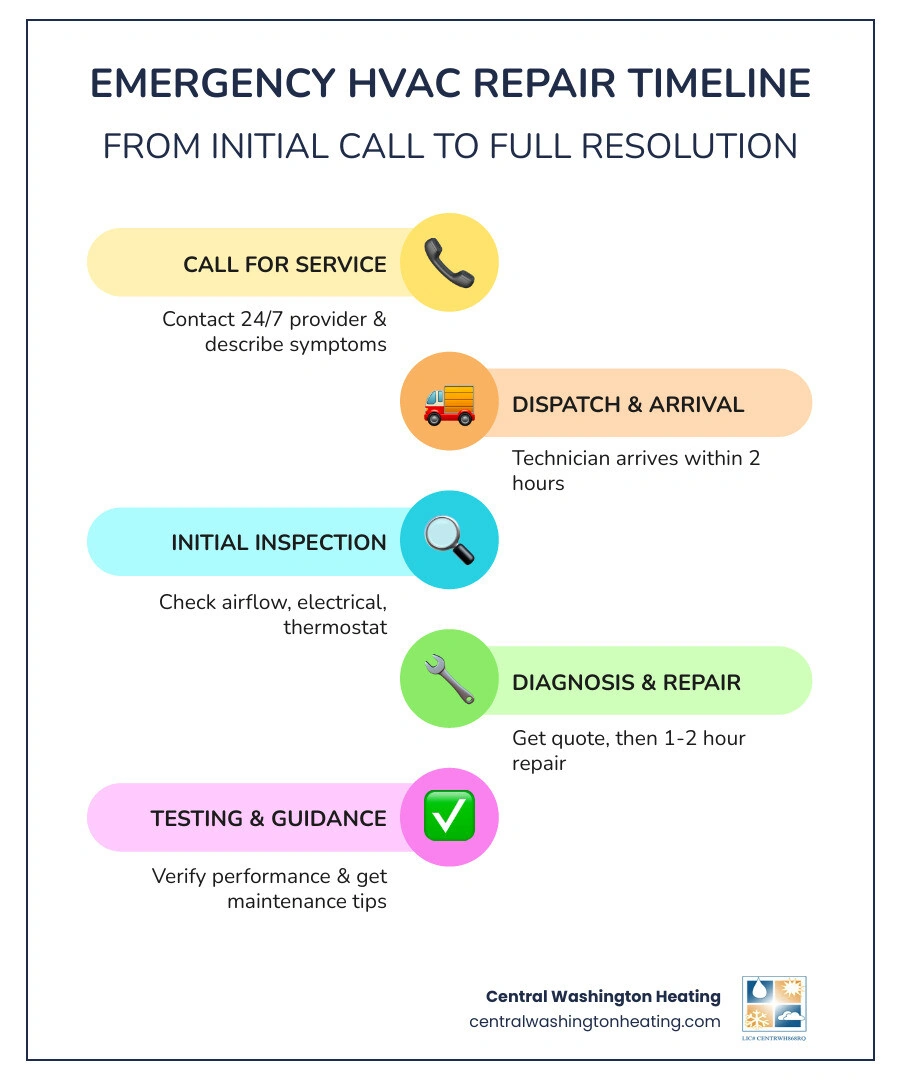
Here is a quick overview of what the emergency repair process looks like from start to finish:
- Call for service – Contact a 24/7 HVAC provider and describe your symptoms
- Dispatch and arrival – A licensed technician is sent to your home, typically within a few hours
- Initial inspection – The technician evaluates your system, checking airflow, electrical components, thermostats, and safety controls
- Diagnosis and solution – You receive a clear explanation of the problem and a repair plan before any work begins
- Repair – Most repairs take one to two hours depending on the issue
- Testing – The technician verifies the system is running safely and correctly before leaving
- Post-repair guidance – You get maintenance recommendations to help prevent future breakdowns
Knowing what to expect before the technician arrives makes the whole experience far less overwhelming. Whether you are dealing with a frozen heat pump, a system that simply will not turn on, or a burning smell coming from your vents, this guide walks you through every step — from identifying a true emergency to keeping your family safe while you wait.
It is also worth knowing that according to industry data, over 60% of HVAC emergencies happen during peak seasons — exactly when you need your system working most. You are not alone, and help is available around the clock.
Living in the Wenatchee Valley means we deal with some serious temperature swings. When it is April 2026 and a sudden late-season freeze hits, or a July heatwave pushes temperatures past 95°F, a broken HVAC system isn’t just an “inconvenience”—it can be a genuine health hazard.
But how do you know if you should call for an Emergency HVAC Service East Wenatchee WA right now or wait until Monday morning? We generally define a true emergency by the risk it poses to your family’s safety or your property’s integrity.
Health Risks and Vulnerable Occupants
If you have infants, seniors, or family members with chronic health conditions in the home, a lack of climate control is an immediate emergency. In the winter, indoor temperatures dropping below 50°F can lead to hypothermia. In the summer, temperatures rising above 95°F can cause heat exhaustion or heat stroke. If your home has reached these thresholds, do not hesitate to seek an Emergency Heating Repair Ardenvoir Guide or cooling assistance.
Electrical Burning Smells and No Airflow
If you smell something like burning plastic or “electrical” ozone coming from your vents, shut the system off at the breaker immediately. This often indicates a failing motor or a dangerous wiring issue that could lead to a fire. Similarly, if your system is running but there is absolutely no airflow, your blower motor may have failed, or your coils could be dangerously frozen.
Refrigerant Leaks and Frozen Units

If you see ice forming on your outdoor heat pump in the middle of a summer afternoon, you likely have a refrigerant leak or a severe airflow restriction. Refrigerant is essential for cooling, but it is also a chemical that requires professional handling. Exposure can cause symptoms like labored breathing or skin irritation, making this a high-priority repair.
Information to Gather Before Calling for Service
When you are in the middle of a crisis, it is easy to forget the details. However, having specific information ready when you Request Service helps our dispatch team prioritize your call and ensures the technician arrives with the right tools.
Check the Basics First
Before making the call, take a quick look at your thermostat. Is it set to the correct mode? Are the batteries fresh? Sometimes a simple setting error is the culprit. You can also use an HVAC Troubleshooter tool to see if there is a quick fix you might have missed, like a tripped circuit breaker or a completely clogged air filter.
Gather System Details
If the basics don’t solve it, grab a flashlight and find the following:
- System Make and Model: Usually found on a metal plate on the side of the indoor or outdoor unit.
- Recent Symptoms: Did you hear a loud “boom” or a high-pitched screeching before it died?
- System Age: Knowing if the unit is 5 years old versus 20 years old helps the technician understand what kind of wear and tear to expect.
- History: Has the unit been struggling for a few days, or did it stop suddenly?
Being able to describe these symptoms clearly can shave valuable time off the diagnostic process.
Emergency HVAC repair what to expect: A Step-by-Step Timeline
When you call for emergency help, the process moves faster than a standard maintenance appointment. Here is a breakdown of the typical timeline for a System Repair in our service area.
| Feature | Standard Service | Emergency Response |
|---|---|---|
| Scheduling | Booked days or weeks in advance | Prioritized for same-day/immediate dispatch |
| Arrival Window | Large window (e.g., 8 AM – 12 PM) | Narrower window, often within a few hours |
| Focus | Comprehensive tune-up and cleaning | Rapid diagnosis and restoration of comfort |
| Availability | Business hours only | 24/7, including holidays and weekends |
The Dispatch Call
When you call for 24-Hour AC Repair East Wenatchee WA, the dispatcher will ask about high-risk occupants (like seniors or babies) and the specific symptoms you’re seeing. This helps us get a technician to the most critical situations first.
Arrival and Diagnosis
Once the technician arrives for your 24-Hour A-C Repair Wenatchee WA, they will perform a targeted evaluation. They aren’t just looking for what broke; they are looking for why it broke to ensure the fix lasts.
Common system failures and emergency HVAC repair what to expect
Most emergency calls in Central Washington stem from a few common culprits:
- Blown Fuses or Tripped Breakers: Often caused by an overworked system trying to keep up with extreme temperatures.
- Failed Capacitors: These are like batteries that start your motors; they frequently fail during summer heatwaves.
- Electric air handler Malfunctions: If your electric heating elements fail, you’ll lose heat instantly. See our Emergency Air handler Repair Wenatchee WA Guide for more.
- Heat Pump Icing: In winter, if the defrost cycle fails, your unit can become a block of ice. Check our Emergency Heat Pump Repair East Wenatchee Guide for troubleshooting tips.
Preparing your home for the technician’s arrival
To make the repair go as smoothly as possible, take a few minutes to prepare:
- Clear the Workspace: Move any storage boxes or debris away from the indoor air handler and the outdoor unit.
- Pet Safety: Secure your furry friends in a separate room so they don’t get spooked or slip out the door.
- Access: Ensure gates are unlocked and you have a clear path to the attic, crawlspace, or basement.
- Lighting: If it’s night, turn on outdoor lights to help the technician find your home and work safely. Our Leavenworth WA Emergency Air handler Repair Guide has more local tips for mountain-area homes.
Staying Safe and Comfortable While You Wait
Even with a fast response, it may take a couple of hours for a technician to arrive. During that time, your priority is keeping everyone safe.
In the Winter (Heating Failure)
If you are waiting for an Emergency Heat Pump Repair Cashmere WA Guide specialist:
- Gather in one room: Pick a central room, close the doors, and hang thick blankets over windows and doorways to trap heat.
- Layer up: Use extra clothing, hats, and blankets.
- Use secondary heat safely: If you use portable electric heaters, keep them at least three feet away from anything flammable and never leave them unattended.
- Protect your pipes: Open cabinet doors under sinks to let room air reach the plumbing and prevent frozen pipes.
In the Summer (Cooling Failure)
If you have called for 24-Hour A-C Repair Leavenworth WA:
- Close the blinds: Block out the sun on the south and west sides of your home.
- Hydrate: Drink plenty of water to avoid heat exhaustion.
- Use fans: Circulate air with ceiling or floor fans. You can even place a bowl of ice in front of a fan for a “homemade AC” effect.
- Move to the lowest level: Heat rises, so the basement or the first floor will stay cooler longer.
Long-Term Solutions and Preventing Future Breakdowns
While we are always here for emergencies, the best “repair” is the one you never have to make. Statistics show that homeowners who schedule regular maintenance are 50% less likely to experience an emergency breakdown.
The Power of Prevention
A well-maintained system can last 15 to 20 years, whereas a neglected one might fail in as little as 8 to 10 years. Regular tune-ups allow us to catch small issues—like a fraying belt or a weakening capacitor—before they turn into a 2 AM emergency. Check out our Emergency Heat Pump Maintenance East Wenatchee Tips for a checklist of what we look for.
When to Consider Replacement
If your system is over 12-15 years old and you find yourself calling for emergency repairs every season, it might be time to look into an Emergency Heat Pump Installation Guide East Wenatchee WA. Modern high-efficiency systems can operate 15-20% more efficiently, which lowers your energy bills and provides much more reliable comfort.
Restoring your home’s climate: Emergency HVAC repair what to expect after the fix
Once the technician finishes the physical repair, the job isn’t quite done. You should expect:
- Performance Testing: We will run the system through a full cycle to ensure it reaches the set temperature.
- Airflow Verification: We check that air is moving through all vents quietly and efficiently.
- A Detailed Report: You’ll get an explanation of what failed and how to prevent it from happening again.
- Follow-up: Sometimes a temporary part is used to get your heat back on immediately, with a permanent manufacturer part scheduled for installation the next day.
For more details on the post-repair process, see our Emergency Heat Pump Leavenworth Guide or the 24-Hour Air handler Repair Cashmere WA Guide.
Frequently Asked Questions about Emergency HVAC Services
What is considered a true HVAC emergency?
A true emergency is any situation that threatens the health of the occupants (extreme heat or cold) or the safety of the property (electrical smells, smoke, or major water leaks). If your system is just making a slightly odd noise but still keeping the house at 70°F, it can usually wait until regular business hours.
How long does an emergency repair typically take?
Once the technician arrives, most repairs take between one and two hours. If a specialized part is required that isn’t on the service truck, the technician will often provide a temporary solution to keep you safe until the part can be sourced.
Can I wait until business hours if my system is still blowing some air?
If your system is “short-cycling” (turning on and off rapidly) or blowing lukewarm air, but the house is still at a safe temperature, you might choose to wait for a standard appointment. However, be aware that ignoring these warning signs can lead to a total system failure at a much less convenient time. About 40% of emergencies start with simple thermostat or minor component malfunctions that were ignored.
Conclusion
At Central Washington Heating, we understand that an HVAC failure is more than just a mechanical problem — it is a disruption to your family’s life. As a veteran-owned business with over 30 years of expertise in the Wenatchee Valley, we take pride in our quality craftsmanship and our 24/7 availability.
Whether you are in Wenatchee, East Wenatchee, Leavenworth, Cashmere, or any of the surrounding mountain towns, you can rely on us for fast, professional, and honest service. We specialize in quiet, efficient systems that are custom-tailored to our unique local climate.
Don’t sit in the cold or suffer through the heat. Request Expert Emergency Service Today. We are here to keep your home comfortable, no matter what the Central Washington weather throws your way.

Written by the Central Washington Heating and Air team
The techs and comfort advisors who've kept the Wenatchee Valley heated, cooled, and breathing easy for 30+ years — family & veteran owned, with 40+ years of combined industry experience.
- Licensed & insured · LIC# CENTRWH742JN
- Daikin Comfort Pro certified
- Wenatchee, WA
Last updated July 29, 2026
Ready for comfort you can count on?
Schedule service, request a free estimate, or call now for 24/7 emergency help. Our team is standing by across the Wenatchee Valley.
Get started today
Free estimates on installs · no-pressure, written quotes
Schedule My ServiceCall (509) 776-0247Mon–Fri: 8:00 AM – 4:30 PM · 24/7 for emergencies
Already have a quote? Get a free second opinion →