
Don't Sweat It: Choosing the Perfect AC for Your Central Washington Home
Learn how to choose the right AC for Central Washington: sizing, SEER2, heat pumps, mini-splits & maintenance tips for Wenatchee homes.
Why Knowing How to Choose the Right AC for Central Washington Saves You Money and Misery
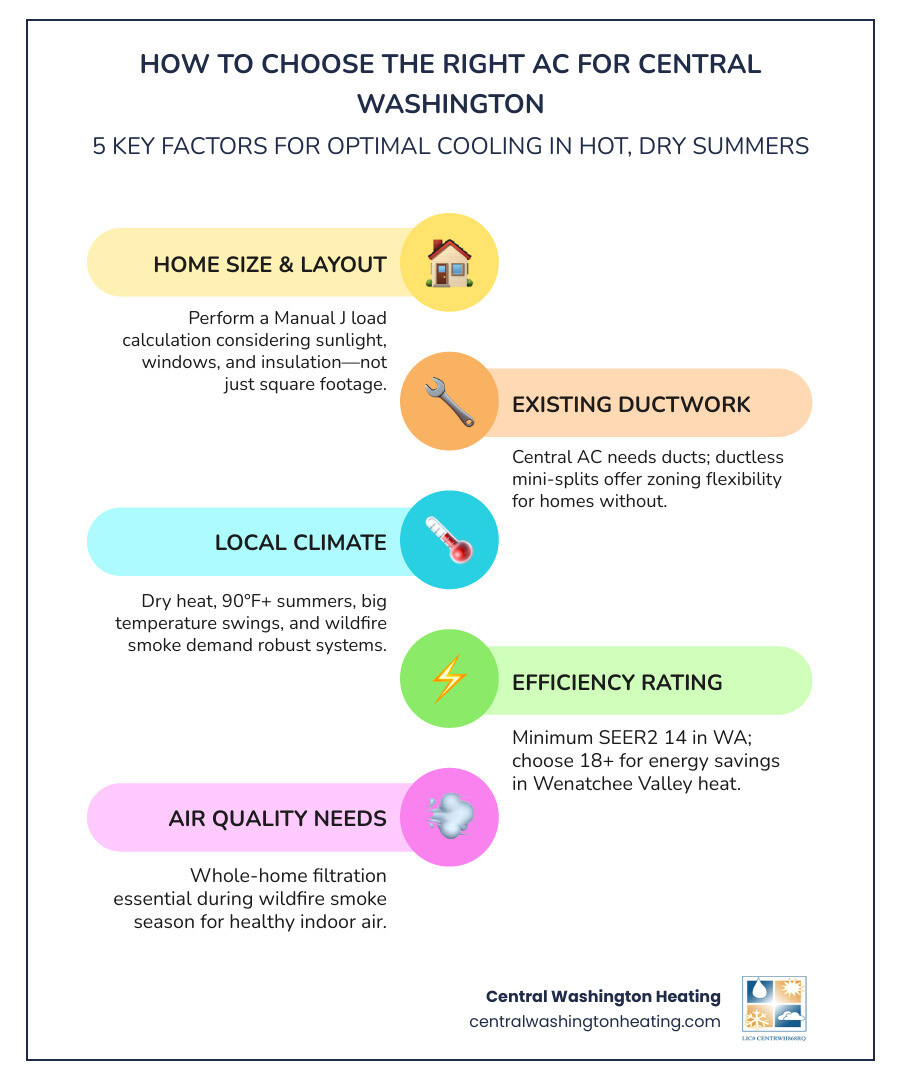
How to choose the right AC for Central Washington comes down to five key factors:
- Home size and layout – Use a Manual J load calculation, not just square footage
- Existing ductwork – Determines whether central AC or a ductless mini-split makes more sense
- Local climate – Hot, dry summers and cold winters favor heat pumps with high SEER2 ratings (18+)
- Efficiency rating – Washington State requires a minimum SEER2 of 14; aim higher for real savings
- Air quality needs – Wildfire smoke season makes filtration a critical part of any system choice
Summers in the Wenatchee Valley are no joke. Temperatures regularly push into the 90s and beyond along the Columbia River valley, and the heat hits fast — one week you’re comfortable, the next your home feels like an oven. If your current system is struggling to keep up, or you don’t have central cooling at all, picking the wrong replacement can mean years of high energy bills, uneven temperatures, and callbacks to a technician you wish you hadn’t hired.
The good news? Choosing the right system doesn’t have to be overwhelming. Whether you’re cooling a historic craftsman in Leavenworth, a newer build in East Wenatchee, or a lakeside home in Chelan, the right AC is out there — you just need to know what to look for.
This guide walks Central Washington homeowners through everything: sizing, system types, efficiency ratings, heat pumps, installation, and maintenance. By the end, you’ll know exactly what to ask for and why it matters.
How to Choose the Right AC for Central Washington Based on Climate

Central Washington has a unique microclimate that demands more from an air conditioner than the milder coastal regions. In areas like Entiat, Waterville, and Malaga, we deal with intense, dry heat and significant temperature swings—sometimes 30 degrees or more between day and night.
When you are figuring out how to choose the right ac for central washington, you have to account for these extremes. A system that works in Seattle might struggle here because it isn’t engineered for the sustained 95°F+ days we see in July and August. Furthermore, our region faces a specific challenge: wildfire smoke. During the late summer, the air quality in the Wenatchee River valley can plummet. Your AC system shouldn’t just cool the air; it should protect your family.
Modern systems act as the “lungs” of your home. By integrating high-efficiency filtration, you can filter out the fine particulate matter from smoke and the dust from local orchards. Understanding the Essential Benefits of Whole Home Air Filtration is vital for anyone living in smoke-prone areas like Leavenworth or Cashmere.
How to choose the right AC for Central Washington home sizing
One of the biggest mistakes we see homeowners make is assuming “bigger is better.” An oversized unit will cool your home too quickly, a process called short-cycling. This prevents the unit from running long enough to properly dehumidify the air, leaving you with a home that feels cold but clammy. Conversely, an undersized unit will run constantly, driving up your utility bills and wearing out the motor prematurely.
To get it right, we perform a professional Load Calculation. This isn’t a “rule of thumb” based on square footage. Instead, we use the industry-standard Manual J calculation, which looks at:
- Sunlight exposure: Does your living room face the afternoon sun off the Columbia River?
- Insulation levels: Is your home a 1920s build in Monitor or a modern home in East Wenatchee?
- Kitchen placement: Kitchens generate massive amounts of heat (adding up to 4,000 BTUs to your cooling needs).
- Occupancy: Every extra person in the home adds about 600 BTUs to the cooling Capacity required.
By matching the Air Conditioner to your home’s specific thermal profile, you ensure the system runs at peak efficiency.
Sizing and System Types: Finding Your Perfect Fit
The infrastructure of your home—specifically your Ductwork—is the primary fork in the road when choosing a system. If your home has existing, well-insulated ducts, a central AC system or a ducted heat pump is often the most straightforward choice. However, if your ducts are leaky or non-existent, you might be losing up to 30% of your conditioned air before it even reaches your bedroom.
Here is a quick breakdown to help you compare your options:
| Feature | Central AC | Ductless Mini-Split |
|---|---|---|
| Best For | Homes with existing, high-quality ducts | Homes without ducts, additions, or “hot zones” |
| Installation | Uses existing vents; 1-2 day install | Minimal mess; 3-inch hole in wall |
| Efficiency | 14–21 SEER2 | 18–30+ SEER2 |
| Zoning | Whole-home cooling | Room-by-room control |
| Lifespan | 12–15 years | 15–20 years |
How to choose the right AC for Central Washington with no ducts
Many older homes in Dryden, Peshastin, and Leavenworth were built long before central cooling was standard. If you’re in this boat, you don’t have to tear apart your beautiful lath-and-plaster walls to stay cool. An AC Without Ducts, also known as a mini-split, is the “Goldilocks” solution for many local residents.
Mini-splits use inverter technology, which allows the compressor to adjust its speed precisely rather than just clicking on and off. This results in incredibly quiet operation (some units are as low as 19 dB) and allows for true zoning. You can keep your bedroom at a crisp 68 degrees while leaving the guest room at 74, saving you a fortune on electricity. If you are looking for an AC Replacement Chelan WA, a mini-split is often the most efficient way to handle the intense lakeside sun.
Maximizing Efficiency with SEER2 and Heat Pumps
In 2026, efficiency isn’t just a buzzword; it’s a state requirement. Washington has a minimum SEER (Seasonal Energy Efficiency Ratio) rating of 14. However, with our local electricity rates and climate, we often recommend aiming for 16 to 20+. You can use a SEER Calculator to see how much an upgrade could slash your monthly bills.
One of the smartest moves for a Central Washington homeowner is choosing a heat pump. When comparing a Heat Pump vs AC, a heat pump is essentially an air conditioner that can work in reverse.
- Summer: It pumps heat out of your home to keep you cool.
- Winter: It extracts heat from the outdoor air (even in sub-zero temperatures) and pumps it into your home.
Modern “cold-climate” heat pumps are incredibly effective in our winters. Since they use electricity to move heat rather than create it, they can be up to 50% more efficient than older electric resistance heating. This makes them a perfect year-round comfort solution for homes in Waterville or Orondo.
Professional Installation and Long-Term Maintenance
An air conditioner is only as good as the hands that install it. A poor installation can reduce a system’s efficiency by 30% from day one. Our AC Installation Guide East Wenatchee WA emphasizes the importance of “precision commissioning”—checking the refrigerant charge, balancing the airflow, and ensuring the outdoor condenser has at least two feet of clearance for proper breathing.
Once your system is in, Maximizing AC Lifespan with Regular Maintenance is the key to protecting your investment. A well-maintained system can last up to 20 years, whereas a neglected one might fail in 10. We recommend a professional tune-up every spring. During these visits, we check for AC Condenser Fan Motor Failure Signs & Solutions to catch small problems before they become mid-July emergencies.
If you already have a system that’s acting up, don’t wait. Scheduling AC Maintenance Wenatchee WA now can save you from a total system breakdown when the mercury hits 100 degrees.
Frequently Asked Questions About Central Washington Cooling
Finding an AC Repair Near Me Wenatchee WA is easy, but knowing the “whys” of your system helps you make better decisions. Here are the most common questions we hear from your neighbors.
What SEER2 rating is required in Washington for 2026?
As of 2026, all new air conditioning installations in Washington must meet a minimum SEER2 rating of 14. SEER2 is a more rigorous testing standard than the old SEER rating, better reflecting real-world conditions. While 14 is the legal minimum, we find that SEER2 ratings of 16–18 provide the best return on investment for the Wenatchee Valley’s long cooling seasons.
Why are heat pumps recommended for the Wenatchee Valley?
Heat pumps are the “Swiss Army Knife” of HVAC. Because we experience both extreme heat and freezing winters, having one system that handles both efficiently is a massive advantage. They are all-electric, align with Washington’s clean energy goals, and can significantly lower your winter heating bills compared to older electric air handlers or baseboard heaters.
How often should I change my AC filters during smoke season?
Normally, we recommend changing filters every 90 days. However, during “smoke season” or high-wind events in dusty areas like Orondo or Waterville, you should check your filter every 30 days. If the filter looks gray or “fuzzy,” change it immediately. A clogged filter restricts airflow, which can cause your evaporator coil to freeze and potentially damage your compressor.
Conclusion
Choosing the right AC for your home in Central Washington is about more than just staying cool—it’s about efficiency, air quality, and long-term peace of mind. From the historic streets of Leavenworth to the sun-drenched orchards of Cashmere and the growing neighborhoods of East Wenatchee, we’ve spent over 30 years helping our neighbors find the perfect cooling solutions.
As a family- and veteran-owned business, we take pride in our “measure twice, cut once” approach. We don’t just “box-swap” units; we engineer systems tailored to the unique microclimates of the Wenatchee Valley. Whether you need a 24/7 emergency repair, a precision tune-up, or a brand-new high-efficiency heat pump, we are here to help.
Don’t spend another summer sweating through the night or worrying about your energy bills. Request Service Today to schedule your consultation. Let’s make this summer your coolest one yet!

Written by the Central Washington Heating and Air team
The techs and comfort advisors who've kept the Wenatchee Valley heated, cooled, and breathing easy for 30+ years — family & veteran owned, with 40+ years of combined industry experience.
- Licensed & insured · LIC# CENTRWH742JN
- Daikin Comfort Pro certified
- Wenatchee, WA
Last updated July 29, 2026
Ready for comfort you can count on?
Schedule service, request a free estimate, or call now for 24/7 emergency help. Our team is standing by across the Wenatchee Valley.
Get started today
Free estimates on installs · no-pressure, written quotes
Schedule My ServiceCall (509) 776-0247Mon–Fri: 8:00 AM – 4:30 PM · 24/7 for emergencies
Already have a quote? Get a free second opinion →