
How Improper AC Sizing and Charge Kill Your Efficiency
Discover how incorrect sizing during installation wastes energy, causing 30% inefficiency, short cycling & high bills. Expert Wenatchee AC tips!
Why is my AC constantly cycling? How incorrect sizing during installation wastes energy in Wenatchee
How incorrect sizing during installation wastes energy is one of the most costly – and most overlooked – problems facing homeowners in Wenatchee, East Wenatchee, and across the Wenatchee Valley. According to research backed by NIST, improper HVAC installation can increase your household energy use for heating and cooling by around 30% over what it should be. And the root cause, more often than not, is a system that was never the right size to begin with.
Here is a quick look at the main ways incorrect sizing wastes energy:
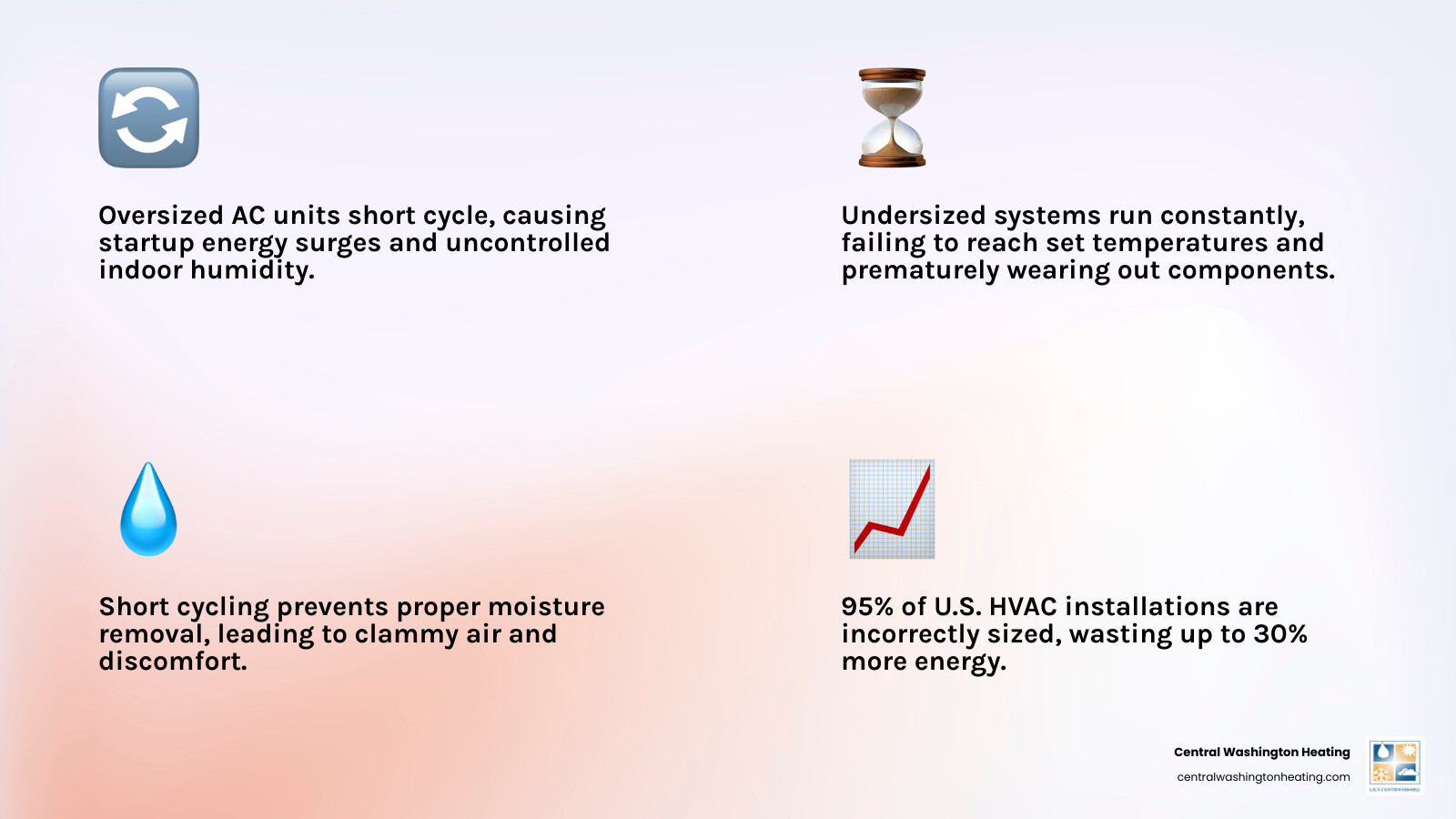
- Oversized systems cool or heat too fast, then shut off early – a pattern called short cycling that burns extra power on every startup and leaves humidity uncontrolled
- Undersized systems run nonstop trying to hit a temperature they can never reach, driving up energy bills and wearing out components ahead of schedule
- Compounding faults like leaky ducts, wrong refrigerant charge, and poor airflow stack on top of sizing errors, pushing waste even higher
- Skipped or rushed load calculations mean the system is chosen based on guesswork rather than your home’s actual heating and cooling needs
Studies suggest that roughly 95% of HVAC systems installed across the U.S. are incorrectly sized – and the majority are oversized. That means most homeowners are already paying more than they should every single month, without knowing why.
If your energy bills have been climbing, your home never quite feels comfortable, or your system seems to turn on and off constantly, incorrect sizing during installation could be the reason.

When we talk about the capacity of an HVAC system, we aren’t talking about how “good” it is. We are talking about its ability to remove heat (in the summer) or add heat (in the winter) to a specific volume of space. If that capacity doesn’t match your home’s needs, the efficiency of the unit – no matter how high the SEER rating on the box – simply evaporates.
In our 30+ years of experience serving the valley, we’ve found that many homeowners fall into the trap of thinking a more powerful system will provide better comfort. In reality, finding the Right System Ac Install Needs is a scientific process, not a “bigger is better” guessing game.
How incorrect sizing during installation wastes energy through short cycling
The most common mistake in our region is installing an oversized unit. When a system is too large for the space, it reaches the thermostat’s setpoint almost immediately. While that might sound like a good thing, it leads to “short cycling.” This is where the unit roars to life, runs for three to five minutes, and then abruptly shuts off.
Think of it like driving a car in stop-and-go Wenatchee traffic versus cruising down Highway 2 at a steady speed. Every time your AC or electric air handler starts up, it consumes a massive surge of electricity. This startup surge is significantly higher than the energy required to keep the system running at a steady state. If your system is cycling on and off dozens of times an hour, those energy spikes add up to a massive utility bill. Furthermore, because it never stays on long enough to complete a full cycle, it never reaches its peak operating efficiency. If you find your system is constantly “clicking” on and off, it might be time to Replace Entire Ac System with one that actually fits your home.
How incorrect sizing during installation wastes energy in undersized systems
On the flip side, an undersized system presents a different set of problems. In this scenario, the unit is too small to handle the heat load of your home during a typical July afternoon in East Wenatchee. It will run 24/7, desperately trying to lower the temperature, but it will never quite reach the setpoint.
This constant operation leads to:
- Extreme Energy Consumption: Because the motor never gets a break, your meter just keeps spinning.
- Component Burnout: Parts like the compressor and blower motor are designed for intermittent rest. Running them nonstop leads to premature failure.
- Uneven Comfort: You’ll likely notice that rooms furthest from the air handler remain stuffy or cold, while the room with the thermostat is the only one that feels “okay.”
When Selecting The Right Mini Split Ac or central system, we ensure the unit has the stamina to handle our local climate without being forced to run itself into an early grave.
The “Bigger is Better” Myth: Why Oversized Systems Fail
It is a common misconception that a 5-ton unit will cool a house “better” than a 3-ton unit. In the HVAC world, “bigger” usually just means “more problems.” Statistics show that a staggering 75% of systems operating today are oversized. This leads to a home that feels cool but “clammy.”
To truly understand why this happens, you have to look at what an air conditioner actually does. It doesn’t just lower the temperature; it removes moisture. If the system is too big, it cools the air so fast that it shuts off before it has a chance to pull the humidity out. You end up with 72-degree air that feels like a damp basement. Proper Understanding Heat Pump Installation requires recognizing that the system needs to run for longer, steadier periods to create a truly comfortable environment.
The silent system killer: Short cycling
We often call short cycling the “silent killer” of HVAC systems. Beyond the immediate energy waste, the mechanical stress is devastating. Every time a motor starts, it experiences thermal stress and physical wear.
An oversized system that short cycles can have its lifespan reduced by 5 to 10 years. Parts like contactors, capacitors, and compressors – the heart of your system – are rated for a certain number of “starts.” When you double or triple those starts through improper sizing, you are essentially fast-forwarding your system toward a breakdown. This is why following a Mini Split Installation Checklist For Homes that emphasizes correct sizing is so vital for long-term reliability.
Humidity and comfort struggles in East Wenatchee
In the Wenatchee Valley, we might not have the humidity of the coast, but we still need effective moisture control to stay comfortable. A correctly sized AC or heat pump should maintain indoor humidity levels between 30% and 50%.
When an oversized system cycles off too quickly, the evaporator coil doesn’t stay cold long enough to condense water vapor from the air. The result is “thermostat ping-pong,” where the air near the thermostat is cold, but the rest of the house feels muggy. Homeowners often respond by lowering the thermostat even further to try and get comfortable, which only wastes more energy. Our Ac Installation Guide East Wenatchee Wa focuses on balancing these factors so you can set your thermostat once and forget about it.
Beyond Tonnage: How Installation Faults Compound Efficiency Loss
Sizing is the foundation, but even a perfectly sized unit can be ruined by a sloppy installation. The how incorrect sizing during installation wastes energy narrative often includes “compounding faults” – errors that happen during the physical setup of the unit. According to national studies, these faults can independently increase energy use by 30% above what is necessary.
When we walk through the Heat Pump Installation Process, we look at the system as a whole, including the ducts, the refrigerant, and the airflow. If any of these are off, the “size” of the unit becomes irrelevant.
The impact of leaky ducts and poor airflow
Ductwork is the “veins and arteries” of your HVAC system. If your ducts are leaky – especially if they run through unconditioned attics or crawlspaces – you are literally paying to cool the outdoors.
- Static Pressure Issues: If your ducts are too small for your unit (a common result of “upsizing” the AC without changing the ducts), the system has to work twice as hard to push air through a restricted space. This is like trying to breathe through a cocktail straw while running a marathon.
- Efficiency Loss: Leaky ducts are often the dominant fault in residential systems. In some cases, duct leakage alone can increase energy bills by over 20%.
When you Choose The Right Air handler Installation or AC setup, ensuring the ductwork can actually handle the airflow is paramount.
Refrigerant charge and sensor pairing errors
The refrigerant is the medium that carries heat out of your home. If there is too little (undercharge) or too much (overcharge), the system cannot move heat efficiently.
- The “Topping Off” Trap: Some installers simply “top off” a system until it feels cold. This is a recipe for disaster. Professional installers measure refrigerant by weight and verify it using superheat and subcooling measurements.
- National Impact: Research shows that indoor airflow and refrigerant charge faults account for 20.7 Terawatt-hours of wasted energy annually in the U.S. That is $2.5 billion out of homeowners’ pockets.
Whether you are Choosing The Best Air handler Installation (electric) or a new AC, the precision of the charge is what locks in that high-efficiency rating you paid for.
The Essential Role of Manual J Load Calculations
So, how do we avoid these errors? It starts with a Load Calculation, specifically the industry-standard Manual J. This isn’t a guess; it’s a mathematical assessment of exactly how much heat your home gains and loses.
If you are looking at a Air handler Installation East Wenatchee Complete Guide, you’ll see that sizing an electric air handler or heat pump requires looking at the building envelope as a whole. We don’t just look at the floor; we look at everything that touches the outside world.
Factors considered in modern sizing
A true Manual J calculation considers:
- Insulation Levels: What’s in your walls and attic?
- Window Orientation: How many south-facing windows are soaking up the Wenatchee sun?
- Ceiling Height: Vaulted ceilings require more “muscle” than standard 8-foot rooms.
- Occupancy: How many people (and heat-generating appliances) are in the home?
- Local Climate: We use “design days” based on our specific regional weather, not a national average.
Today, we can even use advanced tools like LiDAR to create 3D models of a home in minutes, ensuring the math is perfect before a single bolt is turned.
Why rules of thumb fail homeowners
For decades, the “rule of thumb” was one ton of cooling for every 500 square feet. This is outdated and dangerous. Two houses in Leavenworth might both be 2,000 square feet, but if one has modern triple-pane windows and high-density insulation while the other is a drafty 1970s build, their HVAC needs will be wildly different.
Using a rule of thumb is the fastest way to end up with an oversized system that short cycles and wastes money. We focus on the building envelope – the “shell” of your home – to ensure the equipment is matched to the actual reality of your living space.
Frequently Asked Questions About HVAC Sizing
How can I tell if my AC is oversized?
The biggest red flag is a cycle length of less than 8-10 minutes. If your system turns on, blasts cold air, and shuts off in five minutes, it’s likely oversized. Other signs include high indoor humidity (feeling “sticky” or “clammy”), uneven temperatures between rooms, and frequent “clicking” or starting noises.
What is the most common installation fault?
While how incorrect sizing during installation wastes energy is a huge factor, duct leakage is often cited as the #1 physical installation fault. Many systems lose 10% to 30% of their conditioned air before it ever reaches the living space because of unsealed joints or holes in the ductwork.
Does a bigger system cool my home faster?
Technically, yes, it will drop the temperature on the thermostat faster. However, “faster” is not “better.” Because it cools so quickly, it fails to remove humidity and creates cold spots and hot spots. A properly sized system should run longer, gentler cycles that provide even, comfortable, and efficient cooling.
Conclusion
At Central Washington Heating, we’ve spent over 30 years helping our neighbors in Wenatchee, East Wenatchee, Leavenworth, and Cashmere stay comfortable without breaking the bank. As a family- and veteran-owned business, we know that quality craftsmanship matters. We don’t believe in “rules of thumb” or “good enough” installations. We believe in doing the math, sealing the ducts, and ensuring every system we install is a perfect fit for the home it serves.
If you’re worried that your current system is short cycling or your energy bills are higher than they should be, don’t wait for a total breakdown. Let our licensed technicians perform a professional evaluation and show you what true efficiency looks like.
Request Service Today to ensure your home is ready for whatever the Washington weather throws our way!

Written by the Central Washington Heating and Air team
The techs and comfort advisors who've kept the Wenatchee Valley heated, cooled, and breathing easy for 30+ years — family & veteran owned, with 40+ years of combined industry experience.
- Licensed & insured · LIC# CENTRWH742JN
- Daikin Comfort Pro certified
- Wenatchee, WA
Last updated July 29, 2026
Ready for comfort you can count on?
Schedule service, request a free estimate, or call now for 24/7 emergency help. Our team is standing by across the Wenatchee Valley.
Get started today
Free estimates on installs · no-pressure, written quotes
Schedule My ServiceCall (509) 776-0247Mon–Fri: 8:00 AM – 4:30 PM · 24/7 for emergencies
Already have a quote? Get a free second opinion →