
The Ultimate Guide to SEER2 Ratings for New Air Conditioners
Discover what seer2 rating to look for in a new AC for Wenatchee. Compare tiers, meet 2026 standards & maximize efficiency savings.
Understanding SEER2 and How It Measures Efficiency
What SEER2 rating to look for in a new AC depends on where you live and your specific comfort needs — but here's a quick answer for Central Washington homeowners:
| Your Goal | Recommended SEER2 Rating |
|---|---|
| Meet minimum code (North region) | 13.4 SEER2 |
| Heat pump minimum (all regions) | 14.3 SEER2 |
| High efficiency and value | 15.2 – 17.5 SEER2 |
| Qualify for federal tax credits | 17.0+ SEER2 |
| Maximum efficiency and comfort | 18.0+ SEER2 |
If you're shopping for a new air conditioner in the Wenatchee Valley, you've probably run into the term "SEER2" and wondered what it actually means for your home and your energy bills. It's a fair question — and the answer matters more than most people realize.
SEER2 stands for Seasonal Energy Efficiency Ratio 2. Think of it like the miles-per-gallon rating on a car, but for your air conditioner. The higher the number, the less electricity the unit uses to cool your home over a full cooling season. A more efficient system means lower monthly utility bills — and in Central Washington, where summer temperatures can climb well into the 90s, that adds up fast.
The "2" in SEER2 isn't just a name update. Since January 2023, the U.S. Department of Energy requires all new air conditioners to be rated under a stricter testing standard that better reflects real-world conditions in your home — not just ideal lab settings. That's why SEER2 numbers look slightly lower than the old SEER ratings you may have seen before, even though the equipment performance is the same or better.
This guide walks you through everything you need to know — from minimum standards in our region to which ratings qualify for rebates — so you can make a confident, informed decision.
To understand what SEER2 rating to look for in a new AC, we first have to look at what changed in the industry. SEER2 stands for Seasonal Energy Efficiency Ratio 2. It is a mathematical formula: the total cooling output (measured in BTUs) divided by the total electrical energy consumed (measured in watt-hours) over an entire typical cooling season.
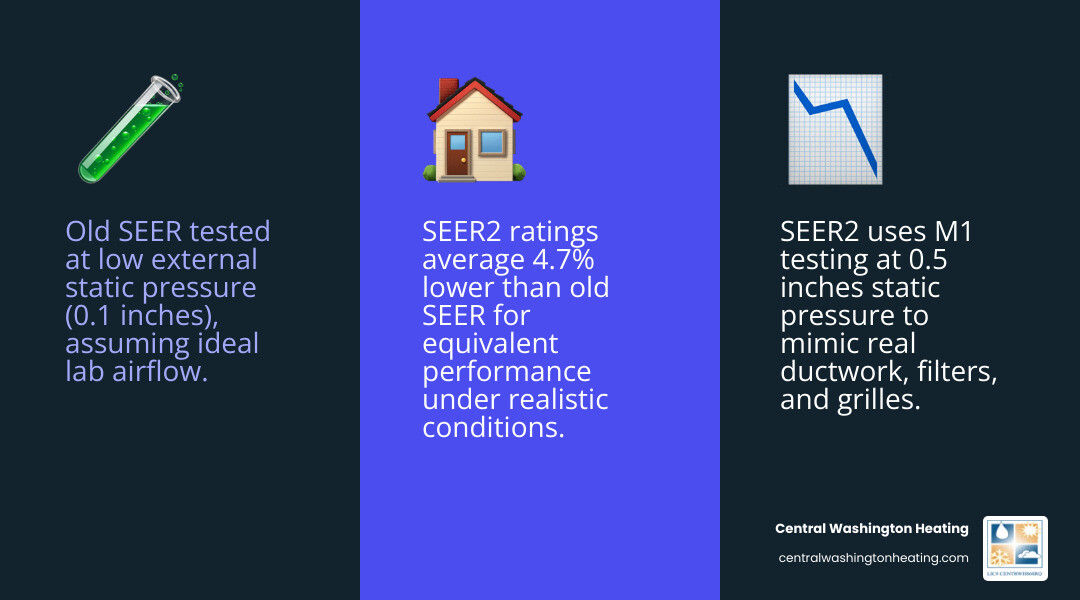
In the past, the original SEER rating was calculated using laboratory conditions that didn't always match the reality of a home in Leavenworth or Cashmere. The old test assumed very low resistance to airflow. However, once you add ductwork, air filters, and grilles, the system has to work much harder.
The Department of Energy introduced the "M1" testing procedure to create SEER2. This new standard increases the external static pressure used during testing by five times—from 0.1 inches of water column to 0.5 inches. This higher pressure simulates the "real-world" resistance found in your home's air conditioner and duct system.
Because the testing is tougher, the numerical ratings for SEER2 are roughly 4.7% lower than the old SEER ratings for the exact same piece of equipment. For example, an older unit labeled as 16 SEER would now be rated around 15.2 SEER2. For a deeper dive into these terms, you can check our Glossary SEER page or our Glossary AC guide.
What SEER2 Rating to Look for in a New AC for Central Washington
When homeowners in Wenatchee, East Wenatchee, or Chelan ask us about the right efficiency level, we start with the legal requirements. The U.S. is divided into three regions for HVAC standards: North, Southeast, and Southwest. Washington State falls into the North region.
As of April 2026, the minimum allowable efficiency for a new split-system air conditioner in our area is 13.4 SEER2. If you are opting for a heat pump—which provides both cooling and electric heating—the nationwide minimum is 14.3 SEER2.
However, just because 13.4 is the legal minimum doesn't mean it's the right choice for your home. Our climate in the Wenatchee Valley is unique; we experience hot, dry summers and cold winters. Choosing the right system AC install needs means balancing the initial system selection with the long-term energy savings. For those living in East Wenatchee, our AC Installation Guide East Wenatchee WA provides more localized insights into system selection.
Comparing Efficiency Tiers: What is a "Good" Rating?

Efficiency ratings generally fall into three tiers. Understanding these helps you narrow down what SEER2 rating to look for in a new AC:
- Entry-Level (13.4 – 15.1 SEER2): These units meet the basic legal requirements. They are reliable and represent a standard entry-level investment, but they use more electricity during our peak July and August heatwaves. They are often single-stage systems, meaning they are either 100% "on" or "off."
- Mid-Range (15.2 – 17.5 SEER2): This is often considered the "sweet spot" for Central Washington. These units offer a significant jump in efficiency without the higher performance tier of top-tier models. Many in this range qualify for ENERGY STAR certification.
- Premium Performance (18.0+ SEER2): These are the high-performance athletes of the HVAC world. They often feature variable-speed technology, which allows the system to adjust its cooling output precisely to your home's needs.
If you're curious about how much you could save by moving from an old 10 SEER unit to a new 16 SEER2 model, our SEER Calculator is a great tool. Upgrading from a very old unit to a modern mid-range system can cut cooling energy use by up to 37.5%. For more help on the replacement process, see our AC Unit Replacement Guide 2025.
Deciding what SEER2 rating to look for in a new AC based on usage
How much you use your air conditioner is a major factor in determining your long-term efficiency gains. If you live in a part of the valley where you run your AC from May through September, a higher SEER2 rating will maximize your energy savings much faster through lower monthly bills.
In areas with lower utility rates, the "efficiency timeline" for a very high-efficiency unit might be longer. However, if utility rates increase (as they historically do), a more efficient unit acts as a hedge against those future increases. We always emphasize the benefits of professional AC installation to ensure the system is tuned to your specific usage patterns.
Determining what SEER2 rating to look for in a new AC for maximum comfort
Efficiency isn't just about the bill; it’s about how the air feels. High SEER2 ratings (18+) are almost always associated with variable-speed compressors.
Unlike a basic AC that blasts cold air and then shuts off, a variable-speed unit can run at a very low, steady capacity. This provides:
- Better Humidity Control: By running longer cycles at a lower speed, the system removes more moisture from the air.
- Quiet Operation: These systems are significantly quieter than entry-level models—sometimes the birds in your yard will be louder than your AC!
- Consistent Temperatures: You won't experience the 3-degree swings common with older "on/off" systems.
Different AC unit brands offer various technologies to achieve these ratings, and we can help you find the one that fits your comfort goals.
Beyond the Rating: Factors That Impact Your System’s Performance
You could buy the most efficient 24 SEER2 unit on the market, but if it isn't installed correctly, it won't perform at that level. In fact, poor installation can reduce a system's efficiency by 30% or more.
To get the most out of your SEER2 rating, we consider:
- Proper Sizing: We perform a Manual J load calculation to ensure the unit is the perfect size for your home's square footage, window orientation, and insulation levels. An oversized unit will "short-cycle," wasting energy and failing to dehumidify.
- Ductwork Sealing: Leaky ducts in an attic or crawlspace can lose 20% of your cooled air before it ever reaches your living room. Custom, well-sealed ductwork is essential for quiet and efficient operation.
- Home Insulation: If your attic insulation is below R-38, your new AC has to work overtime.
- Maintenance: Maximizing AC lifespan with regular maintenance is the only way to ensure your system stays at its rated efficiency year after year.
For a look at the full process, read our comprehensive guide to AC installation.
Frequently Asked Questions About SEER2 Ratings
How is SEER2 different from the original SEER rating?
The primary difference is the testing standard. SEER2 uses the "M1" protocol, which tests equipment at a much higher static pressure (0.5 vs 0.1). This change was made because the old test didn't account for the resistance of modern ductwork and filters. Because the test is harder, the numerical SEER2 rating is usually about 4.7% lower than the old SEER rating, even if the unit is identical.
Which SEER2 ratings qualify for federal tax credits?
Under the Inflation Reduction Act and the 25C tax credit, homeowners can often claim a credit for high-efficiency systems. Generally, for split-system air conditioners, you want to look for a rating of 17.0 SEER2 or higher (and an EER2 of at least 12.0) to meet ENERGY STAR requirements for these incentives. Heat pumps have different thresholds but often offer even larger credits—up to $2,000 in some cases.
Does a higher SEER2 rating mean the unit cools faster?
No. The SEER2 rating measures efficiency, not capacity. A 3-ton unit with 14 SEER2 and a 3-ton unit with 20 SEER2 both provide 36,000 BTUs of cooling. The difference is that the 20 SEER2 unit uses significantly less electricity to provide that same amount of cooling. In fact, high-efficiency variable-speed units often cool "slower" and more steadily to maintain a more consistent, comfortable temperature.
Conclusion
Choosing the right air conditioner for your home in the Wenatchee Valley is about more than just picking a number. Whether you are in Leavenworth, East Wenatchee, or Waterville, the goal is to find a system that keeps you cool during our scorching summers while maintaining high efficiency.
At Central Washington Heating, we bring over 30 years of local expertise to every project. As a family- and veteran-owned business, we take pride in our quality craftsmanship and customized ductwork that ensures your high-efficiency system actually delivers on its promises. Our licensed technicians are ready to help you navigate the latest standards and find the perfect fit for your comfort and lifestyle.
Ready to upgrade your home comfort? Request service today to schedule a consultation with the Wenatchee Valley's trusted HVAC experts!

Written by the Central Washington Heating and Air team
The techs and comfort advisors who've kept the Wenatchee Valley heated, cooled, and breathing easy for 30+ years — family & veteran owned, with 40+ years of combined industry experience.
- Licensed & insured · LIC# CENTRWH742JN
- Daikin Comfort Pro certified
- Wenatchee, WA
Last updated July 29, 2026
Ready for comfort you can count on?
Schedule service, request a free estimate, or call now for 24/7 emergency help. Our team is standing by across the Wenatchee Valley.
Get started today
Free estimates on installs · no-pressure, written quotes
Schedule My ServiceCall (509) 776-0247Mon–Fri: 8:00 AM – 4:30 PM · 24/7 for emergencies
Already have a quote? Get a free second opinion →