
Stop the Aging Process: Why Maintenance Plans Keep Units Running Longer
Discover how a maintenance plan extends equipment life: cut breakdowns, boost efficiency & save on HVAC repairs in Wenatchee.
Why a Maintenance Plan Is the Smartest Way to Extend Equipment Life
How a maintenance plan extends equipment life comes down to one simple idea: catching small problems before they become major ones. Instead of waiting for your heating or cooling system to break down, a structured maintenance plan keeps it running efficiently, safely, and for far longer than equipment that only gets attention when something goes wrong.
Here’s a quick look at how maintenance plans protect your HVAC investment:
- Prevents premature wear – Regular inspections reduce strain on motors, coils, and electrical components
- Catches early warning signs – Technicians spot minor issues before they trigger full system failures
- Maintains energy efficiency – Clean, calibrated systems use less power to do the same job
- Reduces unexpected downtime – Scheduled care means fewer emergency breakdowns
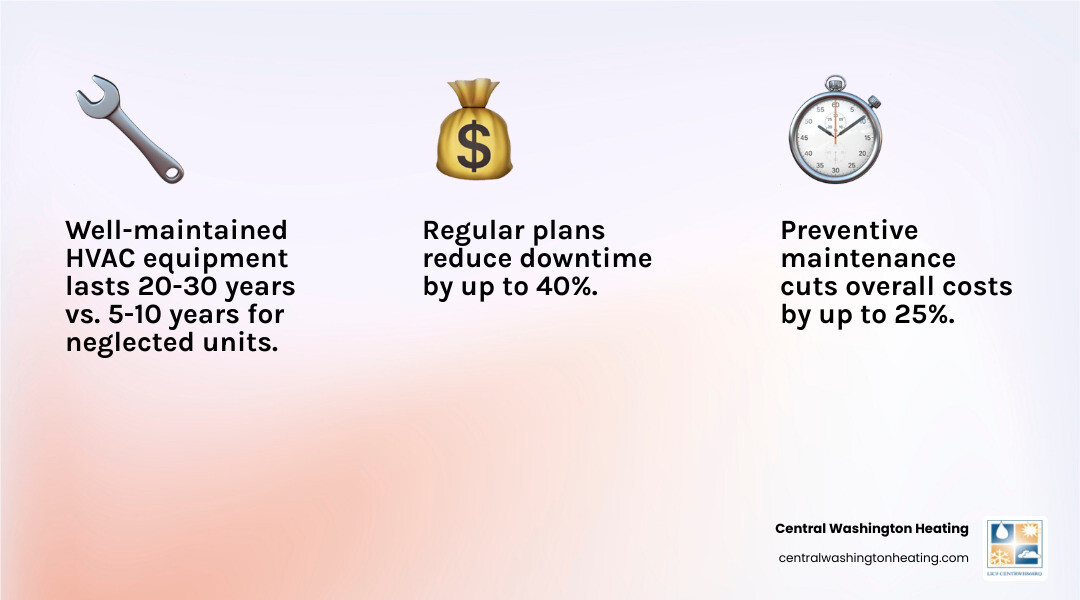
- Extends operational lifespan – Equipment with consistent maintenance routinely lasts 20-30 years, while neglected units often fail within 5-10 years
The numbers back this up. Well-executed preventive maintenance plans can significantly improve system reliability and reduce downtime by up to 40%. For homeowners in Wenatchee and the surrounding Central Washington area, that means more comfort, optimized energy usage, and fewer stressful surprises.
Think of it like regular checkups for your home’s most hardworking systems. Skip them long enough, and the burden of catching up is always greater than the commitment to staying current.
Proactive Care vs. Reactive Repairs

In our three decades of serving the Wenatchee Valley, we’ve seen two distinct types of homeowners: those who plan ahead and those who react to crises. Reactive maintenance follows the “if it ain’t broke, don’t fix it” philosophy. While this might seem convenient in the short term, it is almost universally more problematic over time.
When you wait for a system to fail, you aren’t just dealing with a repair; you are dealing with “the ripple effect.” An unexpected breakdown in the middle of a Cashmere winter or a Chelan heatwave leads to emergency service calls, potential property damage (like frozen pipes), and the extreme stress of a home that is no longer habitable.
By contrast, proactive care is a systematic approach to equipment health. It involves regular, scheduled inspections and adjustments designed to keep equipment at peak efficiency. This strategy is essential for sustaining operational reliability. When we perform Benefits Regular AC Maintenance, we aren’t just looking for broken parts; we are optimizing the entire system to ensure it doesn’t break in the first place.
The same logic applies to your heating system. For those utilizing electric air handlers or heat pumps, Benefits Regular Air handler Maintenance ensures that the heating elements and blower motors aren’t working harder than necessary. Proactive care transforms maintenance from a “to-do” item into a strategic advantage that keeps you in control of your home comfort.
How a Maintenance Plan Extends Equipment Life
The core question many homeowners ask is exactly how a maintenance plan extends equipment life. To understand this, we have to look at the physics of your HVAC system. Every time your air conditioner or heat pump turns on, mechanical parts move, electrical currents flow, and air is pushed through filters and coils. Over time, this creates friction, heat, and microscopic wear.
Without a plan, this wear accumulates. A slightly dusty coil makes the compressor run hotter. A loose wire creates resistance that degrades electrical components. A motor with poor lubrication creates friction that eventually leads to a burnout.
When you Extend Life of Heat Pump with Regular Maintenance, you are effectively “stopping the clock” on this aging process. We ensure that every component is preserved in its ideal state. This leads to better asset utilization, meaning you get every possible year of service out of the machine you paid for. Maximizing AC Lifespan with Regular Maintenance is the difference between replacing a unit in 12 years or enjoying it for 25.
How a maintenance plan extends equipment life through early detection
Much like the human body, machinery often gives warning signals before a major “heart attack” occurs. These signals are subtle—a slight vibration, an unusual hum, or a small increase in energy consumption.
During a professional HVAC Tune-Up, our licensed technicians use diagnostic tools to find these red flags. For example, a thermal scan might reveal an overheating electrical connection in your air handler. Fixing that connection is a simple adjustment and takes minutes. Ignoring it could lead to a fried control board or even a fire. Early detection is the ultimate failure prevention tool, allowing us to make minor adjustments that stop major catastrophes.
How a maintenance plan extends equipment life by reducing operational stress
Imagine running a marathon while breathing through a straw. That is what your HVAC system does when it has a dirty filter or clogged ductwork. This is known as operational stress. When airflow is restricted, the system has to run longer cycles to reach the temperature set on your thermostat.
By following Essential Air handler Maintenance Tips, such as ensuring clean airflow and proper system calibration, we reduce the load on the equipment. Proper lubrication is also critical; research shows that poor lubrication causes more equipment failures than almost any other single factor. By keeping the “vitals” of your system moving smoothly, we ensure the machinery doesn’t literally wear itself out prematurely.
Essential Components of a Longevity-Focused Plan
What exactly goes into a maintenance plan that actually works? It’s more than just a quick glance at the unit. A comprehensive plan must be tailored to the specific environment—whether that’s the dusty orchards of Monitor or the wind-swept hills of Waterville.
| Maintenance Factor | Neglected Equipment | Maintained Equipment |
|---|---|---|
| Average Lifespan | 5–10 Years | 20–30 Years |
| Energy Efficiency | Drops 5-10% annually | Stays near factory ratings |
| Repair Frequency | High (Emergency basis) | Low (Planned basis) |
| Safety Risk | Elevated (Electrical/Fire) | Minimal (Regularly Audited) |
A high-quality plan includes several key pillars:
- Electrical Testing: Checking amp draws and tightening connections to prevent component failure.
- Cleaning Protocols: Removing debris from outdoor coils and dust from indoor blowers to maintain heat exchange efficiency.
- Safety Audits: Testing sensors and emergency shut-offs to protect your family.
- Environmental Protection: In Central Washington, we deal with extreme temperature swings. A good plan includes checking that units are level and protected from moisture or debris that can cause rust.
For those who want to be proactive between professional visits, these Air handler Maintenance Tips for Homeowners offer a great starting point for keeping the area around your unit clean. However, an Annual AC Service is still required to handle the technical calibrations that require specialized tools and licensing. Using quality OEM (Original Equipment Manufacturer) parts during these services ensures that your system remains compatible and holds its warranty.
The Role of Technology and Documentation
In April 2026, maintenance is more high-tech than ever. We now use predictive maintenance technologies, such as IoT sensors and advanced diagnostics, to monitor equipment health in real-time. This allows us to move beyond “calendar-based” maintenance and into “condition-based” maintenance.
Documentation is the “Equipment DNA.” By keeping detailed maintenance logs, we can track the performance of your system over years. This helps us identify recurring issues and make informed “repair vs. replace” decisions. When you sign an AC Service Agreement, you aren’t just buying a visit; you are building a data history of your home’s comfort system.
We often look at specific KPIs (Key Performance Indicators) to measure the success of a plan:
- MTBF (Mean Time Between Failures): We want this number to be as high as possible.
- MTTR (Mean Time To Repair): With a good plan and documented history, we can diagnose and fix issues much faster, reducing your downtime.
For a deeper dive into how these systems work together, check out our Ultimate HVAC Maintenance Guide.
Frequently Asked Questions about Maintenance Plans
How often should I schedule professional maintenance?
For most homes in the Wenatchee Valley, we recommend a semi-annual approach: once in the spring for your cooling system and once in the fall for your heating system. If you have a heat pump that works year-round, a Heat Pump Annual Service is the bare minimum, though quarterly checks are ideal for systems that see heavy usage or are located in high-dust environments like orchards.
Can a maintenance plan help improve my home’s energy efficiency?
Absolutely. According to ENERGY STAR®, HVAC systems account for approximately 43% of the average home’s energy use. A system that is clogged with dirt or has a failing capacitor has to work harder and run longer to cool or heat your home. By reducing friction and optimizing airflow, a maintenance plan ensures your system runs at peak performance, which directly translates to optimized energy consumption.
What are the common signs that my equipment needs immediate attention?
Keep an ear out for unusual noises like popping, rattling, or screeching. Poor airflow, frequent cycling (turning on and off rapidly), and rising energy consumption without a change in weather are all red flags. If you notice any of these, it’s time to call in the experts before a small glitch becomes a total system failure.
Conclusion
At Central Washington Heating, we believe that your home comfort shouldn’t be a source of stress. Our veteran-owned business has spent over 30 years perfecting the art of HVAC longevity in the Wenatchee Valley. From Leavenworth to Chelan, our licensed technicians are dedicated to providing the quality craftsmanship and reliable service your family deserves.
Don’t wait for the next heatwave or cold snap to find out if your system is up to the task. Protect your investment, enhance your system’s efficiency, and stop the aging process of your HVAC unit today.
Request Service Today to learn more about our customized maintenance plans.

Written by the Central Washington Heating and Air team
The techs and comfort advisors who've kept the Wenatchee Valley heated, cooled, and breathing easy for 30+ years — family & veteran owned, with 40+ years of combined industry experience.
- Licensed & insured · LIC# CENTRWH742JN
- Daikin Comfort Pro certified
- Wenatchee, WA
Last updated July 7, 2026
Ready for comfort you can count on?
Schedule service, request a free estimate, or call now for 24/7 emergency help. Our team is standing by across the Wenatchee Valley.
Get started today
Free estimates on installs · no-pressure, written quotes
Schedule My ServiceCall (509) 776-0247Mon–Fri: 8:00 AM – 4:30 PM · 24/7 for emergencies
Already have a quote? Get a free second opinion →