
What Your AC Is Trying to Tell You With Those Weird Sounds
Discover what ac making strange noises what they mean—banging, squealing, buzzing. Troubleshoot & fix AC issues in Wenatchee Valley now!
Why AC Making Strange Noises What They Mean Matters for Your Home’s Comfort
If your ac making strange noises what they mean is the question running through your head right now, here is a quick answer before we go deeper:
| AC Sound | What It Usually Means | Urgency |
|---|---|---|
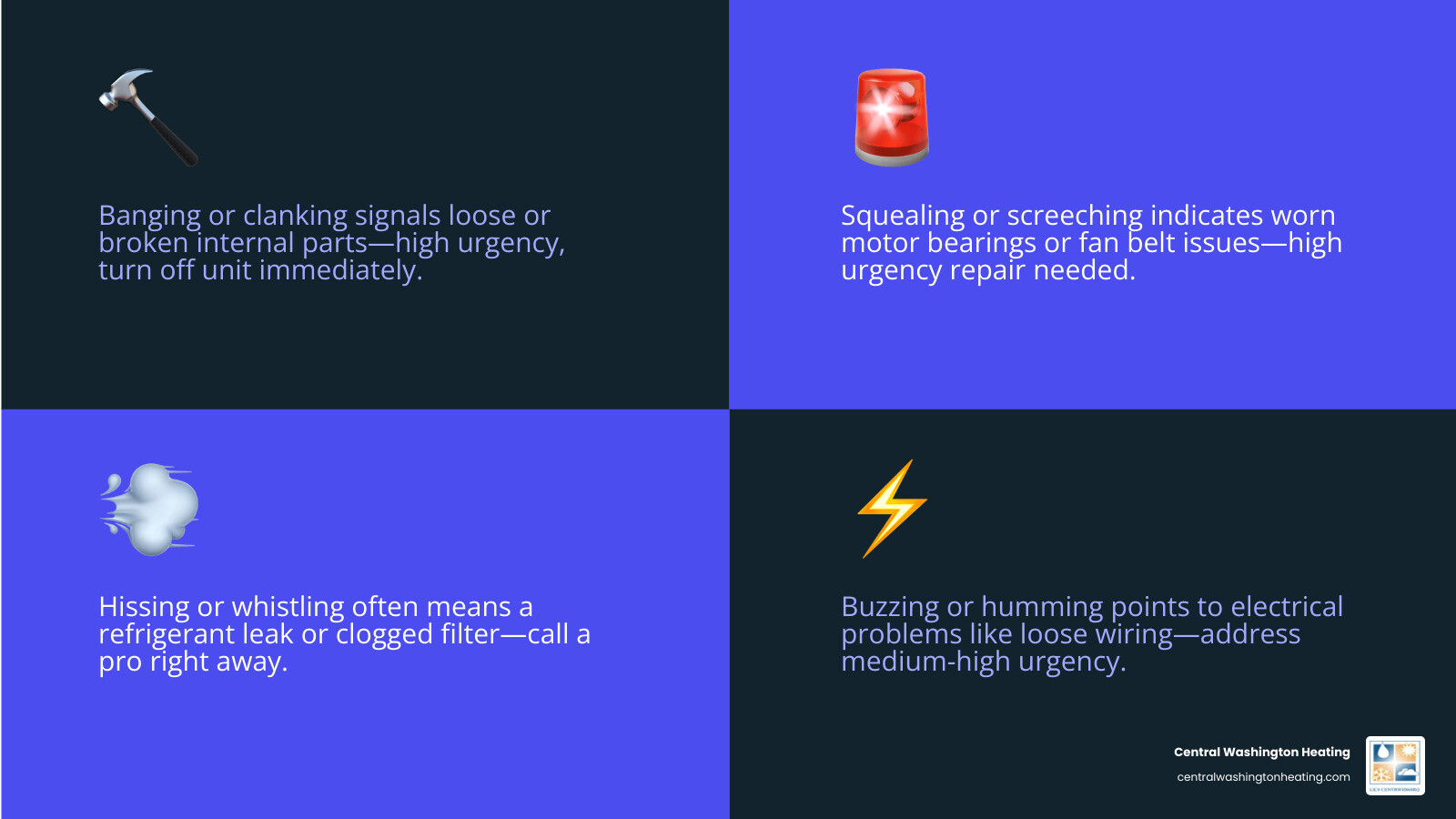
| Banging / Clanking | Loose or broken internal part | High — turn off unit |
| Squealing / Screeching | Worn motor bearings, high pressure, or fan belt | High — turn off unit |
| Hissing / Whistling | Refrigerant leak, duct issue, or clogged filter | High — call immediately |
| Buzzing / Humming | Electrical issue, loose wiring, or frozen coils | Medium-High |
| Clicking | Thermostat or relay problem (constant clicking is a red flag) | Medium |
| Gurgling / Bubbling | Clogged drain line or air in refrigerant lines | Medium |
| Rattling | Loose panels, debris in unit, or loose screws | Low-Medium |
Your air conditioner is built to run quietly in the background. Modern AC systems typically operate somewhere between 25 and 55 decibels — roughly the sound level of a quiet conversation. So when yours starts making unfamiliar sounds, that noise is not just annoying. It is your system sending you a signal that something needs attention.
Homeowners across the Wenatchee Valley — from Wenatchee and East Wenatchee to Leavenworth and Cashmere — know that Central Washington summers put real demands on cooling systems. A strange noise that gets ignored for a week or two can quietly turn a simple, affordable repair into a full system breakdown right when you need cool air most. Catching these sounds early and knowing what they mean is genuinely one of the best ways to protect your comfort and your investment.
Deciphering Your AC Making Strange Noises What They Mean
When you hear a heavy metal-on-metal sound, it is rarely good news. Understanding Why is AC Making Strange Noises often starts with identifying the “weight” of the sound. Banging and clanking are usually signs that something has come loose or is physically hitting another component inside your unit.

If you hear a loud banging, it often points toward the compressor. Over time, parts like connecting rods, piston pins, or crankshafts can wear out or break. Because the compressor is the “heart” of your system, a banging sound here is a major red flag.
Clanking, on the other hand, often sounds like a metallic “thwack.” This is frequently caused by an unbalanced or bent fan blade. If the blade is hitting the housing or other internal supports, it will create a rhythmic clatter. You should also check if Is AC Outdoor Unit Making Unusual Vibrations, as excessive shaking can cause internal parts to rub together, leading to premature failure.
Squealing and Screeching: AC Making Strange Noises What They Mean for Motors
A high-pitched squeal is hard to ignore, and for good reason. These sounds often originate from the blower motor in your indoor unit or the condenser fan motor outside.
If your system uses a belt-driven motor (common in older units), a screeching sound usually means the fan belt has slipped or is frayed. In newer systems, this sound often points to AC Condenser Fan Motor Failure Signs Solutions such as dry bearings. Bearings require proper lubrication to spin freely; when they dry out, the metal-on-metal friction creates a piercing scream.
Another possibility for a brief screech at startup is high pressure within the compressor. If you hear a high-pitched sound that lasts for about 15 seconds when the unit kicks on and then shuts the system down, your compressor may be struggling with internal pressure issues. This is an emergency – turn the system off immediately to prevent the motor from burning out.
Buzzing and Humming: AC Making Strange Noises What They Mean for Electrical Systems
Buzzing is a “busy” sound that usually indicates an electrical struggle. If the buzzing is coming from the outdoor unit, it could be a malfunctioning contactor relay switch, a failing capacitor, or even loose wiring. Electrical arcing – where electricity “jumps” between connections – can also create a distinct buzzing or sizzling noise that poses a fire hazard.
In some cases, a loud buzz from the indoor unit is actually a sign of frozen evaporator coils. When airflow is restricted (often by a dirty filter), the coils get too cold and turn into a block of ice. This puts a massive strain on the blower motor. If you’ve noticed your electric Air handler Making Noise during the winter, the causes are often similar: loose parts or electrical components reaching the end of their lifespan.
Identifying High-Urgency Sounds in Your Cooling System
Some sounds require you to drop what you are doing and turn off the power. Hissing and whistling are at the top of that list.
A persistent hissing sound is the classic sign of a refrigerant leak. Because refrigerant is under high pressure, it makes a “shhh” sound as it escapes through small cracks in the coils or lines. This is not just a performance issue; refrigerant leaks are health hazards that can cause headaches or nausea, and they are environmentally damaging.
Whistling can also be caused by internal valve leaks or severe airflow restrictions. If your system sounds like a teakettle, it might be struggling to pull air through a clogged filter or a crushed duct. Interestingly, homeowners often ask why an electric Why Air handler Making a Whistling Noise in the fall; the answer is usually the same – restricted airflow that forces air through tiny gaps at high velocity.
Clicking and Popping: AC Making Strange Noises What They Mean for Your Thermostat
A single click at the start and end of a cooling cycle is perfectly normal. That is just the relay switch responding to the electrical signal from your thermostat. However, constant or rapid-fire clicking is a sign of trouble. It often means a control is failing or an electrical component is struggling to engage.
Popping sounds are frequently related to your ductwork. When the blower kicks on, the change in pressure can cause metal ducts to expand or contract, creating a “pop” or “boom” sound. While usually harmless, persistent popping can also indicate low refrigerant levels causing ice to form and then break off inside the unit.
Gurgling and Bubbling: Drain Line and Refrigerant Flow
If your AC sounds like it is finishing a soda through a straw, you are likely dealing with a drainage or refrigerant issue.
- Gurgling: This usually points to the condensate drain line. As your AC removes humidity from the air, that water has to go somewhere. If the drain line is partially clogged with algae or debris, air bubbles can get trapped, creating a gurgling sound.
- Bubbling: This is more serious. Bubbling often indicates air bubbles in the refrigerant lines, which happens when the refrigerant charge is low. It can also mean there is a leak allowing air to enter the sealed system.
Troubleshooting Steps for Homeowners in the Wenatchee Valley
Before you call for a repair in Wenatchee or East Wenatchee, there are a few simple things you can check yourself. Sometimes, the fix is simpler than you think.
- Check the Filter: A dirty filter is the root of many noises, including whistling and buzzing. If it looks gray or “fuzzy,” replace it immediately.
- Clear Debris: Head outside to your condenser unit. Remove any sticks, leaves, or “helicopter” seeds that might be poking through the grille and hitting the fan blades.
- Tighten the Panels: Sometimes a “scary” rattling noise is just a loose screw on the exterior housing. Grab a screwdriver and ensure all panel screws are snug.
- Inspect the Vents: Ensure that furniture, curtains, or rugs aren’t blocking your return air vents. Restricted air makes the system work harder and louder.
Normal vs. Problematic AC Sounds
| Normal Sounds | Problematic Sounds |
|---|---|
| Soft “whoosh” of air | Metallic banging or clanking |
| Single click at startup | Rapid, constant clicking |
| Quiet hum from the fan | High-pitched screaming or squealing |
| Gentle dripping (near drain) | Persistent hissing or whistling |
Preventing Future Issues with Professional Maintenance
The best way to handle a noisy AC is to prevent the noise from starting in the first place. This is where an annual tune-up becomes invaluable. During a professional maintenance visit, we don’t just look at the unit; we perform a deep dive into its mechanical health.
Our technicians will:
- Lubricate Moving Parts: This prevents the dry-bearing squeal that plagues so many systems in Leavenworth and Cashmere.
- Tighten Electrical Connections: This eliminates buzzing and prevents dangerous electrical arcing.
- Clean the Coils: Clean coils prevent the “frozen” state that leads to blower motor strain.
- Check Refrigerant Levels: We ensure there are no leaks (hissing) and that the pressure is correct for maximum SEER2 efficiency.
If you’ve read our electric Air handler Loud Noise Guide, you know that whether it is heating or cooling, a well-maintained system is a quiet system. Regular care extends the lifespan of your equipment and keeps your energy bills from spiking during those hot July afternoons.
Frequently Asked Questions about AC Making Strange Noises What They Mean
Is it safe to run my AC if it is making a loud banging noise?
No. A banging noise usually means a part has come loose or broken inside the compressor or fan assembly. If you continue to run the unit, that loose part can fly off and cause catastrophic damage to other components, potentially turning a repair into a full system replacement.
Why does my air conditioner make a hissing sound like air escaping?
This is almost always a sign of a refrigerant leak. Because the refrigerant is essential for the cooling process and is under high pressure, you must turn off the system and call a professional. Handling refrigerant requires specialized tools and licensing.
How can I tell the difference between a normal hum and a problematic buzz?
A normal hum is steady and relatively quiet — you shouldn’t be able to hear it clearly through closed windows. A problematic buzz is often louder, may have a “sizzling” quality, or may be accompanied by the smell of burning plastic. If the buzz is loud enough to be distracting, it is time for an inspection.
Conclusion
At Central Washington Heating, we have spent over 30 years helping our neighbors stay comfortable. As a family- and veteran-owned business, we understand that your home is your sanctuary. When your ac making strange noises what they mean becomes a concern, you don’t have to guess. Our licensed technicians are experts at “translating” those sounds into solutions.
Whether you are in Wenatchee, East Wenatchee, Chelan, or any of our surrounding communities, we provide 24/7 emergency service to ensure you are never left in the heat. From custom ductwork that ensures quiet operation to high-efficiency installations, we are here to provide the quality craftsmanship you deserve.
Don’t let a small rattle turn into a big headache. Request Service Today to restore peace and quiet to your home.

Written by the Central Washington Heating and Air team
The techs and comfort advisors who've kept the Wenatchee Valley heated, cooled, and breathing easy for 30+ years — family & veteran owned, with 40+ years of combined industry experience.
- Licensed & insured · LIC# CENTRWH742JN
- Daikin Comfort Pro certified
- Wenatchee, WA
Last updated July 29, 2026
Ready for comfort you can count on?
Schedule service, request a free estimate, or call now for 24/7 emergency help. Our team is standing by across the Wenatchee Valley.
Get started today
Free estimates on installs · no-pressure, written quotes
Schedule My ServiceCall (509) 776-0247Mon–Fri: 8:00 AM – 4:30 PM · 24/7 for emergencies
Already have a quote? Get a free second opinion →