
Don't Get Fooled: A Homeowner's Guide to AC Refrigerant Leaks and Refills
Uncover the signs of an AC refrigerant leak, its serious dangers, and why professional repair is essential for your home.
Why Detecting an AC Refrigerant Leak Early Can Save Your System
An AC refrigerant leak can turn your comfortable home into a sweltering nightmare - and the sooner you catch it, the better. Here are the key signs to watch for:
Common Signs of Refrigerant Leaks:
- Warm air blowing from vents instead of cool air
- AC running constantly but not cooling your home
- Unusually high electricity bills
- Hissing or bubbling sounds from the unit
- Ice formation on indoor coils
- Oily residue around AC components
Your air conditioner doesn't "use up" refrigerant like a car uses gas. Refrigerant is designed to cycle through a closed system indefinitely - from liquid to gas and back again - absorbing heat from inside your home and releasing it outside.
When refrigerant levels drop, it's always because of a leak somewhere in the system. Even a small leak can drastically reduce your AC's efficiency and lead to expensive damage if left untreated.
The stakes are higher than just comfort. Refrigerant is a toxic chemical that can cause health problems like dizziness and headaches. Some older refrigerants also contribute to ozone depletion when released into the atmosphere.
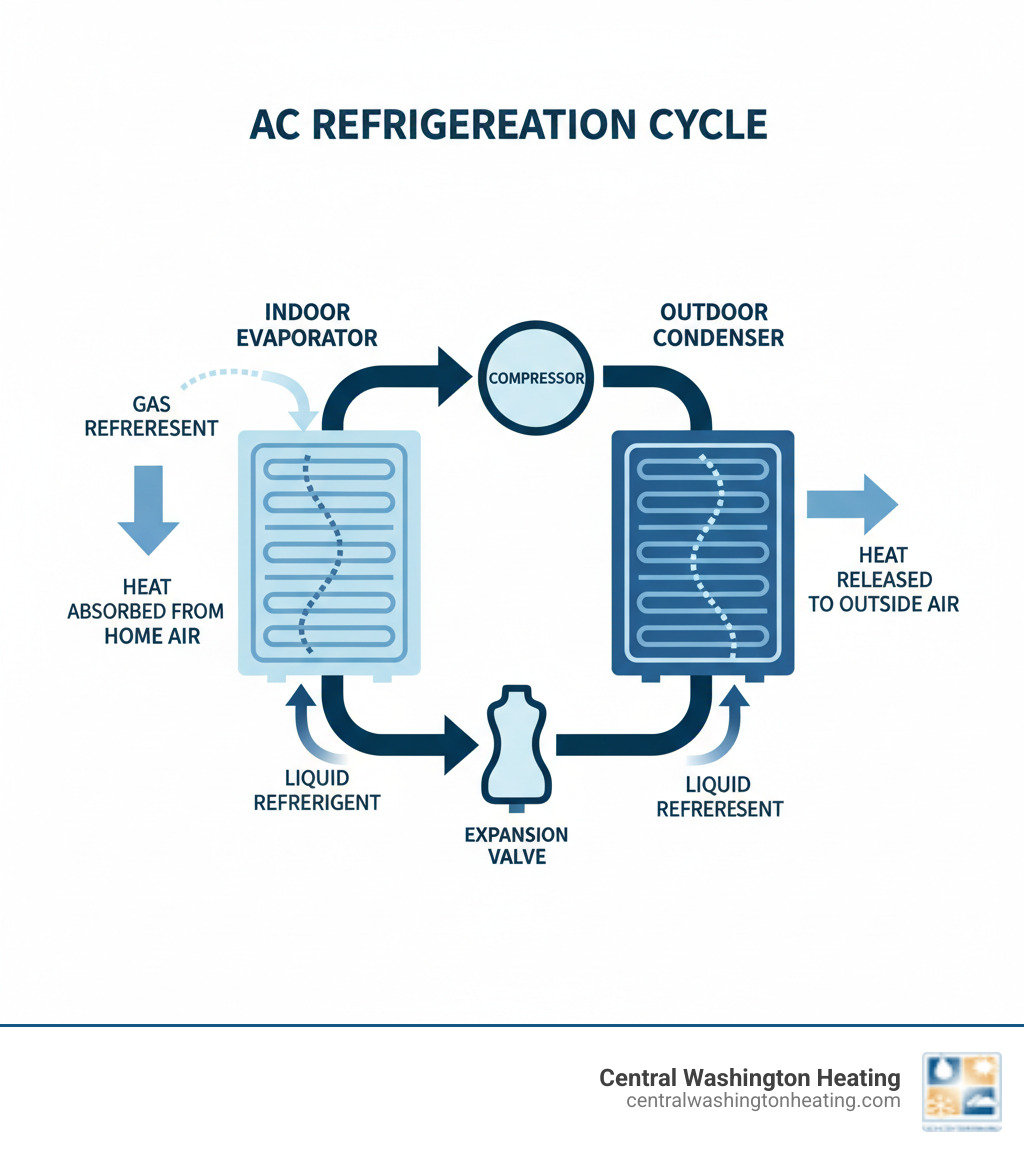
Learn more about AC refrigerant leak:
Telltale Signs Your AC is Leaking Refrigerant
Your air conditioner has a way of telling you when something's wrong - you just need to know what to listen for. After years of helping homeowners in Central Washington, we've learned to spot the warning signs of an AC refrigerant leak before they turn into bigger headaches.
The most obvious clue? Warm air blowing from your vents when you're expecting that cool relief. It's like ordering ice cream and getting soup instead - definitely not what you signed up for! This happens because your system simply doesn't have enough refrigerant to absorb heat properly. If you're wondering why your AC is blowing warm air, a refrigerant leak is often the culprit.
Your electricity bills creeping higher is another red flag. When your AC is low on refrigerant, it's like trying to cool your house with one hand tied behind its back - it has to work twice as hard to get half the results. This leads to those frustrating longer cooling cycles where your system runs and runs but never quite gets your home comfortable. Sound familiar? Our guide on why your AC is constantly running but not cooling dives deeper into this issue.
Listen carefully to your AC unit. Hissing or bubbling sounds aren't just annoying - they're your system's way of crying for help. The hissing is refrigerant escaping under pressure, while bubbling often means there's a leak where moisture is present. These aren't sounds you want to ignore. If your unit is making other strange noises too, check out our article on why your AC is making strange noises.
Here's something that catches many homeowners off guard: frozen evaporator coils. It seems backwards, doesn't it? Your AC isn't cooling, but there's ice forming on the indoor unit. This happens when low refrigerant levels prevent proper heat absorption, causing moisture to freeze on the coils instead. If you're seeing ice where it shouldn't be, our post on why ice is forming on your AC unit explains exactly what's happening.
Finally, keep an eye out for visible oily residue around your AC components. Refrigerant contains special oils that lubricate your compressor, and when refrigerant leaks out, this oil often comes with it. While the refrigerant itself evaporates quickly, the oil leaves behind telltale greasy spots - like breadcrumbs leading you to the problem.
Spotting any of these signs early can save you from a complete system breakdown. An AC refrigerant leak won't fix itself, and the longer you wait, the more damage it can cause to your entire system.
What Causes Leaks and Why They're a Serious Problem
Your AC system starts life as a perfectly sealed closed loop, but time and the elements have other plans. Understanding what leads to an AC refrigerant leak can help you spot trouble early and appreciate why professional care is so important.
Wear and tear is the most common villain in this story. Think about it - your AC works hard for you, cycling on and off thousands of times each year. All that refrigerant flowing through the system, expanding and contracting with temperature changes, puts stress on every joint and seal. Over the years, even the tiniest weak spots can develop into leaks.
The constant vibrations from your outdoor unit don't help matters either. That steady hum you hear? It's actually creating subtle movement throughout the system. Refrigerant lines can gradually rub against brackets or other components, wearing thin spots that eventually give way. When your system wasn't installed properly to begin with, these vibrations become even more destructive.
Corrosion might surprise you as a culprit, especially since it can happen from the inside out. Your home's indoor air contains more chemicals than you might realize - formaldehyde from furniture and carpets, cleaning product residues, and other household compounds. When these mix with moisture, they can create acids that slowly eat away at copper coils. It's like a very slow chemical attack that creates pinhole leaks over time.
Sometimes an AC refrigerant leak isn't anyone's fault - factory defects do happen, though they're rare. A flaw in manufacturing might not show up for years, making it frustrating when a relatively new system starts having problems.
Improper installation is perhaps the most preventable cause. Poor soldering, loose connections, or accidentally damaging a line during installation can create immediate problems or set the stage for future leaks. Even small components like Schrader valves have rubber seals that can fail if handled roughly during installation.
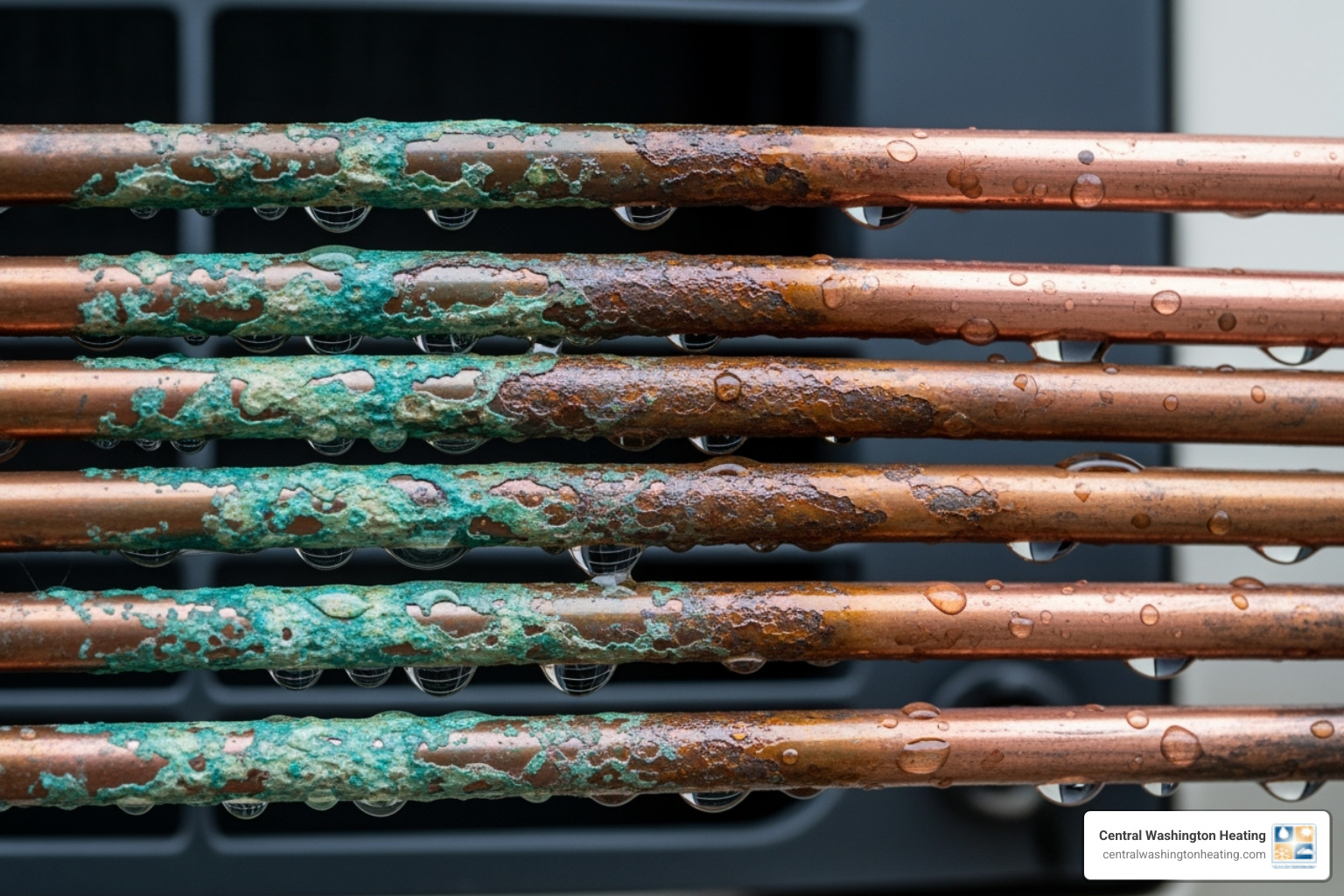
The Dangers of an AC Refrigerant Leak
An AC refrigerant leak creates risks that go far beyond an uncomfortable home. The health and environmental dangers are real, and they're why we take every leak seriously.
Your family's health comes first. Refrigerant might be safely contained in your AC system, but when it leaks, it becomes a health hazard. Breathing in refrigerant can cause dizziness and headaches at minimum. More serious exposure can lead to nausea, skin irritation, and breathing problems. In severe cases, refrigerant can actually displace oxygen in enclosed spaces, creating a dangerous situation. Children and pets face higher risks because their smaller bodies are more sensitive to these chemicals.
The environmental impact is equally troubling. Older refrigerants like R-22 are powerful ozone depletion agents. When they escape into the atmosphere, they rise up and break down the protective ozone layer that shields us from harmful UV rays. Even newer refrigerants like R-410A, while safer for the ozone, are potent greenhouse gases that contribute to climate change when released.
Why You Need a Professional
Here's the bottom line: fixing an AC refrigerant leak is not a weekend DIY project. This is hazardous chemical territory that requires proper training, equipment, and certification.
The law is crystal clear on this point. You need an EPA license to work with refrigerants and dispose of them properly. This isn't just bureaucratic red tape - it's a serious safety requirement. Attempting DIY repairs on refrigerant systems can expose you to massive fines from environmental agencies.
Beyond the legal issues, there are real DIY risks to consider. Refrigerant can cause chemical burns, and working with pressurized systems requires specialized knowledge to avoid injury. Our technicians have the training and tools to handle these materials safely while getting to the root of your leak problem.
Professional diagnosis means finding the actual source of the leak, not just adding more refrigerant and hoping for the best. That's the difference between a real solution and an expensive band-aid that will fail again soon.
How Professionals Find and Fix an AC Refrigerant Leak
When you call us about a suspected AC refrigerant leak, we don't just show up and start guessing where the problem might be. Finding a refrigerant leak is like being a detective – sometimes the clues are obvious, but often they're hiding in plain sight.
Our technicians start with a thorough visual inspection, looking for telltale signs like oily residue around connections or ice formation on coils. But here's the thing about refrigerant leaks: many of them are completely invisible to the naked eye. That's where our specialized leak detection methods become essential.
The workhorse of our diagnostic arsenal is the electronic leak detector, often called a "sniffer." These sophisticated devices can detect even tiny amounts of refrigerant gas escaping from your system. We slowly move the sensor along refrigerant lines, around coils, and near all the connections. When it picks up even the smallest trace of escaping refrigerant, it alerts us with an audible alarm. Modern detectors are incredibly sensitive – they can find leaks as small as 4 grams per year, which is about the weight of a penny.
For those particularly sneaky leaks that seem to play hide-and-seek with us, we turn to the UV dye test. This method involves injecting a special fluorescent dye into your AC system that mixes with the refrigerant. After the system runs for a while (sometimes we need to wait a few days or even weeks), we return with a black UV light and scan the entire system. Any leak will glow like a guide under the UV light, making even pinhole leaks clearly visible.
Sometimes the old-school methods work best. The bubble test involves applying a soapy water solution to suspected leak areas – joints, connections, and valve stems. If refrigerant is escaping, it creates bubbles in the solution, just like when you were a kid blowing bubbles in the backyard. While this method works great for accessible areas with more significant leaks, it's not as effective for tiny leaks or hard-to-reach spots.
When all else fails, we use pressure testing with nitrogen gas. We safely remove the refrigerant from the system and pressurize it with inert nitrogen instead. Since nitrogen isn't a refrigerant, it's environmentally safe if it escapes. We then monitor the system pressure – any drop indicates a leak somewhere. This method is particularly useful for confirming that we've successfully sealed a leak after repairs.
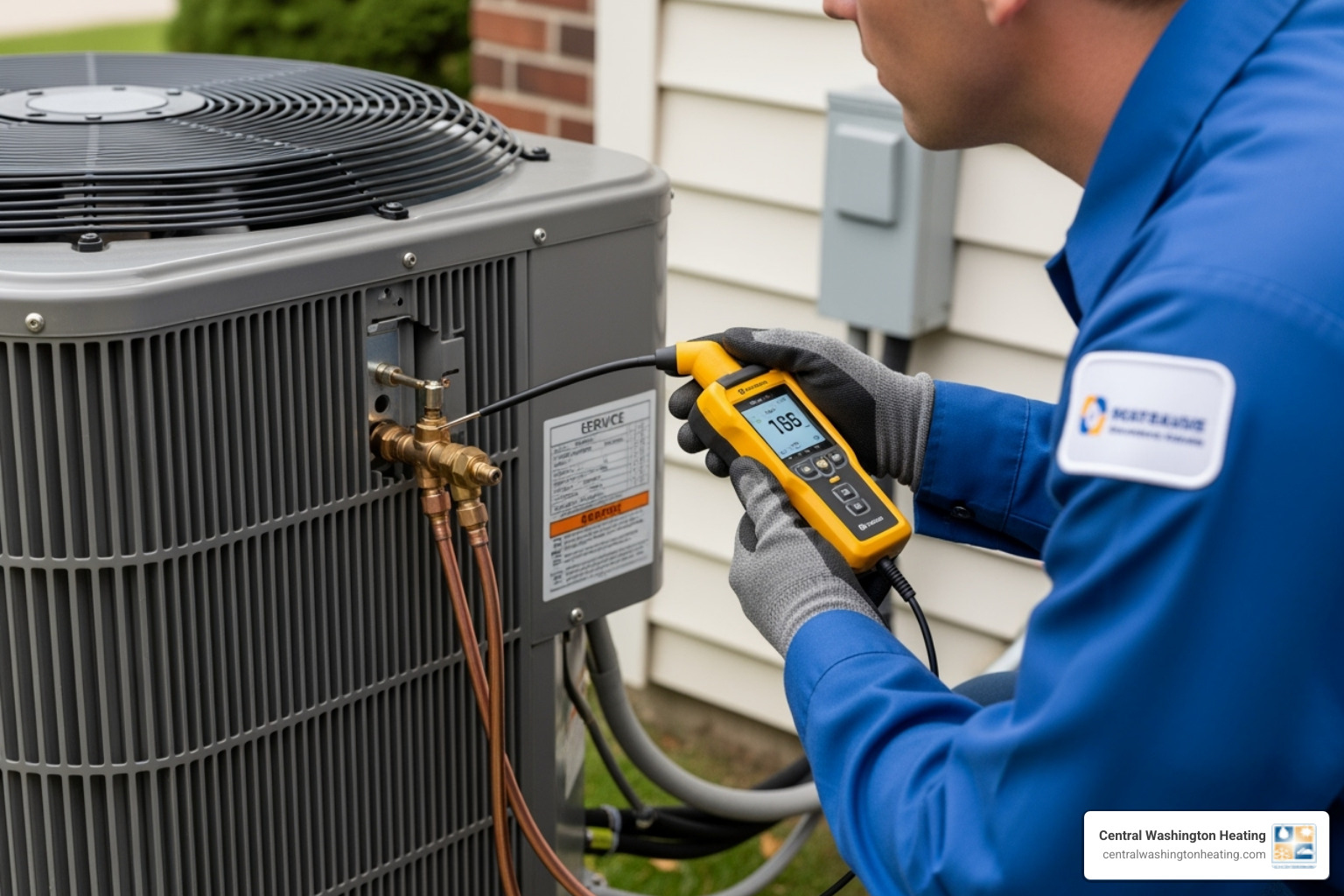
Common Repair Methods for an AC Refrigerant Leak
Once we've played detective and found your AC refrigerant leak, it's time to fix it. The repair method we choose depends entirely on where the leak is located and how extensive the damage has become.
For major components that have suffered significant damage, component replacement is often the most sensible approach. When we find multiple leaks or extensive corrosion in your evaporator coils (the indoor coils that get cold) or condenser coils (the outdoor coils that get hot), trying to patch every tiny hole would be like putting band-aids on a screen door. Replacing the entire coil gives you a reliable, long-term solution that won't leave you sweating again next month.
Smaller leaks at connections and valves often have simpler solutions. Those little Schrader valves – the ones that look like tire valves – sometimes just need tightening or a new internal seal. We have specialized tools that let us work on these without depressurizing your entire system, which saves time and refrigerant.
When we find leaks at pipe joints that haven't been neglected too long, on-site brazing can work wonders. Think of brazing as welding's more precise cousin – we use a high-temperature torch and special metal alloy to create a permanent seal over the leak. It's skilled work that requires the right tools and experience, but when done properly, it creates a bond that's often stronger than the original joint.
After any repair, we don't just pack up and leave. We perform a vacuum test to ensure your system is completely sealed and free of moisture, then recharge it with exactly the right type and amount of refrigerant. Our goal isn't just to stop the leak – we want to restore your AC system to peak performance so you can get back to enjoying a comfortable home.
Every repair situation is unique, which is why professional diagnosis and repair are so important. For more insights into how we handle various AC challenges, check out our comprehensive guide on AC Repair Essential Home Comfort.
Repair vs. Replace: Making the Right Call
When you're dealing with an AC refrigerant leak, one of the toughest decisions you'll face is whether to fix what you have or start fresh with a new system. It's like deciding whether to patch up an old pair of jeans or just buy new ones - except this decision affects your comfort and wallet for years to come.
System age is usually the biggest factor in this decision. Most AC units have a good run of 15 to 20 years before they start showing their age. If your unit is getting up there in years and suddenly springs a major refrigerant leak, it might be trying to tell you something. Older systems don't just develop one problem - they tend to have multiple issues cropping up, leading to a frequency of repairs that can drain your patience and your bank account.
Here's where things get really interesting - and expensive. If your system uses the older R-22 refrigerant (you might know it as Freon), you're facing a particularly challenging situation. Due to the R-22 phase-out, this refrigerant is no longer produced in the United States as of 2020. What's left is becoming increasingly scarce and jaw-droppingly expensive. It's like trying to buy parts for a classic car - they're out there, but you'll pay premium prices.
On the flip side, newer systems use R-410A (Puron), which offers some real R-410A benefits. These systems run more efficiently, operate more quietly, and are generally kinder to both the environment and your utility bills. Plus, R-410A is readily available, so future maintenance won't break the bank.
| Feature | R-22 (Freon) | R-410A (Puron) |
|---|---|---|
| Efficiency | Lower | Higher |
| Environmental | Ozone-depleting substance (phased out) | Non-ozone-depleting, but still a greenhouse gas |
| Availability | Scarce, expensive, no longer produced/imported | Readily available |
| Toxicity | Higher, can cause severe health issues upon exposure | Lower, but still hazardous and requires professional handling |
When making this economic decision, many HVAC professionals use what's called the "50% rule." If repairing your AC refrigerant leak would run you close to half the price of a new system, replacement usually makes more sense. Think of it this way - would you spend thousands fixing a 15-year-old car that might need more repairs next month?
We get it - replacing an entire AC system feels like a big step. But a new, energy-efficient system can actually save you money over time through lower utility bills, fewer repair calls, and that priceless peace of mind that comes with knowing your system won't leave you sweating on the hottest day of summer.
Every situation is unique, and we're here to give you an honest assessment of what makes the most sense for your home and circumstances. Our AC Unit Replacement Guide 2025 can help you think through all the factors involved in this important decision.
Frequently Asked Questions About Refrigerant Leaks
When homeowners in Central Washington find they might have an AC refrigerant leak, they often have pressing questions about what to do next. We've been helping families steer these situations for years, and we understand the confusion and concern that comes with AC problems. Let's address the most common questions we hear.
Is it legal to just "top off" or recharge an AC system without fixing the leak?
This is one of the most frequent questions we get, and the answer is a firm no. Simply adding more refrigerant to a leaking system without fixing the underlying problem is both illegal under EPA regulations and a terrible idea for several reasons.
Think of it like trying to fill a bucket with a hole in the bottom – you're just wasting the refrigerant and your money. More importantly, every bit of refrigerant that escapes contributes to environmental harm. Whether it's older R-22 that depletes the ozone layer or newer refrigerants that act as greenhouse gases, releasing these chemicals into the atmosphere is prohibited by federal law.
Beyond the legal and environmental issues, topping off a leaking system creates inefficiency throughout your AC. Your system will struggle to cool properly, your energy bills will climb, and you'll likely face more serious damage down the road. It's truly a short-term solution that creates long-term problems.
Any reputable HVAC professional will always locate and repair the leak before adding refrigerant. If someone offers to just "top you off" without finding the source, run the other way.
What should a homeowner do if they suspect an AC refrigerant leak?
If you're noticing warm air from your vents, hearing strange hissing sounds, or seeing ice on your indoor unit, don't panic – but do act quickly. Here's exactly what you should do:
Turn off your system immediately. This is the most important step. Switch off your AC at the thermostat and, if you can safely reach it, flip the breaker too. This prevents your compressor from running without enough refrigerant, which can cause expensive damage.
Get some fresh air flowing. Open windows and doors, especially if you suspect the leak is near your indoor unit. Refrigerant gases can build up in enclosed spaces, and you want to clear them out as quickly as possible.
Call us right away. An AC refrigerant leak isn't something you can fix yourself, and it's not something that can wait. Our certified technicians have the specialized equipment and training to handle refrigerants safely. If it's after hours and you're dealing with an emergency, remember we offer Emergency 24 Hour AC Repair.
Keep everyone away from the unit. If you smell something strong or hear loud hissing, make sure kids and pets stay clear of both your indoor and outdoor units. Avoid any DIY repair attempts – working with refrigerants requires an EPA license for good reason.
We know it's frustrating when your AC isn't working, especially during Central Washington's hot summer days, but trying to fix a refrigerant leak yourself can be dangerous and is illegal.
How can I prevent refrigerant leaks in my AC system?
The good news is that many refrigerant leaks are preventable with some basic care and attention. While you can't stop every possible leak – some are just due to normal wear and tear – you can significantly reduce your risk.
Annual professional maintenance is your best defense against leaks. During our Annual AC Service, we check all the connections, inspect the coils for early signs of corrosion, and catch small issues before they become big problems. It's like getting a physical for your AC – we can spot trouble brewing and fix it before it ruins your summer.
Professional installation matters more than many homeowners realize. Poor installation is behind many premature leaks. When refrigerant lines aren't properly connected or coils get damaged during installation, you're setting yourself up for problems down the road. Always choose experienced, certified technicians for any AC work.
Keep your outdoor unit happy by maintaining clear space around it. Trim back vegetation, clear away debris, and be careful when mowing nearby. We've seen too many refrigerant lines damaged by wayward lawnmowers or falling branches. Your outdoor unit needs room to breathe and protection from physical damage.
Don't ignore the warning signs your system gives you. If your AC starts struggling to cool, making new noises, or driving up your energy bills, call us sooner rather than later. Small problems caught early are much easier and less expensive to fix than major breakdowns. Our AC Running Smoothly AC Maintenance guide has more tips for keeping your system in top shape.
Change your air filters regularly – every one to three months during peak season. A dirty filter makes your entire system work harder, creating extra stress that can contribute to leaks over time.
Taking these simple steps can help you avoid the headache and expense of dealing with an AC refrigerant leak. Your future self will thank you for the preventive care, especially when your neighbors are calling for emergency repairs on the hottest day of the year.
Conclusion: Ensure Your Comfort and Safety
When it comes to an AC refrigerant leak, we can't stress enough how serious this issue really is. What might seem like a minor problem at first glance can quickly snowball into something that affects your health, your wallet, and even the environment around us.
Think about it - those dangers we've discussed aren't just theoretical. The headaches and dizziness from refrigerant exposure are real. The skyrocketing energy bills from an overworked system are real. The potential for thousands of dollars in compressor damage is very real. And let's not forget the environmental impact of these powerful chemicals escaping into our atmosphere.
That's exactly why the importance of professional service goes far beyond just fixing what's broken. When you call Central Washington Heating, you're not just getting someone with the right tools - you're getting certified technicians who understand the complexities of modern refrigerant systems. We know the difference between R-22 and R-410A systems, we can steer EPA regulations safely, and we have the expertise to determine whether your system needs a simple repair or if it's time to consider replacement.
Here's something many homeowners don't realize: addressing an AC refrigerant leak promptly actually creates significant long-term savings. A properly sealed system runs efficiently, uses less electricity, and puts less strain on components like your compressor. That means lower monthly bills and fewer emergency repair calls down the road. It's one of those situations where spending a little now can save you a lot later.
We've been serving families throughout Central Washington for years, and we've seen how a quick response to refrigerant issues can make all the difference. Don't wait until your system fails completely or until you're dealing with a health concern from refrigerant exposure.
Your comfort and safety are too important to leave to chance. If you've noticed any of those warning signs we talked about - the warm air, the ice formation, those telltale hissing sounds - it's time to take action.
Central Washington Heating is here to help restore both comfort and peace of mind to your home. Schedule your AC repair in East Wenatchee today and let our experienced team take care of your AC refrigerant leak the right way.

Written by the Central Washington Heating and Air team
The techs and comfort advisors who've kept the Wenatchee Valley heated, cooled, and breathing easy for 30+ years — family & veteran owned, with 40+ years of combined industry experience.
- Licensed & insured · LIC# CENTRWH742JN
- Daikin Comfort Pro certified
- Wenatchee, WA
Last updated July 29, 2026
Ready for comfort you can count on?
Schedule service, request a free estimate, or call now for 24/7 emergency help. Our team is standing by across the Wenatchee Valley.
Get started today
Free estimates on installs · no-pressure, written quotes
Schedule My ServiceCall (509) 776-0247Mon–Fri: 8:00 AM – 4:30 PM · 24/7 for emergencies
Already have a quote? Get a free second opinion →