
Don't Miss Out: How to Get Money Back for Your Heat Pump
Maximize savings on your new heat pump! Learn about federal and local Heat pump incentive programs & claim your money back today.
Why Heat Pump Incentives Matter for Central Washington Homeowners
Heat pump incentive programs offer substantial financial relief for homeowners upgrading their heating and cooling systems. Here’s what you need to know:
Federal Incentives Available:
- Energy Efficient Home Improvement Tax Credit (25C): Up to $2,000 or 30% of installation cost
- Home Energy Rebates Program: Up to $8,000 for qualifying low-income households
- Geothermal Tax Credit (25D): 30% of total cost with no annual limit
State & Local Programs:
- Washington state utility rebates
- Pacific Power incentives up to $3,250
- Municipal and county programs
- Manufacturer rebates
Key Requirements:
- Primary residence installations
- ENERGY STAR certified equipment
- Professional installation by qualified contractors
- Specific efficiency ratings (HSPF2/SEER2 standards)
The research shows that switching to a heat pump can reduce annual heating and cooling bills anywhere from $100 to $1,300 per year, with the average homeowner saving $667 annually. When you factor in available incentives, the upfront investment becomes much more manageable.
These programs exist because heat pumps are 3-5 times more efficient than traditional fossil fuel heating systems. They work by moving heat rather than creating it, making them incredibly energy-efficient for both heating and cooling your home.
The timing is crucial – many federal incentives are available through December 31, 2025, with some extending to 2032. Missing these deadlines could cost you thousands in potential savings.

Why a Heat Pump is a Smart Upgrade for Your Home
A heat pump is one of the smartest upgrades for your Central Washington home, acting as two systems for the price of one: heating in winter and cooling in summer. It saves money and helps the environment, and heat pump incentive programs make this smart upgrade even more affordable. Let’s explore why heat pumps are a game-changer for home comfort.

The All-in-One Comfort Solution
What makes heat pumps so clever is that they don’t create heat—they move it. Instead of burning fuel like a air handler, a heat pump relocates existing heat. In winter, it extracts heat from the outside air (even when it’s cold) and moves it indoors via a refrigerant cycle. A reversing valve switches the direction of heat flow for summer, moving warm air out of your house.
This heat transfer process is highly efficient because moving heat requires less energy than creating it. The result is perfect summer cooling and cozy winter heating from a single system, eliminating the need for separate units. If you have hot and cold spots, see our guide on Solving Uneven Cooling Issues With Heat Pump.
Efficiency and Environmental Impact
Heat pumps are 3-5 times more efficient than traditional heating systems, saving the average homeowner $667 annually on energy bills, with some saving up to $1,300 per year.
Beyond utility savings, choosing a heat pump helps the planet. These systems reduce energy consumption, lower your home’s carbon footprint, and contribute to reduced greenhouse gas emissions. Heat pumps also naturally dehumidify indoor air in the summer. Many models include advanced filtration to improve your Indoor Air Quality Services Wenatchee WA, which is great for family members with allergies.
Since heating and cooling account for more than half of most homes’ energy use, your heat pump upgrade contributes to a cleaner energy future. Experts estimate that widespread adoption of electric heat pumps could reduce U.S. greenhouse gas emissions by about 306 million metric tons by 2050.
Want to learn more about maximizing your comfort? Read about how a Heat Pump Can Improve Home Comfort. For additional energy-saving strategies throughout your home, The Energy Saver guide shows you how easy it is to cut your energy use at home and on the road.
Your Guide to Federal Heat Pump Incentive Programs
The federal government’s Inflation Reduction Act created impressive heat pump incentive programs. They include tax credits that reduce what you owe and income-based rebates that cut upfront costs. Let’s break down how these work so you can maximize your savings.

The Energy Efficient Home Improvement Tax Credit (25C)
The 25C Energy Efficient Home Improvement Credit provides 30% of your heat pump installation cost, up to a maximum of $2,000. It applies to air-source heat pumps and heat pump water heaters installed in your primary residence. The 25C credit is an annual claim, but it’s a nonrefundable credit with no carry-forward option, meaning it only reduces your tax bill to zero.
To qualify, your heat pump must meet the highest efficiency tiers set by the Consortium for Energy Efficiency (CEE). Starting January 1, 2025, air-source heat pumps must be recognized as ENERGY STAR Most Efficient, which simplifies requirements.
The 25C credit also covers other energy-efficient home improvements, with an annual limit of $3,200 total. Heat pumps get their own generous slice of this pie:
| Improvement Type | Credit Amount | Annual Limit |
|---|---|---|
| Heat Pumps & Heat Pump Water Heaters | 30% of cost | $2,000 |
| Exterior Doors | 30% of cost | $250 per door, $500 total |
| Windows & Skylights | 30% of cost | $600 total |
| Insulation & Air Sealing | 30% of cost | Part of $1,200 envelope limit |
| Home Energy Audit | 30% of cost | $150 |
| Electrical Panel Upgrades | 30% of cost | $600 |
For details on qualified expenses, see the More details on all of these credits are spelled out at the IRS website. To maintain efficiency, learn about Heat Pump Compressor Issues.
Income-Based Rebates: The Home Energy Rebates Program
The Home Energy Rebates Program offers significant point-of-sale discounts that reduce your upfront cost. Rebate amounts depend on your household income relative to the Area Median Income (AMI).
- Low-income households (<80% of AMI) can receive up to $8,000.
- Moderate-income households (80%-150% of AMI) can get up to $4,000.
These rebates are applied at purchase for immediate savings. However, these are state-run programs, and the rollout has been slow. Some states have launched programs, while others are still in process or have declined funding. The program also covers heat pump water heaters, electrical panel upgrades, and electric wiring.
To stay updated, bookmark the Check the DOE’s state-by-state tracker for rebate availability for real-time information on program launches in your state.
Finding Local Savings: State, Utility, and WA-Specific Rebates
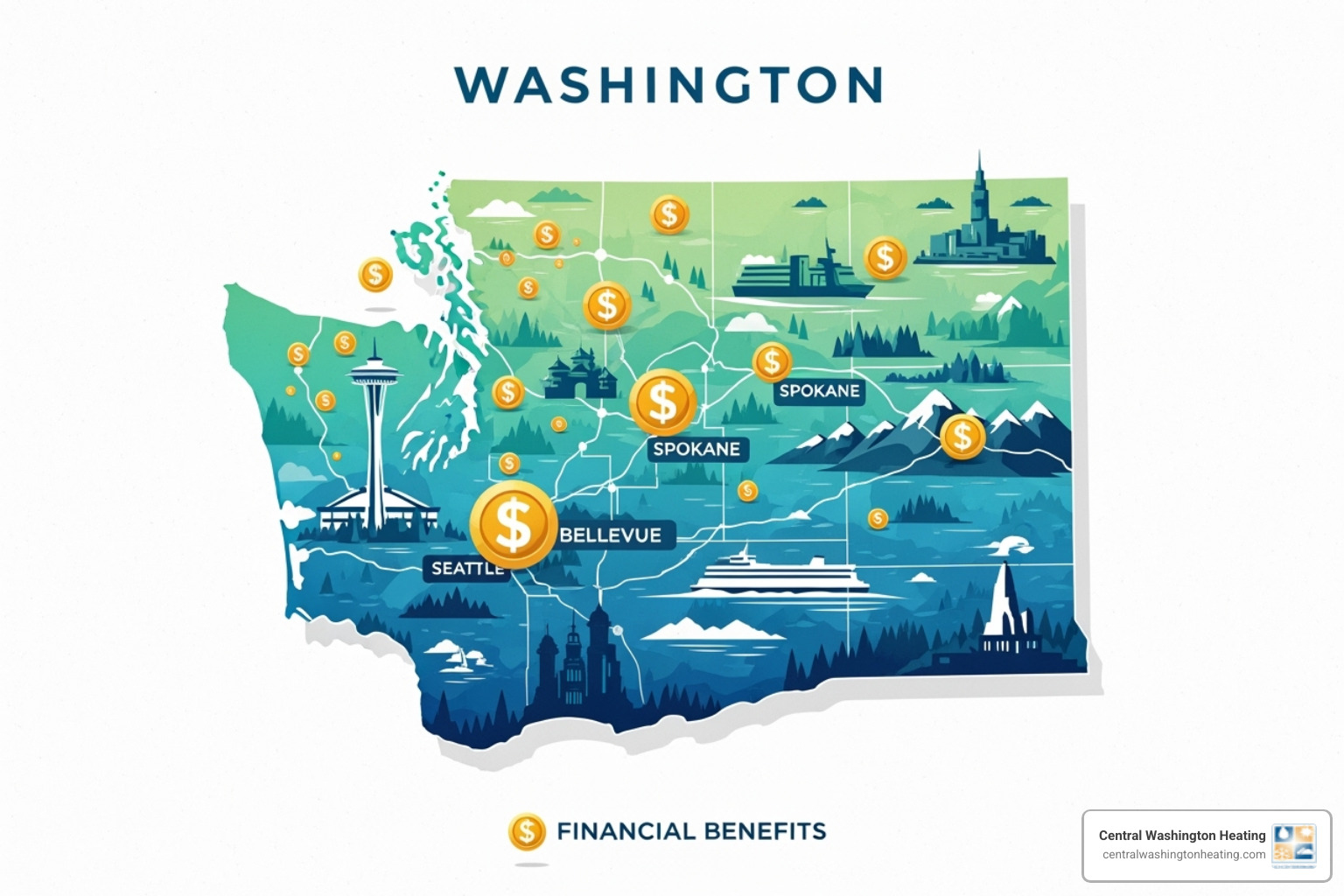
Beyond federal incentives, many states, municipalities, and utilities offer their own heat pump incentive programs. These local programs can boost your savings, especially when combined with federal benefits. Central Washington homeowners should explore these regional opportunities to make a heat pump upgrade more affordable.
How to Find Local Heat Pump Incentive Programs
Finding local incentives is rewarding. Here’s where to look:
- DSIRE Database: The Database of State Incentives for Renewables & Efficiency is a comprehensive map of state and utility programs. Click here for a list of additional incentives that may not be included above.
- Your utility company’s website: Companies like Pacific Power and Puget Sound Energy offer generous rebates. Pacific Power’s program provides incentives from $250 to $3,250 for Washington customers.
- City and county programs: A quick online search for your city plus “heat pump incentives” can reveal local opportunities.
- Washington state programs: The Department of Commerce provides information on how federal funding is used statewide. Check Inflation Reduction Act Home Energy Rebates in Washington for updates.
When you’re researching these programs, it’s also worth considering whether your current system might benefit from replacement. Our guide on Heat Pump Replacement Wenatchee WA can help you evaluate your options.
Maximizing Your Savings by Combining Offers
You can often stack these incentives to create substantial savings. Combining federal tax credits with state, local, and utility rebates can dramatically reduce your out-of-pocket costs. For example, you could claim the federal 25C tax credit, receive a utility rebate, and qualify for local incentives for remarkable savings.
The key is reading the fine print of each program. Most programs allow stacking, but some have specific rules. For instance, a utility rebate might need to be subtracted from your project cost before calculating your federal tax credit. Strategic planning is crucial to maximize every available dollar, making a significant investment more manageable.
Once your new system is installed, proper maintenance becomes crucial for protecting your investment and ensuring continued efficiency. Regular upkeep helps you maintain those energy savings for years to come. Learn more about keeping your system running smoothly in our article on Preventative Heat Pump Maintenance.
From Selection to Savings: Your Action Plan
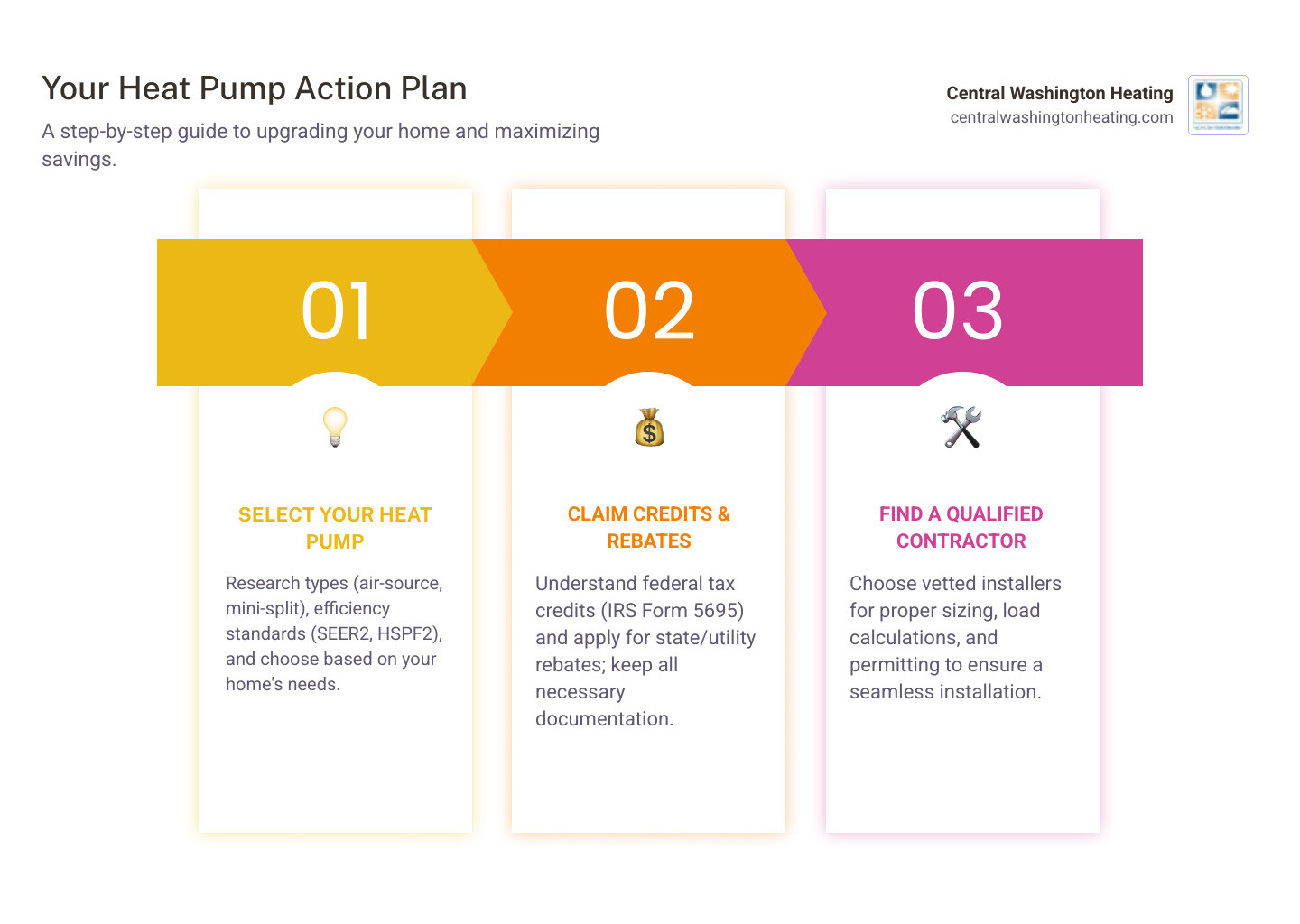
Ready to switch to efficient home heating and cooling? The process of using heat pump incentive programs to lower your energy bills can be straightforward. Let’s break down the steps to make your heat pump upgrade a reality.
Choosing the Right Heat Pump for Your Home
Finding the right heat pump is crucial, and today’s models are designed for almost any home.
- Air-source heat pumps are the most popular choice, reliable and efficient for the Central Washington climate. Ducted systems integrate with existing ductwork, while ductless mini-splits are great for homes without ducts or for room-by-room control. Learn more in our guide Why Choose Mini Split Systems.
- Cold-climate heat pumps are designed for our winters, keeping homes warm even in sub-zero temperatures. Look for the ENERGY STAR Cold Climate designation.
- Ground-source (geothermal) heat pumps offer exceptional efficiency and qualify for a generous 30% federal tax credit with no annual limit.
When selecting a heat pump, consider efficiency standards like SEER2 and HSPF2, your home’s load calculation, the local climate, and your ductwork situation.
The Process for Claiming Credits and Rebates
Claiming incentives is straightforward if you stay organized.
- For federal tax credits like the 25C, use Claim the credits using IRS Form 5695 when you file your taxes. Starting in 2025, you’ll need the heat pump’s Product Identification Number (PIN) from your installer.
- Keep all receipts, invoices, and manufacturer documentation for your records and potential IRS review.
- State, local, and utility rebates have unique processes. Some are point-of-sale discounts, while others require post-installation applications. Some may even require pre-approval, so check requirements early.
Your contractor should be well-versed in the local heat pump incentive programs and can guide you through the specific requirements for your area. For insights into what the installation process looks like, check out our article on Exploring Heat Pump Installation Process.
Finding and Working with a Qualified Contractor
Your choice of contractor is critical. A good professional is a partner in maximizing your comfort, efficiency, and savings. Look for contractors who are familiar with heat pump incentive programs and can guide you through eligibility and applications. Many utility companies maintain lists of approved contractors.
Experience matters tremendously in heat pump installation. Your contractor should perform detailed load calculations for proper sizing and handle all necessary permitting. Don’t be shy about asking for references or checking online reviews. Also verify that they’re properly licensed and insured in Washington.
The best contractors will help you identify which heat pump incentive programs your chosen system qualifies for and assist with the necessary paperwork. This partnership approach ensures a smooth installation and successful incentive claims.
Your relationship with your contractor doesn’t end at installation. Knowing when to call for professional help down the road is important – our guide on When to Call for Heat Pump Repair can help you recognize when it’s time to reach out.
When you’re ready to move forward with your heat pump installation in Central Washington, our experienced team is here to help with Heat Pump Installation Wenatchee WA. We’ll guide you through every step of the process, from selection to savings.
Frequently Asked Questions about Heat Pump Incentives
Navigating heat pump incentive programs can feel overwhelming at first, especially when you’re trying to understand how different credits and rebates work together. We’ve helped countless homeowners in Central Washington work through these programs, and certain questions come up again and again. Let’s tackle the most common concerns to help clear things up.
Can renters claim any incentives for heat pumps?
This is a great question that surprises many people. Yes, renters can claim the 25C tax credit if they pay for eligible improvements to their principal residence. The key factor is who’s actually covering the installation costs – if you’re footing the bill as the renter, you can claim the credit.
Of course, there’s a practical hurdle here. Most landlords need to approve any major home modifications like heat pump installations. It’s worth having a conversation with your landlord about the benefits – after all, they’re getting a valuable upgrade to their property while you handle the upfront costs and claim the tax benefits.
When it comes to rebate programs, the rules can be trickier and vary significantly by state and specific program. Some income-based rebates are designed specifically with renters in mind, while others focus on property owners. Always check the fine print of each program you’re considering.
Can I combine a federal tax credit with a state or utility rebate?
This is where things get exciting – you can usually “stack” incentives from different sources, which can lead to substantial savings. The federal government has made it clear that their rules don’t prevent you from combining federal tax credits with state, local, or utility rebates.
However, there’s an important detail to watch for. Some utility rebates are treated as “purchase price adjustments,” which means you need to subtract the rebate amount from your total project cost before calculating your 30% federal tax credit. It’s not necessarily a bad thing – you’re still saving money – but it affects how you do the math.
For example, if your heat pump installation costs $8,000 and you receive a $1,000 utility rebate, you’d calculate your federal tax credit based on the remaining $7,000. This approach ensures you’re not double-dipping on the same dollars, which keeps everything above board with the IRS.
The golden rule here is to read the program fine print carefully. Each incentive has its own terms and conditions, and understanding these details upfront helps you plan your finances accurately and avoid any surprises come tax time.
What happens if my tax credit is more than the taxes I owe?
This scenario catches some homeowners off guard, especially those who typically receive tax refunds or have lower tax liability. The 25C Energy Efficient Home Improvement Credit is nonrefundable, which means it works differently than some other tax credits you might be familiar with.
Think of it this way: this credit can reduce your tax bill to zero, but it won’t generate a refund check if there’s money left over. If you owe $1,500 in taxes and have a $2,000 heat pump credit, you’ll pay zero taxes, but you won’t get that extra $500 back as a refund.
Additionally, any unused portion cannot be carried forward to future tax years. This is quite different from the 25D Residential Clean Energy Credit for geothermal systems, which can be carried forward if it exceeds your tax liability.
This limitation is why it’s worth consulting with a tax professional when planning your heat pump installation, especially if you typically have low tax liability. They can help you understand whether the timing of your installation might affect how much of the credit you can actually use.
Take Advantage of Savings for Your Home
The stars have truly aligned for homeowners considering a heat pump upgrade. Between federal tax credits, income-based rebates, and local utility programs, there’s never been a better time to make the switch to efficient heating and cooling. These heat pump incentive programs can transform what might seem like a significant investment into a surprisingly affordable home improvement project.
Think about it: you could potentially save thousands on your installation while also reducing your monthly energy bills for years to come. The math is pretty compelling when you factor in the long-term benefits of lower utility costs, increased home value, and the peace of mind that comes with a more reliable system.
Beyond the financial advantages, choosing a heat pump means taking a meaningful step toward energy independence. You’re reducing your reliance on fossil fuels and contributing to cleaner air in our beautiful Central Washington region. It’s one of those rare decisions where doing good for the environment also means doing good for your wallet.
The window of opportunity won’t stay open forever, though. Many of these federal incentives have specific end dates, and some state programs are still rolling out with limited funding. The sooner you act, the more likely you are to secure all available savings.
At Central Washington Heating, we understand that navigating these incentive programs can feel overwhelming. That’s exactly why we’re here – to guide you through every step of the process. From helping you choose the perfect heat pump for your home’s unique needs to ensuring you qualify for every available rebate and tax credit, we handle the details so you don’t have to.
Our team stays current on all the latest program requirements and eligibility criteria, which means you can focus on enjoying your more comfortable home while we take care of the paperwork. We’ve helped countless homeowners in our region take advantage of these programs, and we’d love to help you too.
Ready to start saving? Schedule your professional heat pump installation in Chelan, WA today! Your future self – and your energy bills – will thank you.
Written by the Central Washington Heating and Air team
The techs and comfort advisors who've kept the Wenatchee Valley heated, cooled, and breathing easy for 30+ years — family & veteran owned, with 40+ years of combined industry experience.
- Licensed & insured · LIC# CENTRWH742JN
- Daikin Comfort Pro certified
- Wenatchee, WA
Last updated July 29, 2026
Ready for comfort you can count on?
Schedule service, request a free estimate, or call now for 24/7 emergency help. Our team is standing by across the Wenatchee Valley.
Get started today
Free estimates on installs · no-pressure, written quotes
Schedule My ServiceCall (509) 776-0247Mon–Fri: 8:00 AM – 4:30 PM · 24/7 for emergencies
Already have a quote? Get a free second opinion →