
Filter Frenzy: Top Air Filtration Systems to Transform Your Home's Air
Breathe cleaner! Discover how an air filtration system transforms your home's air for better health. Find your perfect solution.
Why Your Home's Air Quality Matters More Than You Think
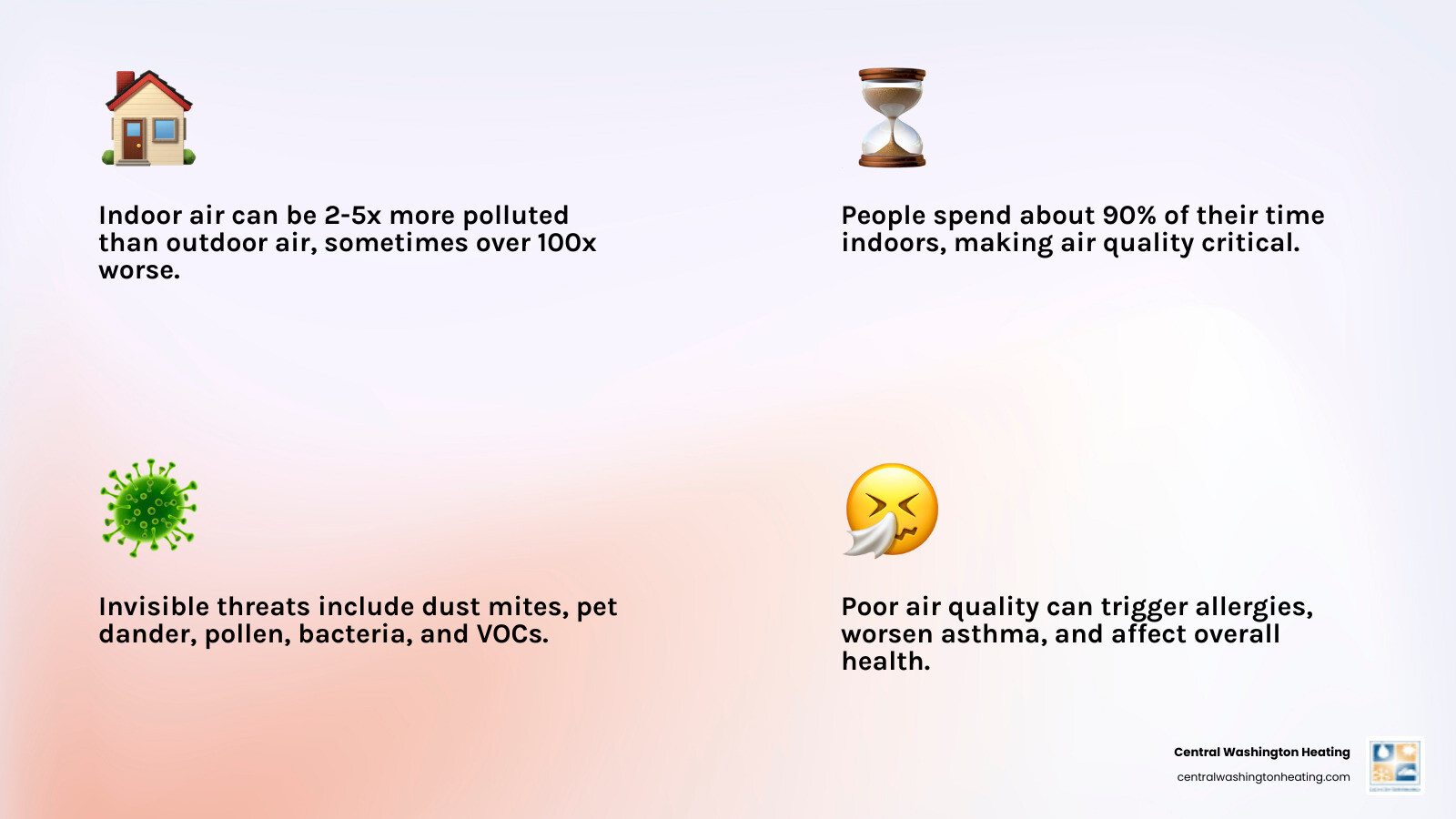
Air filtration system technology has become essential for Central Washington homeowners who want to breathe cleaner, healthier air indoors. The Environmental Protection Agency reports that indoor air pollutants are often 2 to 5 times higher than outdoor levels - and sometimes over 100 times worse.
Top Air Filtration Systems at a Glance:
- HEPA Filter Systems - Remove 99.97% of particles 0.3 microns or larger
- Whole-Home Units - Integrate with your HVAC system for complete coverage
- Portable Air Purifiers - Target specific rooms with focused cleaning
- UV Light Systems - Kill bacteria, viruses, and mold spores
- Activated Carbon Filters - Eliminate odors, smoke, and chemical vapors
Your indoor air contains invisible threats like dust mites, pet dander, pollen, bacteria, and volatile organic compounds (VOCs). These contaminants can trigger allergies, worsen asthma, and affect your family's overall health.
People spend about 90% of their time indoors, making air quality a critical factor in your daily comfort and long-term wellness. The right air filtration system can transform your home's environment by capturing microscopic particles, neutralizing odors, and reducing respiratory irritants.
Whether you're dealing with seasonal allergies, pet dander, cooking odors, or simply want fresher air throughout your home, understanding your options will help you make the best choice for your family's needs.
Why Indoor Air Quality is Your Home's Unseen Health Factor

Think about it - you probably check the weather before heading outside, but when's the last time you thought about the air quality inside your own home? It's a blind spot for most of us, yet it's where we spend roughly 90% of our time.
Here's what might surprise you: the air in your living room could be harboring more pollutants than a busy city street. We're talking about invisible troublemakers like dust mites that love your cozy bedding, pet dander that floats around long after Fluffy left the room, and pollen that sneaks indoors on your clothes and shoes.
But the story doesn't end there. Your indoor air also contains microscopic invaders you'd never expect - bacteria, mold spores, viruses, and something called volatile organic compounds (VOCs). These VOCs come from everyday items sitting right in your home: cleaning supplies under the kitchen sink, that fresh coat of paint in the bedroom, even your favorite furniture.
Your body feels the impact of these uninvited guests more than you might realize. Poor indoor air quality is often the hidden culprit behind those persistent allergy symptoms - the morning sneezing fits, itchy eyes that won't quit, and that stuffy feeling that never seems to go away.
For people with asthma, contaminated indoor air can turn a manageable condition into a daily struggle. These airborne particles act as triggers, causing respiratory irritation and making breathing more difficult. Even if you don't have asthma, long-term exposure to indoor pollutants can lead to throat irritation, persistent coughing, and chest discomfort.
The good news? An effective air filtration system can be a game-changer for your family's health. When you remove these harmful particles from your indoor environment, you're creating a space where everyone can breathe easier and sleep better.
Many families with asthma find that improved air quality brings remarkable relief, reducing the triggers that cause inflammation and breathing troubles. It's why respiratory health experts, including those at the American Lung Association, recommend air filtration as an important part of managing asthma symptoms.
If you want to learn more about protecting your home's air quality, check out The EPA's guide to indoor air quality and find practical tips for reducing asthma triggers.
Decoding the Technology: Types of Air Purifiers and How They Work

An air filtration system isn't just a fancy fan; it's a sophisticated device designed to strip away unwanted elements from your indoor air. Different systems employ various filtration methods, each targeting specific types of pollutants, from tiny particles to unpleasant odors and even harmful microorganisms. Let's explore the ingenious ways these systems work to deliver cleaner air to your Central Washington home.
Mechanical Filters: The Foundation of Clean Air
At the heart of many effective air purification systems are mechanical filters, particularly High-Efficiency Particulate Air (HEPA) filters. These aren't just any filters; they are the gold standard for particle removal. HEPA filters are carefully designed with a very fine mesh of fibers that are certified to capture an astounding 99.97% of particles as small as 0.3 micrometers in diameter. This includes a vast array of common household irritants like dust, pollen, mold spores, pet dander, and bacteria. Even tiny viral droplets, which often attach to larger airborne particles, can be effectively trapped by these remarkable filters.
It's important to distinguish between true HEPA filters and those labeled "HEPA-type" or "HEPA-like." While the latter may offer some filtration, they haven't met the rigorous certification requirements of true HEPA standards. When it comes to your HVAC system, filters are rated by their Minimum Efficiency Reporting Value (MERV). While basic HVAC filters primarily protect your equipment from dust buildup, upgrading to higher MERV-rated filters can significantly improve your home's overall air quality by capturing more airborne particles.
To understand why this is so crucial, you can learn more about What is a HEPA filter? and find Why You Need a Good Air Filter in your HVAC system.
Gas, Odor, and VOC Removal
While mechanical filters are champions at capturing particles, they don't typically address gases or odors. That's where activated carbon filters step in. These filters are made from highly porous carbon that has been treated to increase its surface area, allowing it to adsorb (not absorb, but rather collect on its surface) a wide range of gaseous pollutants. Think of it like a sponge for smells and chemicals!
Activated carbon filters are highly effective at neutralizing common household odors from cooking, pets, and tobacco smoke. They also tackle volatile organic compounds (VOCs), which are gases emitted from various solids or liquids, including paints, cleaning supplies, air fresheners, and even new furniture. However, it's worth noting that while activated carbon is powerful, it's not equally effective against all gases; for instance, some research suggests it's not particularly efficient against certain complex compounds like formaldehyde, ammonia, or nitrogen oxide. For comprehensive air purification, many advanced air filtration system models combine HEPA and activated carbon filters, ensuring both particulate and gaseous pollutants are addressed.
Advanced Technologies in an air filtration system
Beyond mechanical and carbon filtration, several advanced technologies are employed in modern air purifiers to improve their capabilities, particularly in germicidal action.
UVGI (Ultraviolet Germicidal Irradiation): This technology uses UV-C light, a specific wavelength of ultraviolet light, to destroy microorganisms. As air passes through the air filtration system, bacteria, viruses, and mold spores are exposed to the UV-C light, which damages their DNA or RNA, rendering them unable to reproduce or cause harm. UVGI is often integrated into whole-house HVAC systems, treating the air as it circulates. It's a fantastic complement to mechanical filters, as it targets living organisms that might pass through the physical filter media.
PCO (Photocatalytic Oxidation): Some cutting-edge air purifiers use PCO technology. This process involves a UV lamp shining on a photocatalyst, typically titanium dioxide. When the UV light interacts with the catalyst, it creates highly reactive molecules (hydroxyl radicals) that oxidize gaseous pollutants, effectively breaking them down into harmless compounds like carbon dioxide and water. While promising, it's important to be aware that, depending on the specific pollutants, this reaction can sometimes generate unintended byproducts, such as ozone or formaldehyde, as noted in one laboratory study. Consumer Reports, for example, maintains a cautious stance on PCO and UVGI due to these potential limitations and byproducts.
Other Technologies: You might also encounter technologies like ionizers or electrostatic precipitators. These work by electrically charging particles, causing them to stick to charged plates or surfaces. While effective at removing particles, Consumer Reports does not recommend ozone generators, electrostatic precipitators, or ionizers that produce ozone. Ozone, even at low levels, can be harmful to respiratory health and is not effective at destroying indoor pollutants. Our priority is your family's health, so we lean towards proven, ozone-free technologies.
How to Select the Right Air Filtration System for Your Home
Choosing the perfect air filtration system for your Central Washington home doesn't have to feel overwhelming. Think of it like finding the right pair of shoes - you need something that fits your space, matches your lifestyle, and works within your budget. The key is understanding what makes one system better than another for your specific needs.
When evaluating any air filtration system, there are several crucial factors that determine whether it'll be a perfect match or a disappointing purchase. Filter type is your foundation - HEPA filters capture 99.97% of particles at 0.3 microns, activated carbon handles odors and gases, while UVGI technology kills microorganisms. Most effective systems combine multiple filter types for comprehensive protection.
CADR (Clean Air Delivery Rate) tells you how fast your system actually cleans the air. Think of it as the horsepower of air purification - higher numbers mean faster cleaning. This directly relates to coverage area, which determines the maximum square footage your unit can handle effectively. An undersized system will struggle like a small fan trying to cool a warehouse.
Noise level matters more than you might think, especially if you're planning to run your air filtration system in bedrooms or quiet spaces. Nobody wants their air purifier sounding like a leaf blower at bedtime! Look for decibel ratings around 50 dB or lower - that's about as quiet as your refrigerator.
Don't forget about maintenance needs and energy efficiency. Some systems require filter changes every few months, while others last longer. Energy Star certified units use 40% less electricity, which adds up over time. It's like choosing between a gas-guzzling truck and a fuel-efficient car for your daily commute.
Portable vs. Whole-Home Air Filtration Systems
Here's where things get interesting. You're basically choosing between targeted treatment and whole-house coverage - both have their place in a smart air quality strategy.
Portable room air purifiers are like having a personal bodyguard for specific spaces. They excel at tackling concentrated problems - maybe your bedroom where pet dander accumulates, or your home office where you spend long hours. These units offer flexibility since you can move them around, and they're often the easiest way to dip your toes into air purification.
Whole-home air filtration systems take a completely different approach. Instead of treating one room at a time, these systems integrate with your existing HVAC system to purify every breath of air circulating through your home. It's centralized cleaning that reaches every corner, from your basement to your upstairs bedrooms.
The beauty of whole-home systems goes beyond just air cleaning. They actually help your HVAC system run more efficiently by reducing dust buildup on components. Less dust means your system doesn't have to work as hard, which can extend its lifespan and improve energy efficiency.
Many Central Washington homeowners find the sweet spot combines both approaches - a whole-home system for baseline protection throughout the house, plus portable units in high-priority areas like bedrooms or spaces where family members with allergies spend time.
For a deeper dive into integrated solutions, explore our Guide to Whole-Home Air Filtration.
Understanding Key Specifications
Let's explain the technical jargon that can make or break your air filtration system decision.
CADR (Clean Air Delivery Rate) is certified by the Association of Home Appliance Manufacturers and measures how quickly your purifier cleans specific pollutants - smoke, pollen, and dust. It's expressed in cubic feet per minute (CFM). Here's a simple rule: match the CADR number to your room's square footage. A 250 CFM unit works well in a 250-square-foot room. Pro tip: choose slightly higher than your room size so the unit can run on quieter, lower speeds while still being effective.
Room size calculation isn't just about square footage - ceiling height matters too. A room with 10-foot ceilings has more air volume than one with 8-foot ceilings, even if the floor space is identical. Most manufacturers base their recommendations on standard 8-foot ceilings, so adjust accordingly for higher spaces.
Noise levels are measured in decibels, and the difference between a peaceful home and an annoying hum often comes down to just a few decibels. Around 50 dB sounds like a quiet refrigerator, while 30 dB is whisper-quiet. If you're sensitive to noise or plan to use the system while sleeping, prioritize models with low decibel ratings on their quietest settings.
Energy Star certification isn't just a feel-good environmental badge - it's money in your pocket. These certified units use 40% less energy than standard models, which translates to lower electricity bills month after month. Since your air filtration system might run continuously, energy efficiency becomes increasingly important over time.
By understanding these specifications, you can confidently select an air filtration system that fits your home perfectly, ensuring your family breathes cleaner, healthier air every day.
The Future of Fresh Air: Innovations and Smart Features
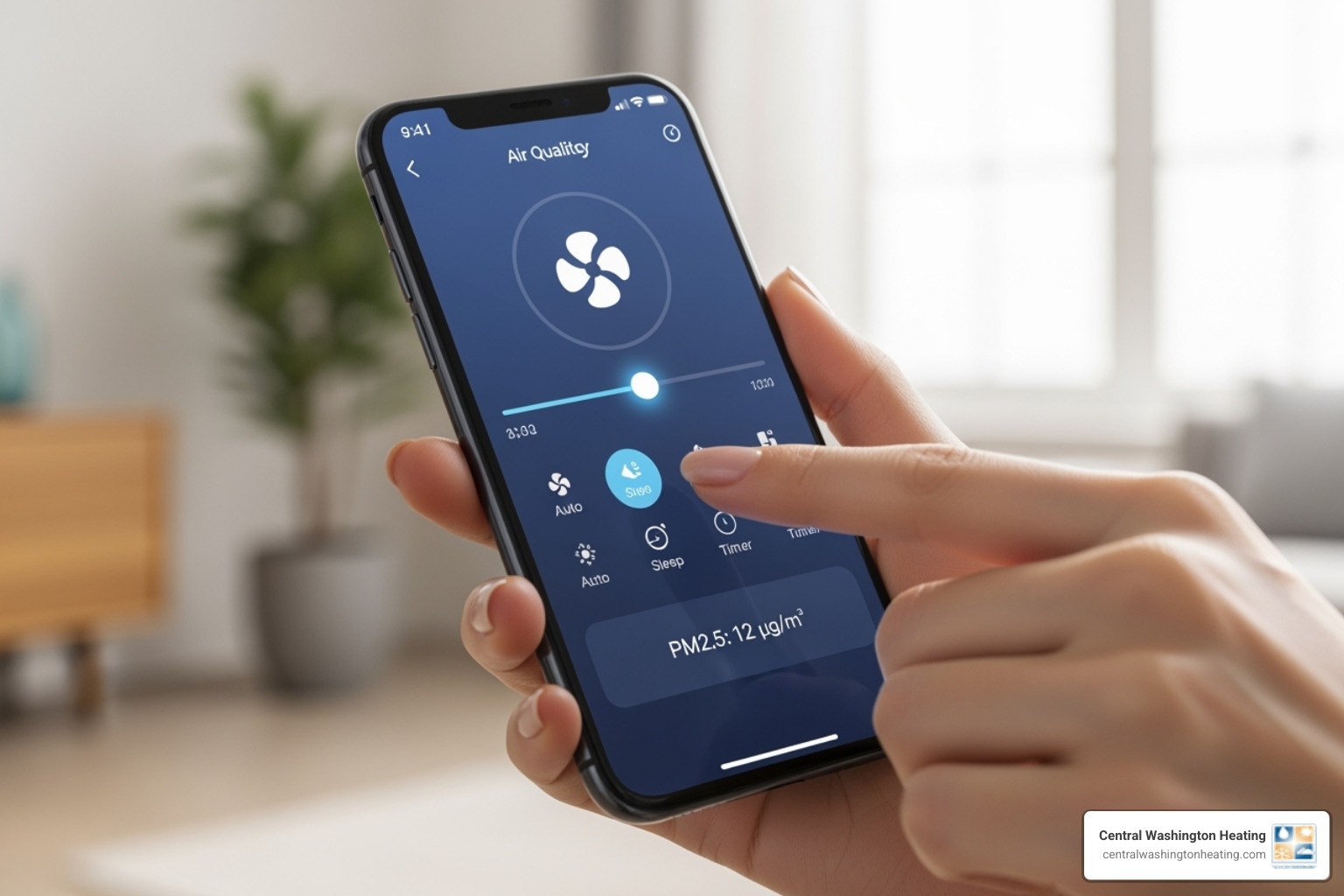
The air filtration system industry is experiencing an exciting change, bringing us into an era where clean air management feels almost magical. Gone are the days when air purifiers were just humming boxes in the corner – today's systems are becoming intelligent partners in maintaining your family's health.
Picture this: you're at work when wildfire smoke starts drifting into the Central Washington valley. Your smart air filtration system detects the change in air quality and automatically kicks into high gear, cleaning your home's air before you even know there's a problem. When you arrive home hours later, you're greeted by fresh, clean air instead of smoky haze.
This scenario isn't science fiction – it's happening right now thanks to smart technology integration. Modern air purifiers connect to your home's Wi-Fi, allowing you to monitor and control them through smartphone apps. Whether you want to check your home's air quality while you're grocery shopping, adjust the fan speed from your bedroom, or set up a cleaning schedule that runs while you're at work, it's all at your fingertips.
But the real game-changer is automatic air quality sensing. These sophisticated sensors continuously monitor your indoor environment, detecting everything from dust particles to volatile organic compounds. When pollution levels spike – maybe from cooking dinner or your neighbor's leaf blower – the system instantly responds by increasing its cleaning power. Once the air clears, it automatically dials back down, saving energy and keeping noise levels low.
The technology behind these sensors is becoming incredibly precise. Some systems can differentiate between different types of pollutants, adjusting their cleaning approach accordingly. If pet dander levels rise, the system might focus on particle filtration. If it detects cooking odors or cleaning chemical vapors, it might prioritize activated carbon filtration.
Advanced filter materials are pushing the boundaries even further. Scientists are developing filters that don't just trap pollutants – they actually destroy them. Some new materials can break down harmful chemicals, neutralize bacteria and viruses on contact, and even convert dangerous ozone back into breathable oxygen. These innovations mean your air filtration system becomes more effective while filters last longer.
One particularly exciting development is the creation of self-cleaning filter components. Some systems now include washable pre-filters and antimicrobial coatings that prevent bacteria and mold growth within the unit itself. This means less maintenance for you and more consistent performance over time.
The convenience factor can't be overstated. Many homeowners love receiving filter replacement reminders directly on their phones, or being able to order new filters with a simple tap. Some systems even provide detailed air quality reports, helping you understand patterns in your home's environment and make informed decisions about ventilation, cleaning schedules, and daily activities.
These technological advances are making clean air more accessible and effortless than ever before. Your air filtration system becomes a proactive health guardian rather than a passive appliance, working behind the scenes to ensure every breath you take at home is as clean and healthy as possible.
To learn more about how these cutting-edge technologies can transform your home's air quality, explore the latest Features in Home Air Filtration Systems available today.
Frequently Asked Questions about Air Filtration
We get a lot of questions from homeowners throughout Central Washington about air filtration system technology. After helping countless families breathe easier, we've noticed the same concerns come up again and again. Let's tackle the big ones that are probably on your mind too.
How often do I need to change my air purifier's filters?
Here's the truth - a dirty filter is basically a useless filter! Think of it like trying to drink through a straw that's clogged with peanut butter. Your air filtration system works hard, but it can only be as effective as its filters allow.
Prefilters are your first line of defense and typically need the most attention. These washable screens catch the bigger stuff like pet hair and dust bunnies. A quick rinse every month or two keeps them doing their job.
HEPA filters are the workhorses that capture those microscopic particles we talked about earlier. Most need replacing every six to twelve months, though this varies based on how much your system runs and how dusty your home gets. If you have pets or live near construction, you might need to swap them out more frequently.
Carbon filters work overtime absorbing odors, smoke, and chemical vapors. They typically burn out faster than HEPA filters - usually every three months or so. If you notice cooking smells lingering longer than usual, it's probably time for a fresh carbon filter.
The good news? Most modern systems come with maintenance indicators that take the guesswork out of timing. These little lights act like friendly reminders, letting you know exactly when it's time to give your system some TLC.
Can an air purifier help with allergies and asthma?
Absolutely, and this is where we see some of the most dramatic improvements in our clients' lives. An air filtration system can be a game-changer for anyone who struggles with respiratory issues.
Allergen capture is where these systems really shine. HEPA filters are incredibly effective at grabbing the troublemakers that make you sneeze - pet dander, pollen, dust mites, and mold spores all get trapped before they can irritate your airways. It's like having an invisible bouncer that keeps the bad guys out of your lungs.
We've had customers tell us their symptom reduction was almost immediate. Less morning congestion, fewer nighttime coughing fits, and dramatically improved respiratory function during allergy season. One client mentioned she finally stopped waking up with puffy eyes every morning after installing a whole-home system.
The American Lung Association actually recommends air filtration as part of a comprehensive approach to managing asthma. It's not a cure-all, but it's definitely a powerful tool in your wellness toolkit.
How effective are air purifiers against viruses and bacteria?
This question became especially important over the past few years, and the answer depends on what technology your air filtration system uses.
HEPA filter effectiveness against viruses is actually pretty impressive, but not for the reason you might think. While individual virus particles are incredibly tiny - much smaller than what HEPA filters are rated for - viruses don't travel alone. They hitch rides on respiratory droplets, dust particles, and other airborne carriers that are well within HEPA's capture range.
UVGI technology takes a different approach entirely. Instead of just trapping germs, UV light systems actually kill bacteria, viruses, and mold spores as air passes through the unit. It's like having a microscopic sanitizer working around the clock.
The reality is that particle size matters, and airborne transmission is complex. While no air filtration system can guarantee 100% protection against all pathogens, a quality system significantly reduces the concentration of harmful microorganisms in your indoor air. When viral droplets and bacteria are floating around less, everyone in your household has a better chance of staying healthy.
Think of it this way - your air purifier won't replace good hygiene habits, but it's definitely a valuable teammate in keeping your home's air as clean and safe as possible.
Conclusion
Your home should be a sanctuary where every breath nourishes your well-being. Throughout this guide, we've uncovered how an effective air filtration system transforms your indoor environment from a potential health hazard into a clean, comfortable haven for your family.
The statistics we've shared paint a clear picture: with indoor air often containing pollutants at levels 2 to 5 times higher than outdoor air, and considering we spend about 90% of our time indoors, clean air isn't just nice to have—it's essential. Whether you're battling seasonal allergies, managing asthma symptoms, or simply wanting to protect your family from invisible threats like dust mites, pet dander, and volatile organic compounds, the right air filtration system delivers measurable relief.
The benefits extend far beyond health improvements. You'll enjoy better sleep quality when allergens aren't disrupting your rest, experience fewer respiratory irritations during daily activities, and even see your HVAC system running more efficiently when protected by quality filtration. Many of our Central Washington clients tell us their homes simply feel fresher and more comfortable after installing proper air filtration.
At Central Washington Heating, we've seen how the right air filtration system can transform lives. We understand that every home is unique, which is why we take time to understand your specific needs—whether that's a comprehensive whole-home solution that integrates seamlessly with your existing HVAC system or targeted portable units for specific rooms where your family spends the most time.
Taking control of your indoor air quality is one of the most proactive steps you can take for your family's health. The technology exists, the benefits are proven, and the peace of mind that comes with breathing cleaner air is invaluable.
Ready to find how clean air can transform your Central Washington home? We're here to guide you through every step of the process, from understanding your options to finding the perfect solution for your family's needs.
Explore the Essential Benefits of Whole-Home Air Filtration and take the first step toward the fresh, healthy air your family deserves.
Written by the Central Washington Heating and Air team
The techs and comfort advisors who've kept the Wenatchee Valley heated, cooled, and breathing easy for 30+ years — family & veteran owned, with 40+ years of combined industry experience.
- Licensed & insured · LIC# CENTRWH742JN
- Daikin Comfort Pro certified
- Wenatchee, WA
Last updated July 29, 2026
Ready for comfort you can count on?
Schedule service, request a free estimate, or call now for 24/7 emergency help. Our team is standing by across the Wenatchee Valley.
Get started today
Free estimates on installs · no-pressure, written quotes
Schedule My ServiceCall (509) 776-0247Mon–Fri: 8:00 AM – 4:30 PM · 24/7 for emergencies
Already have a quote? Get a free second opinion →