
When Should You Replace Your Air Conditioner in 2026?
Wenatchee Valley's HVAC authority for over 30 years. Expert AC, electric air handler, heat pump, and mini-split installation, repair, and maintenance. Family & veteran owned. 24/7 emergency service.
How to Know When Should You Replace Your Air Conditioner in Central Washington
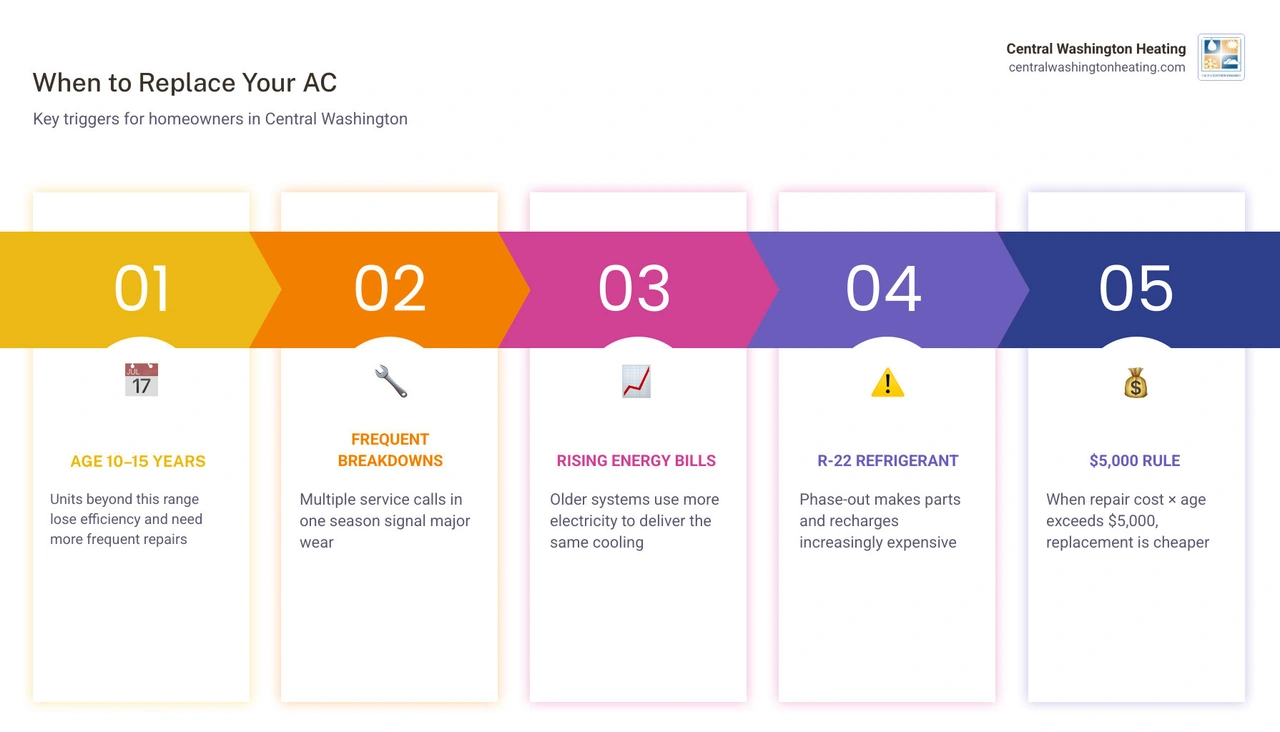
Knowing when should you replace your air conditioner can save you from throwing money at a system that’s already on its way out. Here’s a quick-reference summary of the most common replacement triggers:
Replace your air conditioner when:
- Your unit is 10–15 years old and showing performance problems
- You’re facing frequent breakdowns — especially multiple repairs in a single season
- Your energy bills keep climbing without a clear reason
- Your system uses R-22 refrigerant, which has been phased out since 2020
- Cooling is uneven, with some rooms too hot and others too cold
- You’re hearing unusual noises or noticing strange odors
- A repair estimate multiplied by the unit’s age exceeds $5,000
For homeowners in Wenatchee, East Wenatchee, Leavenworth, and the surrounding Chelan County area, this decision hits especially hard during summer heat waves — the last thing you want is for your AC to quit when temperatures are climbing and you need cool air most.
Central air conditioning quietly handles anywhere from 12% to 27% of your monthly power bill, and when a system starts to fail, that share can creep even higher. An aging unit works harder, cools less effectively, and costs more to run and repair with every passing season. At some point, repairing becomes the more expensive choice — not the smarter one.
The good news is that there are clear, objective signs that tell you when it’s time to stop repairing and start replacing. This guide walks you through all of them.
Key Signs of When Should You Replace Your Air Conditioner

Recognizing the warning signs of a failing cooling system early allows you to plan a replacement on your own terms, rather than dealing with a stressful emergency breakdown in the middle of a July heatwave. When we perform inspections in communities like Cashmere, Chelan, and Malaga, we look for several key indicators that point toward replacement over simple repairs.
If you are trying to determine whether your system is reaching the end of its useful life, reading our comprehensive AC Unit Replacement Guide 2025 is an excellent place to start. In the meantime, keep an eye out for these classic warning signs:
- Frequent Breakdowns: If you have had to call a technician out more than twice in the last two seasons, your system is telling you it is tired. Frequent minor component failures are often the prelude to a catastrophic compressor failure.
- Uneven Cooling: Are some rooms in your house ice-cold while others feel like a sauna? When an air conditioner loses its capacity, it struggles to distribute cool air evenly throughout your home.
- Humidity Issues: An air conditioner’s job is not just to lower the temperature; it is also designed to pull moisture out of the air. If your home feels muggy or swampy even when the AC is running, the system is no longer dehumidifying effectively.
- Excessive Noise: Squealing, grinding, rattling, or banging sounds from your outdoor unit or indoor air handler suggest worn-out bearings, loose belts, or an aging compressor that is about to seize.
- Strange Odors: Musty smells often point to mold growth inside the ductwork or evaporator coil, while burning plastic smells indicate electrical components are overheating.
System Age: When Should You Replace Your Air Conditioner Based on Lifespan?
Age is the most reliable baseline indicator for evaluating an air conditioner. On average, a standard central air conditioning unit lasts 10 to 15 years, while modern air conditioners can push that lifespan to 15 to 20 years under optimal conditions with consistent professional care.
However, local climate extremes in the Wenatchee Valley play a major role in how quickly your equipment ages. In Central Washington, our systems face a double-edged sword: blistering hot summers where the AC runs around the clock, followed by freezing winters that put heavy demands on our heating equipment. This thermal cycling puts extra physical stress on the outdoor condenser, causing components to degrade faster than they would in milder climates.
If your system is crossing that 10-to-12-year threshold, it is time to start planning. To learn more about selecting a system tailored to our unique local climate, check out our guide on How to Choose the Right AC for Central Washington.
Performance Issues and Inconsistent Cooling
When an air conditioner begins to fail, its overall cooling capacity drops. This manifests in several frustrating ways:
- Weak Airflow: You might feel only a gentle whisper of cool air coming out of your registers, even when the fan is set to high. This can be caused by a failing blower motor or restricted airflow.
- Short-Cycling: If your air conditioner turns on, runs for two minutes, shuts off, and then turns back on again shortly after, it is short-cycling. This constant starting and stopping places immense strain on the compressor and wastes a significant amount of electricity.
- Frozen Coils: Restricted airflow from dirty coils, clogged filters, or a slow refrigerant leak can cause the evaporator coil to freeze over, literally turning your indoor unit into a block of ice.
- Poor Indoor Air Quality: Older systems struggle to filter out allergens and maintain proper humidity, leading to increased dust accumulation and airborne irritants throughout your living spaces.
Evaluating System Age and the Repair vs. Replace Decision
When your air conditioner breaks down, you are faced with a major decision: do you pay for the repair, or do you invest in a brand-new system? While a repair might seem like the easier, cheaper option upfront, it can sometimes be a poor financial decision in the long run.
To help make this choice easier, we recommend looking at the age of the unit, its overall reliability, and whether it is still covered by a manufacturer’s warranty (which typically lasts 5 to 10 years on newer systems).
When you are ready to explore your options, you can read about What Brand and Efficiency Level is Right for Your Budget to weigh the long-term return on your investment.
The $5,000 Rule: Deciding When Should You Replace Your Air Conditioner
To remove the guesswork and emotion from this choice, many HVAC professionals use a simple mathematical formula known as The $5,000 Rule.
To use this rule, you multiply the age of your air conditioner (in years) by the estimated repair cost (in dollars). If the resulting “Decision Number” is under $5,000, repairing the unit is generally reasonable. If the number is over $5,000, your money is better spent on a replacement.
$$\text{Age of System (Years)} \times \text{Cost of Repair (\$)} = \text{Decision Number}$$
Here is a quick comparison table to show how the $5,000 rule works in real-world scenarios:
| System Age | Estimated Repair Cost | Decision Number Calculation | Recommended Action |
|---|---|---|---|
| 5 Years Old | Minor repair | $5 \times \$300 = \$1,500$ | Repair (Well under the threshold) |
| 8 Years Old | Moderate repair | $8 \times \$500 = \$4,000$ | Repair (Borderline, but still reasonable) |
| 10 Years Old | Major component repair | $10 \times \$600 = \$6,000$ | Replace (Exceeds $5,000; replace recommended) |
| 12 Years Old | Moderate repair | $12 \times \$500 = \$6,000$ | Replace (Aging system; invest in new equipment) |
| 15 Years Old | Minor repair | $15 \times \$400 = \$6,000$ | Replace (System is at the end of its lifespan) |
The 50% Rule for Major Component Failures
Another simple guideline to keep in mind is the 50% Rule. If your air conditioner is out of warranty and is experiencing a major component failure — such as a cracked evaporator coil, a failed blower motor, or a dead compressor — and the cost of that single repair is more than 50% of the cost of a brand-new unit, you should always choose replacement.
Investing a significant sum into an older, out-of-warranty system does not guarantee that another major part won’t fail next month. Replacement gives you a fresh start, complete with a brand-new manufacturer’s warranty for total peace of mind.
The Impact of Outdated Refrigerants and Rising Energy Bills
Environmental regulations and monthly operating costs are two massive factors that can quickly tip the scales in favor of replacement. If your air conditioner was installed more than a decade ago, it likely relies on outdated technology that is becoming increasingly expensive to keep running.
When planning your upgrade, understanding What SEER2 Rating to Look For in a New AC is crucial for maximizing your monthly savings.
The R-22 Freon Phase-Out and Service Costs in 2026
If your air conditioner was manufactured before 2010, there is a very high probability that it uses R-22 refrigerant (commonly known as Freon). Because R-22 is an ozone-depleting substance, the EPA completely banned its production and import.
In May 2026, the only R-22 left on the market is scarce, reclaimed stock. If an older R-22 system develops a refrigerant leak, the cost to locate the leak, repair it, and recharge the system with reclaimed Freon is astronomically high. Because of this scarcity, any major refrigerant-related issue on an R-22 unit is an automatic trigger for a complete system replacement. Upgrading to a modern system that uses eco-friendly refrigerants is better for both your wallet and the environment.
Rising Energy Bills and Efficiency Loss
Heating and cooling make up up to 50% of a typical home’s total energy usage. As an air conditioner ages, its internal components wear down, causing it to consume more electricity to deliver the same amount of cooling.
If you notice your summer power bills steadily climbing year-over-year despite similar usage patterns, your AC is losing its efficiency. Modern systems must meet strict federal SEER2 (Seasonal Energy Efficiency Ratio) standards. Upgrading an old, inefficient system to a modern, high-efficiency ENERGY STAR qualified unit can save you up to 20% on your heating and cooling costs.
To keep your new investment running at peak efficiency for as long as possible, you can read about Maximizing AC Lifespan with Regular Maintenance.
Replacing the Entire HVAC System vs. Just the AC Unit
When it comes time to replace a failing air conditioner, many homeowners wonder if they can get away with just replacing the outdoor unit. While it is technically possible, it is rarely the smartest move.
Your indoor and outdoor heating and cooling components are designed to work together as a matched system. Upgrading both components at the same time ensures maximum efficiency, saves you money on combined labor costs, and prevents compatibility issues. To understand why this is so important, read our detailed guide on why you should Replace Entire AC System.
When to Replace Your Heat Pump or Electric air handler Simultaneously
If you rely on an electric air handler or a heat pump for your winter heating, replacing these units at the same time as your air conditioner is highly recommended — especially if they are of a similar age.
- Heat Pumps: On average, heat pumps last 10 to 16 years. Because they handle both heating and cooling duties, they accumulate run hours much faster than a standalone AC. If your heat pump is struggling, check out our guide on the Signs It’s Time to Replace Heat Pump.
- Electric air handlers: While electric air handlers can last 15 to 20 years, pairing an old, standard blower motor with a brand-new air conditioner will prevent the new AC from reaching its rated efficiency. Learn more in our Air handler Replacement Guide 2025.
By replacing both systems together, you reset the clock on your entire home comfort system, ensuring worry-free operation for the next decade or more.
Benefits of Modern High-Efficiency Systems
Upgrading to a modern, matched electric HVAC system brings a wealth of day-to-day benefits to your home:
- Variable-Speed Technology: Older systems are either 100% “on” or 100% “off.” Modern variable-speed systems act like a smooth accelerator, adjusting their output to match your home’s exact needs. This eliminates temperature swings and runs incredibly quietly.
- Smart Thermostat Integration: Modern systems pair seamlessly with smart thermostats, allowing you to program schedules, monitor energy usage, and control your home’s climate from your phone.
- Increased Home Value: A brand-new, energy-efficient HVAC system with a transferable warranty is a massive selling point for potential buyers if you ever decide to list your home.
- Whisper-Quiet Operation: Advanced fan blade designs and insulated compressor compartments mean you won’t have to raise your voice when relaxing on your patio next to the outdoor unit.
If you live in Leavenworth, Cashmere, or nearby, you can read our Heat Pump Replacement Leavenworth WA Guide to see how these modern systems perform in our local climate.
Frequently Asked Questions About AC Replacement
How long does a central air conditioner last on average?
On average, a central air conditioning unit lasts 12 to 17 years, though this depends heavily on local climate demand and how well the system has been maintained. Regular professional tune-ups are the single most effective way to protect your equipment. To see how a proactive care plan can protect your investment, read about How a Maintenance Plan Extends Equipment Life.
Is it better to replace the electric air handler and AC at the same time?
Yes. Replacing your electric air handler and air conditioner at the same time ensures that your indoor blower motor and outdoor condenser are perfectly matched. This compatibility is required to achieve the manufacturer’s rated energy efficiency, qualifies you for maximum rebate opportunities, and saves you thousands of dollars in future labor costs by having both units installed during a single service visit.
What are the immediate benefits of upgrading to a SEER2 system in 2026?
Upgrading to a new SEER2-compliant system in 2026 delivers immediate, noticeable drops in your monthly utility bills. You will also enjoy superior indoor humidity control, more consistent room-to-room temperatures, whisper-quiet operation, and the peace of mind that comes with a comprehensive new warranty.
Conclusion
Deciding when should you replace your air conditioner doesn’t have to be a stressful guessing game. By paying attention to the age of your system, tracking your monthly energy bills, and using practical tools like the $5,000 rule, you can make an informed, financially sound decision that keeps your home comfortable for years to come.
At Central Washington Heating, we bring over 30 years of trusted HVAC expertise to the Wenatchee Valley. As a family- and veteran-owned local business, we take immense pride in helping our neighbors in Wenatchee, East Wenatchee, Leavenworth, Chelan, Cashmere, and the surrounding towns find the perfect comfort solutions for their homes.
Our fully licensed technicians are available for 24/7 emergency services, and we specialize in custom ductwork fabrication to ensure your new system operates as quietly and efficiently as possible.
Are you ready to enjoy reliable, whisper-quiet cooling and lower energy bills this summer? Request Service Today to schedule your professional in-home system evaluation!

Written by the Central Washington Heating and Air team
The techs and comfort advisors who've kept the Wenatchee Valley heated, cooled, and breathing easy for 30+ years — family & veteran owned, with 40+ years of combined industry experience.
- Licensed & insured · LIC# CENTRWH742JN
- Daikin Comfort Pro certified
- Wenatchee, WA
Last updated July 7, 2026
Ready for comfort you can count on?
Schedule service, request a free estimate, or call now for 24/7 emergency help. Our team is standing by across the Wenatchee Valley.
Get started today
Free estimates on installs · no-pressure, written quotes
Schedule My ServiceCall (509) 776-0247Mon–Fri: 8:00 AM – 4:30 PM · 24/7 for emergencies
Already have a quote? Get a free second opinion →