
5 Essential AC Troubleshooting Tips Before Calling a Pro
Wenatchee Valley's HVAC authority for over 30 years. Expert AC, electric air handler, heat pump, and mini-split installation, repair, and maintenance. Family & veteran owned. 24/7 emergency service.
When Your AC Won’t Turn On: What Most Central Washington Homeowners Should Check First
If you’re looking for ac troubleshooting tips before calling a professional, start here — most AC failures come down to a short checklist of simple, fixable issues you can work through in under 30 minutes:
- Check your thermostat — Make sure it’s set to “Cool,” the fan is on “Auto,” and the temperature is set at least 5 degrees below the current room temperature. Replace the batteries if the screen is blank or dim.
- Reset the circuit breaker — Flip the AC breaker fully off, wait 30 seconds, then flip it back on. Central AC units run on two separate circuits, so check both the indoor and outdoor breakers.
- Inspect the air filter — Hold it up to a light source. If no light passes through, it’s clogged and needs replacing. A dirty filter is behind roughly 25% of all AC breakdowns.
- Check the outdoor unit — Make sure it has at least 2 to 3 feet of clear space on all sides. Remove any leaves, debris, or overgrown vegetation blocking airflow.
- Look for frozen coils — If you see ice on the indoor unit or refrigerant lines, turn the system off and let it thaw with the fan running for 2 to 4 hours.
- Clear the condensate drain line — Standing water near your indoor air handler often means a clogged drain. A flush with a vinegar-water solution can clear minor blockages.
- Stop and call a pro if you notice — burning smells, sparks, hissing sounds, or a breaker that trips immediately after reset.
Summers in the Wenatchee Valley have gotten increasingly intense, and the last thing any homeowner wants is an AC system that quits on the hottest afternoon of the year. The good news? Research consistently shows that over 80% of AC breakdowns are caused by preventable issues — many of which you can identify and resolve yourself before picking up the phone.
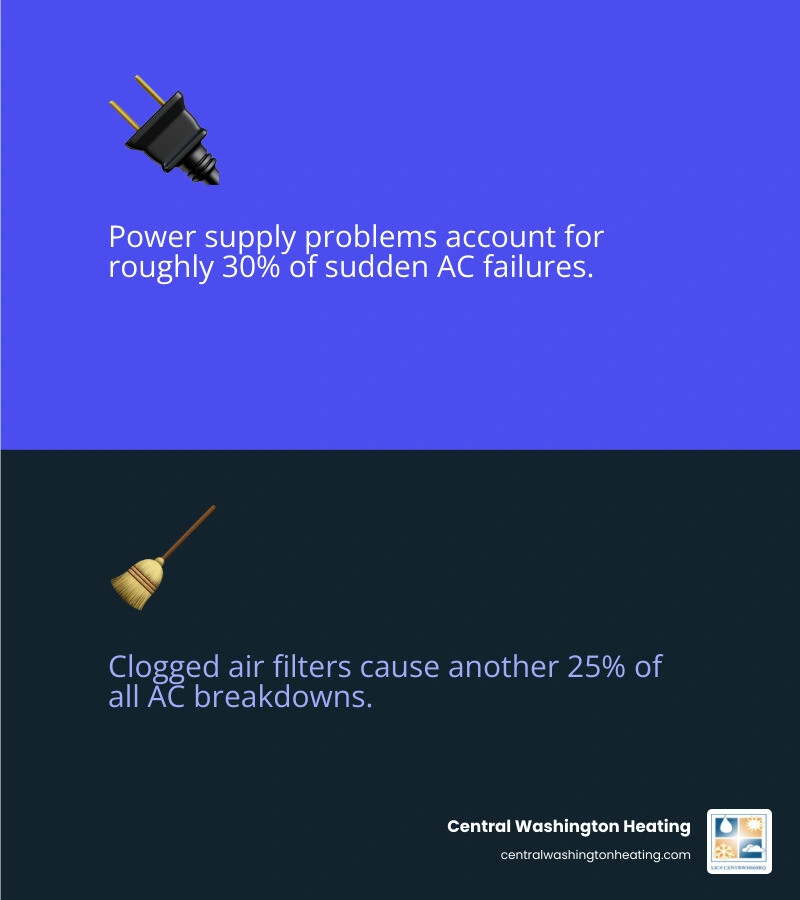
Power supply problems account for roughly 30% of sudden AC failures. Clogged air filters cause another 25%. That means more than half of all breakdowns often trace back to two straightforward checks that take just a few minutes each. Whether your system won’t turn on at all, is blowing warm air, or is running nonstop without cooling your home, a quick and systematic walk-through of the basics can save you time, restore your comfort faster, and help you give a technician better information if a service call does turn out to be necessary.
This guide walks you through every key check — in the right order — so you can troubleshoot confidently and know exactly when it’s time to call in a professional.
Essential AC Troubleshooting Tips Before Calling a Professional
When your home starts feeling more like a sauna than a sanctuary, the natural impulse is to panic. But before you call for a rescue, let’s look at the power supply. It sounds overly simple, but roughly 30% of sudden AC failures are actually just power delivery issues.
In our 30+ years serving the Wenatchee Valley, we’ve seen many “emergencies” that were actually just a tripped switch or a dead battery. By performing a little AC Unit Troubleshooting on your own, you might save yourself the wait time of a service call.

Verify Your Thermostat Settings
The thermostat is the “brain” of your HVAC system. Sometimes, it just needs a little reminder of what its job is.
- Mode Check: Ensure it is firmly set to “Cool.” It’s surprisingly easy for a passerby or a curious child to bump it into “Heat” or “Fan Only” mode.
- The 5-Degree Rule: To test if the system is communicating, lower the set temperature to at least 5 degrees below the current room temperature. This should trigger the “call for cooling.”
- Battery Power: If your thermostat screen is blank or fading, it’s likely time for new batteries. Most modern thermostats use AA or AAA batteries. Even if the screen is on, weak batteries can prevent the thermostat from sending a signal to the outdoor unit.
- Placement Matters: If your thermostat is in direct sunlight or near a heat-producing appliance (like a lamp or TV), it might think the house is much warmer than it actually is, causing the system to run erratically.
If your settings are correct but the system isn’t responding, you might be looking at a calibration issue or a wiring fault that requires AC Thermostat Repair.
Resetting the Circuit Breaker
Your air conditioner is a heavy lifter that draws a lot of electricity. To protect your home, the circuit breaker will “trip” (turn off) if it detects a power surge or an electrical overload.
Central air conditioners typically operate on two separate circuits: one for the indoor air handler and one for the outdoor condenser unit. This is why you might hear the indoor fan blowing even if the outdoor unit isn’t running—and vice versa.
- Locate your electrical panel: Usually found in the garage, basement, or on an exterior wall.
- Identify the AC breakers: Look for switches labeled “AC,” “Condenser,” or “HVAC.”
- The “Full Reset”: A tripped breaker doesn’t always look like it’s off; it might be stuck in the middle. Flip the switch completely to the “OFF” position, wait about 30 seconds, and then flip it firmly back to “ON.”
- Check the Outdoor Disconnect: There is often a secondary “disconnect” box located on the wall near your outdoor unit. Ensure the switch inside is in the “ON” position. We’ve seen these accidentally flipped during yard work or siding repairs.
If the AC Circuit Breaker Keeps Tripping immediately after you reset it, stop. This indicates a serious electrical fault or a failing component that needs professional attention to prevent a fire hazard.
Restoring Airflow and System Efficiency
If your AC is running but you can barely feel air coming out of the vents—or if the air feels lukewarm—you likely have an airflow restriction. Airflow is the lifeblood of your system. Without it, the heat exchange process breaks down, and your system has to work twice as hard to do half the work.
AC Troubleshooting Tips Before Calling a Professional for Dirty Filters
A dirty air filter is the number one cause of AC problems. It’s responsible for roughly 25% of all system failures and is the easiest fix a homeowner can perform.
- The Light Test: Not sure if your filter is “dirty enough” to change? Pull it out and hold it up to a bright light or the sun. If you can’t see light passing through the fibers, the air can’t get through either.
- Replacement Frequency: In the Wenatchee Valley, we recommend checking your filter every month. While standard 1-inch filters might last 90 days in some climates, our local dust and seasonal wildfire smoke can clog them much faster.
- Energy Savings: Replacing a clogged filter can lower your AC’s energy consumption by up to 15%. It’s the most cost-effective way to perform an AC Filter Change and keep your bills low.
- Vent Check: While you’re at it, walk through your home and ensure that furniture, drapes, or rugs aren’t blocking the supply or return vents. This is a common culprit when Fixing Low Airflow from Your AC Vents.
Identifying Frozen Evaporator Coils
It sounds counterintuitive, but your air conditioner can actually freeze up in the middle of a 90-degree July day. When airflow is restricted (usually by a dirty filter or blocked vents), the refrigerant in the indoor evaporator coil gets too cold, causing the condensation on the coil to turn into ice.
Signs of a frozen coil:
- Visible frost or ice on the copper refrigerant lines.
- Ice forming on the indoor cabinet.
- The system is running, but very little air is coming out of the vents.
- Water pooling on the floor around the indoor unit.
If you suspect AC Freezing Up, you must act quickly to prevent damage to the compressor. Turn the system to “OFF” at the thermostat, but switch the Fan setting to “ON.” This keeps the indoor fan running without the cooling cycle, moving warm air over the coils to melt the ice. This process usually takes 2 to 4 hours. Once the ice is gone, check your filter—it’s usually the reason Why is there Ice Forming on AC Unit in the first place.
Inspecting the Outdoor Condenser and Drainage
The outdoor unit (the condenser) is responsible for releasing the heat collected from inside your home. If it’s dirty or crowded, that heat has nowhere to go, and your home stays warm.
Cleaning the Outdoor Unit
Nature has a way of creeping up on your AC. Overgrown grass, weeds, and fallen leaves can “choke” the unit.
- Clear the Perimeter: Maintain at least 2 to 3 feet of clear space on all sides of the unit. Trim back any bushes or flowers that have grown too close.
- Vertical Clearance: Ensure there is at least 5 feet of open space above the unit. Heat rises out of the top; if it’s blocked by a low-hanging branch or an awning, the unit will recycle its own hot air and overheat.
- Gentle Cleaning: If the metal fins on the outside of the unit are covered in dirt or cottonwood fluff, you can gently rinse them with a garden hose. Never use a pressure washer, as the high-pressure stream will bend the delicate aluminum fins and permanently damage the unit.
Proper maintenance here can prevent AC Condenser Fan Motor Failure Signs Solutions from becoming a reality.
Clearing the Condensate Drain Line
As your AC cools the air, it also removes moisture (humidity). This water collects in a drain pan and flows out of your house through a PVC pipe called the condensate drain line.
Over time, algae and sludge can build up in this line, causing a clog. Most modern systems in Central Washington have a “float switch” that detects when the drain pan is filling up. To prevent water damage to your home, this switch will automatically cut power to the AC.
If you see standing water in the drain pan or near your indoor unit, you likely have a clog. You can often clear minor blockages by using a wet/dry vacuum to suck the debris out from the exterior end of the pipe. Flushing the line with a cup of white vinegar once a month during the summer can prevent these clogs from forming. If the line is clear but you’re still getting water, you might be wondering Why is AC Blowing Warm Air; often, a clogged drain is the hidden culprit behind a system shutdown.
Recognizing Serious Mechanical Failures
While many issues are DIY-friendly, some problems require the specialized tools and training of a licensed technician. Attempting to fix complex electrical components or refrigerant lines yourself can be dangerous and may void your warranty.
| Homeowner Check | Professional Repair Required |
|---|---|
| Replacing dead thermostat batteries | Repairing or replacing faulty thermostat wiring |
| Swapping a dirty air filter | Replacing a failed blower motor or fan belt |
| Resetting a tripped circuit breaker | Replacing a burnt-out capacitor or contactor |
| Cleaning debris from around the outdoor unit | Recharging refrigerant or fixing a leak |
| Thawing a frozen evaporator coil | Diagnosing why the coil froze (e.g., low refrigerant) |
If you’ve gone through the basic checklist and your AC is still making Strange Noises or you’re following an AC Hot Air Troubleshooting Guide with no luck, it’s time to call in the experts.
AC Troubleshooting Tips Before Calling a Professional for Emergencies
Safety should always be your top priority. If you encounter any of the following, shut your system off immediately and call for emergency service:
- Burning Smells: An odor of burning plastic or electrical ozone usually indicates melting wire insulation or a failing motor.
- Loud Mechanical Noises: Squealing, grinding, or metal-on-metal banging sounds mean something has broken loose or a bearing has failed.
- Hissing or Bubbling: This often indicates a refrigerant leak. Refrigerant is a high-pressure chemical that requires EPA certification to handle.
- Frequent Short Cycling: If your AC turns on and off every few minutes, it’s putting massive strain on the compressor.
- Sparks or Smoke: Any visible smoke or sparks from the indoor or outdoor unit is a What Qualifies as AC Emergency situation.
Frequently Asked Questions
Why is my AC running but not cooling the house?
This is one of the most common calls we get. If the system is running but the temperature isn’t dropping, it’s usually due to a lack of airflow (dirty filter), a dirty outdoor condenser, or low refrigerant. Check your filter first! If the filter is clean and the outdoor unit is clear, you likely have a refrigerant leak. Since refrigerant is a closed-loop system, “low” levels always mean there is a leak that needs to be sealed. A system that is Constantly Running But Not Cooling will eventually burn out its compressor if the root cause isn’t fixed.
How often should I replace my air filter in Central Washington?
While the standard advice is every 3 months, residents in Wenatchee, East Wenatchee, and Leavenworth should check theirs every 30 days during the summer. Our region deals with high pollen counts in the spring and wildfire smoke in the late summer, both of which can clog a filter in a matter of weeks. A clogged filter restricts airflow, spikes your energy bills, and is the leading cause of frozen coils.
What are the signs that my AC is about to fail?
Most systems don’t just die—they give you warning signs first. Look out for rising energy bills without a change in usage, unusual odors, increased humidity levels inside the home, or a system that struggles to keep up on days that aren’t even that hot. Learning the Signs AC is About to Break Down can help you schedule a replacement on your own terms rather than waiting for a total failure in the middle of a heatwave.
Trust the Wenatchee Valley Cooling Experts
At Central Washington Heating, we’ve spent over 30 years keeping families comfortable from Chelan to Malaga and everywhere in between. As a family- and veteran-owned business, we believe in honest service—which is why we want you to know these ac troubleshooting tips before calling a professional.
If you’ve tried the basics and your home is still too warm, don’t sweat it. Our licensed technicians are available 24/7 for emergency repairs, and we specialize in creating quiet, high-efficiency systems tailored to the unique climate of the Wenatchee Valley. Whether you need a quick diagnostic check or a full system replacement, we’re here to ensure your long-term comfort with quality craftsmanship.
Not sure if you need a pro? Check out our Signs Your AC Needs Repair Guide or use our interactive HVAC Troubleshooter. If you’re Troubleshooting AC Problems in Leavenworth or anywhere in our service area, we’re just a phone call away.
Ready to get your cool back? Request Service Today.

Written by the Central Washington Heating and Air team
The techs and comfort advisors who've kept the Wenatchee Valley heated, cooled, and breathing easy for 30+ years — family & veteran owned, with 40+ years of combined industry experience.
- Licensed & insured · LIC# CENTRWH742JN
- Daikin Comfort Pro certified
- Wenatchee, WA
Last updated July 3, 2026
Ready for comfort you can count on?
Schedule service, request a free estimate, or call now for 24/7 emergency help. Our team is standing by across the Wenatchee Valley.
Get started today
Free estimates on installs · no-pressure, written quotes
Schedule My ServiceCall (509) 776-0247Mon–Fri: 8:00 AM – 4:30 PM · 24/7 for emergencies
Already have a quote? Get a free second opinion →