
How Wenatchee Valley Dry Heat Affects Your AC: Top Risks
Wenatchee Valley's HVAC authority for over 30 years. Expert AC, electric air handler, heat pump, and mini-split installation, repair, and maintenance. Family & veteran owned. 24/7 emergency service.
Why Dry Heat in the Wenatchee Valley Is Tougher on Your AC Than You Think
Understanding how Wenatchee Valley dry heat affects your AC system is the first step to keeping your home cool all summer long. East of the Cascades, Wenatchee sits in a high-desert valley where summer temperatures regularly climb past 100°F — with almost no humidity to moderate the heat. That combination puts a level of strain on residential AC systems that most homeowners don’t see coming until something breaks down.
Quick answer — here’s how Wenatchee Valley dry heat affects your AC system:
- Compressor overwork — Your AC’s compressor runs harder and longer to overcome extreme outdoor temperatures, wearing out faster than in milder climates.
- Reduced efficiency — AC units lose cooling capacity when outdoor temps exceed their rated design range, which happens frequently in Wenatchee summers.
- Dust and debris buildup — Low humidity means fine dust circulates freely, clogging coils, filters, and motors far more quickly than in humid regions.
- Refrigerant stress — High ambient heat causes refrigerant pressure to spike, putting extra strain on seals, lines, and the compressor.
- Shorter system lifespan — The combination of heat stress and dust accumulation accelerates wear on every major component.
- Higher energy bills — Your system runs longer cycles just to maintain your set temperature, driving up electricity use through the hottest months.
Unlike the west side of the Cascades — where coastal moisture helps moderate peak temperatures — Wenatchee’s dry, inland heat creates a relentless thermal load that your AC fights against from June through September. Strong high-pressure systems that settle over the inland Pacific Northwest regularly push valley temperatures into the triple digits, and with relative humidity often dropping below 20%, there’s little natural relief.
The result? AC systems in this region work harder, wear faster, and need more consistent care than units in cooler or more humid parts of the country. Knowing what’s happening inside your system during a Wenatchee heat wave helps you stay ahead of breakdowns before they happen.
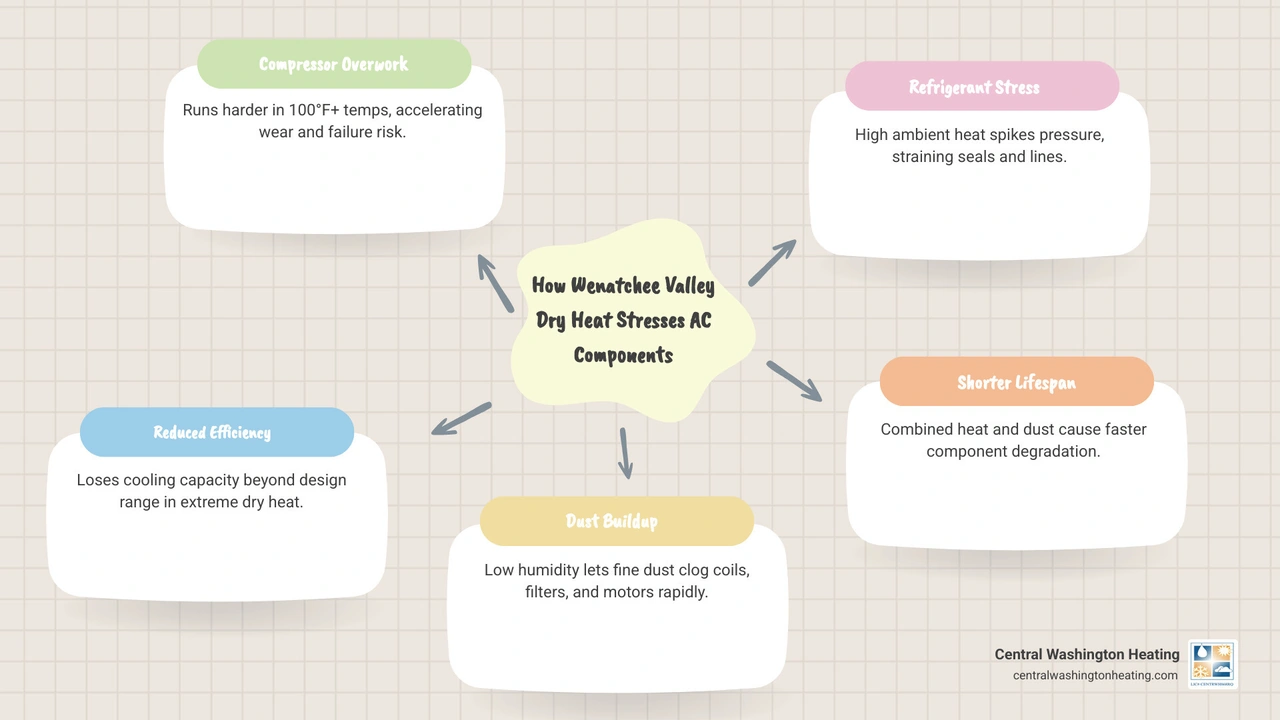
How Wenatchee Valley dry heat affects your AC system
As we move through May 2026, we are already seeing the familiar high-pressure systems building over the interior of the Pacific Northwest. In the Wenatchee Valley, “dry heat” isn’t just a phrase used to make 100 degrees sound better; it’s a specific atmospheric condition that fundamentally changes how your air conditioner operates.
In humid climates, an AC unit spends a significant amount of its energy removing moisture (latent heat) from the air. In our arid valley, your AC doesn’t have to worry much about dehumidification. Instead, it deals almost entirely with “sensible heat”—the actual temperature of the air. While this might sound easier, the extreme temperature differentials in places like East Wenatchee or Malaga mean your system is under constant thermal load.
When the outdoor air is 105°F and you want your living room at 72°F, that 33-degree gap is a massive hurdle. Most AC units are designed to operate most efficiently when the “delta” (the difference between indoor and outdoor temps) is smaller. When the valley bakes, your unit has to run nearly continuous cycles to keep up. This is why we emphasize Spring AC and HVAC maintenance for the Wenatchee Valley to ensure the system is primed for this marathon.
Why dry heat is harder on AC components
The internal physics of your AC system change when the mercury rises in a dry climate. One of the primary ways how Wenatchee Valley dry heat affects your AC system is through refrigerant expansion. Refrigerant is responsible for absorbing heat from inside your home and releasing it outside. As outdoor temperatures soar, the refrigerant gas in your outdoor condenser unit becomes much harder to cool down.
This creates a “backpressure” effect. Your compressor—the heart of the system—has to work significantly harder to pump that high-pressure refrigerant. Think of it like trying to ride a bike uphill in high gear; eventually, the chain is going to snap or your legs are going to give out. In an HVAC system, this leads to overheating motors and fried capacitors.
Furthermore, heat transfer is less efficient when the air is bone-dry and scorching. If your outdoor coils are even slightly dirty, the system loses the ability to shed heat into the atmosphere. This is why AC coil cleaning is perhaps the most critical service for valley residents. A clean coil allows for maximum heat exchange, protecting the compressor from a heat-induced heart attack.
Impact on energy consumption and utility bills
If you’ve lived in Wenatchee, Leavenworth, or Cashmere for a full summer, you know the “August bill shock.” Because the dry air doesn’t hold onto coolness well, your home gains heat rapidly through windows and walls. Your AC reacts by “short cycling” or, more commonly, running for hours without a break.
Every extra minute that compressor runs, your meter is spinning. Efficiency loss is a major factor here. As the outdoor temperature climbs above 95°F, the SEER (Seasonal Energy Efficiency Ratio) of your unit actually drops. A unit that is rated for high efficiency at 82°F might perform significantly worse when it’s 102°F in the shade in Orondo. If you notice your bills are spiking more than usual, it might be time for some AC unit troubleshooting to see if a failing component is dragging down your efficiency.
The hidden toll of low humidity on your cooling equipment
While the heat is the obvious enemy, the “dry” part of dry heat brings its own set of problems—primarily dust. In our region, low humidity means the soil is fine and easily airborne. Whether it’s dust from nearby orchards or the general arid landscape of Central Washington, that grit finds its way into your AC system.
How Wenatchee Valley dry heat affects your AC system lifespan
In more humid areas, moisture can actually help “wash” some particles away or keep them heavy and on the ground. In Wenatchee, dust acts like sandpaper. It gets into the bearings of the fan motors, dries out factory-sealed lubricants, and coats the sensitive electronics.
The most immediate victim is often the air filter. In a dry, dusty summer, a standard filter can become “impacted” (completely blocked) in half the time it would take in a wetter climate. When the filter is clogged, the system chokes. This leads to premature component wear and, eventually, total system burnout. We often see units in the valley fail at the 10 or 12-year mark, whereas the same model might last 18 years in a milder climate. Following a Signs your AC needs repair guide can help you catch these dust-related issues before they turn into a “no-cool” emergency.
Regularly performing an AC filter change is the simplest way to extend your system’s life against the desert-like conditions of the valley.
Unique signs of dry heat overload to watch for
How do you know if the Wenatchee summer is winning the battle against your AC? There are a few “tells” specific to our climate:
- The “Never-Ending” Cycle: If your AC starts at 10:00 AM and doesn’t shut off until 11:00 PM, it’s struggling with the thermal load.
- Whining or Grinding Noises: This often indicates that dry heat and dust have compromised the lubrication in your fan motors.
- The “Luke-Warm” Breeze: If the air coming from your vents feels cool but not cold, your refrigerant may be struggling to shed heat at the condenser due to extreme outdoor ambient temperatures.
- Static Shocks: Extremely dry indoor air can lead to static buildup, which occasionally interferes with sensitive smart thermostat sensors.
Consistent Spring AC and HVAC maintenance allows us to check these specific pressure and lubrication points before the first 90-degree day hits.
Choosing the right system for Central Washington’s climate
Not all AC systems are created equal when it comes to fighting how Wenatchee Valley dry heat affects your AC system. If you are looking to install a new system in Chelan or Entiat, you need equipment that thrives in high-ambient-temperature environments.
| Feature | Standard Central AC | Modern Heat Pump | Ductless Mini-Split |
|---|---|---|---|
| Dry Heat Performance | Good, but works hard | Excellent (Variable Speed) | Superior (Zone Control) |
| Energy Efficiency | Standard | High | Very High |
| Wenatchee Suitability | High | Very High | Excellent for older homes |
| Longevity in Arid Climates | Average | Above Average | Above Average |
We often recommend heat pumps for our customers because they are incredibly efficient at moving heat, and modern units are designed to handle the wide temperature swings we see in the valley. If you’re wondering which is best for your specific property, check out our guide on how to choose the right AC for Central Washington.
How Wenatchee Valley dry heat affects your AC system sizing requirements
One of the biggest mistakes we see in the Wenatchee Valley is “rule of thumb” sizing. A technician might look at your square footage and say, “You need a 3-ton unit.” However, that doesn’t account for the intense solar gain on a 105-degree day in Waterville.
Proper sizing requires a Manual J Load Calculation. This looks at your insulation, the direction your windows face, and—most importantly—the local climate design grains. In our area, we have to size systems to handle higher-than-average peak temperatures. If the unit is too small, it will never reach the set point. If it’s too large, it will “short cycle,” which doesn’t allow it to properly circulate air. To get it just right, read more on how to pick the right size AC for valley heat.
Future technologies for arid climate cooling
As we look toward the future of cooling in Central Washington, several technologies are helping us beat the heat:
- Variable-Speed Compressors: Unlike traditional “on/off” systems, these can run at 20% or 50% capacity. This is perfect for Wenatchee, where it might be 80°F in the morning but 105°F by afternoon. It allows the system to “cruise” efficiently.
- Smart Thermostats: These can be programmed to “pre-cool” your home in the early morning hours when the valley air is still crisp, reducing the load on the system during the peak afternoon heat.
- Customized Ductwork: We specialize in custom ductwork that is sealed and insulated to ensure that the cold air your system works so hard to produce actually makes it to your bedroom without warming up in the attic.
Frequently Asked Questions about Dry Heat Cooling
Why is my AC freezing up in such dry weather?
It seems like a total paradox. How can an AC unit turn into a block of ice when it’s 100 degrees outside with 15% humidity?
The answer is usually airflow. When how Wenatchee Valley dry heat affects your AC system involves heavy dust buildup, your indoor evaporator coil gets coated in grime. This prevents the refrigerant from absorbing heat from your indoor air. The refrigerant stays too cold, the condensation on the coil freezes, and suddenly you have an AC freezing up. If you see ice, turn the system off immediately and call us. You can learn more about why is there ice forming on AC unit to prevent a frozen compressor.
How often should I change my filter during a Wenatchee summer?
In a standard climate, every 90 days is fine. In the Wenatchee Valley? We recommend checking it every 30 days during July and August. Between the dust storms and the occasional wildfire smoke that drifts through the valley, your filter is your system’s first line of defense. A clean filter ensures your blower motor doesn’t burn out prematurely. This is why you need a good air filter—it’s not just for your lungs; it’s for your HVAC’s “lungs” too.
What maintenance is needed for electric heating and cooling systems?
Since we focus on electric heating and cooling solutions in the valley, maintenance is straightforward but vital. For those with electric air handlers or heat pumps, you need to ensure the electrical connections are tight and the heat strips are clear of dust.
Dry heat can make wire casings brittle over many years. During a maintenance visit, we check for any signs of electrical fatigue. Whether you need the best air handler maintenance tips Wenatchee WA or general air handler maintenance tips Wenatchee WA, the goal is the same: ensuring your year-round comfort system is ready for the transition from the scorching summer to our crisp valley winters.
Conclusion: Staying Cool with Central Washington Heating
Living in the Wenatchee Valley means enjoying some of the most beautiful summers in the Pacific Northwest, but it also means respecting the power of our dry heat. At Central Washington Heating, we’ve spent over 30 years helping our neighbors in Cashmere, Leavenworth, and beyond navigate the unique challenges of our high-desert climate.
As a veteran-owned, family-operated business, we take pride in our “quality over quantity” approach. We know exactly how Wenatchee Valley dry heat affects your AC system, and we have the tools and licensed technicians to keep your home a sanctuary of cool air. Whether you need a midnight emergency repair or a custom-ducted high-efficiency installation, we are here for you 24/7.
Don’t let the valley heat catch you off guard this summer. From the banks of the Columbia River to the foothills of the Cascades, we’ve got your back.
Ready to protect your home from the dry heat? Request Service Today.

Written by the Central Washington Heating and Air team
The techs and comfort advisors who've kept the Wenatchee Valley heated, cooled, and breathing easy for 30+ years — family & veteran owned, with 40+ years of combined industry experience.
- Licensed & insured · LIC# CENTRWH742JN
- Daikin Comfort Pro certified
- Wenatchee, WA
Last updated July 7, 2026
Ready for comfort you can count on?
Schedule service, request a free estimate, or call now for 24/7 emergency help. Our team is standing by across the Wenatchee Valley.
Get started today
Free estimates on installs · no-pressure, written quotes
Schedule My ServiceCall (509) 776-0247Mon–Fri: 8:00 AM – 4:30 PM · 24/7 for emergencies
Already have a quote? Get a free second opinion →