
How to Prepare for the Shift to Low GWP Refrigerants in 2026
Wenatchee Valley's HVAC authority for over 30 years. Expert AC, electric air handler, heat pump, and mini-split installation, repair, and maintenance. Family & veteran owned. 24/7 emergency service.
Why Knowing How to Prepare for the Shift to Low GWP Refrigerants Matters for Wenatchee Valley Homeowners
How to prepare for the shift to low GWP refrigerants starts with a few clear steps: audit your current system, identify your refrigerant type, understand the 2025 EPA mandate, and plan your upgrade timeline before supply and service costs rise further.
Here is a quick overview of what preparation looks like:
- Check your system’s refrigerant type – Look at the outdoor condenser data plate to confirm whether your system uses R-22 or R-410A.
- Know your equipment age – Systems over 10 years old using high-GWP refrigerants are the highest priority for replacement planning.
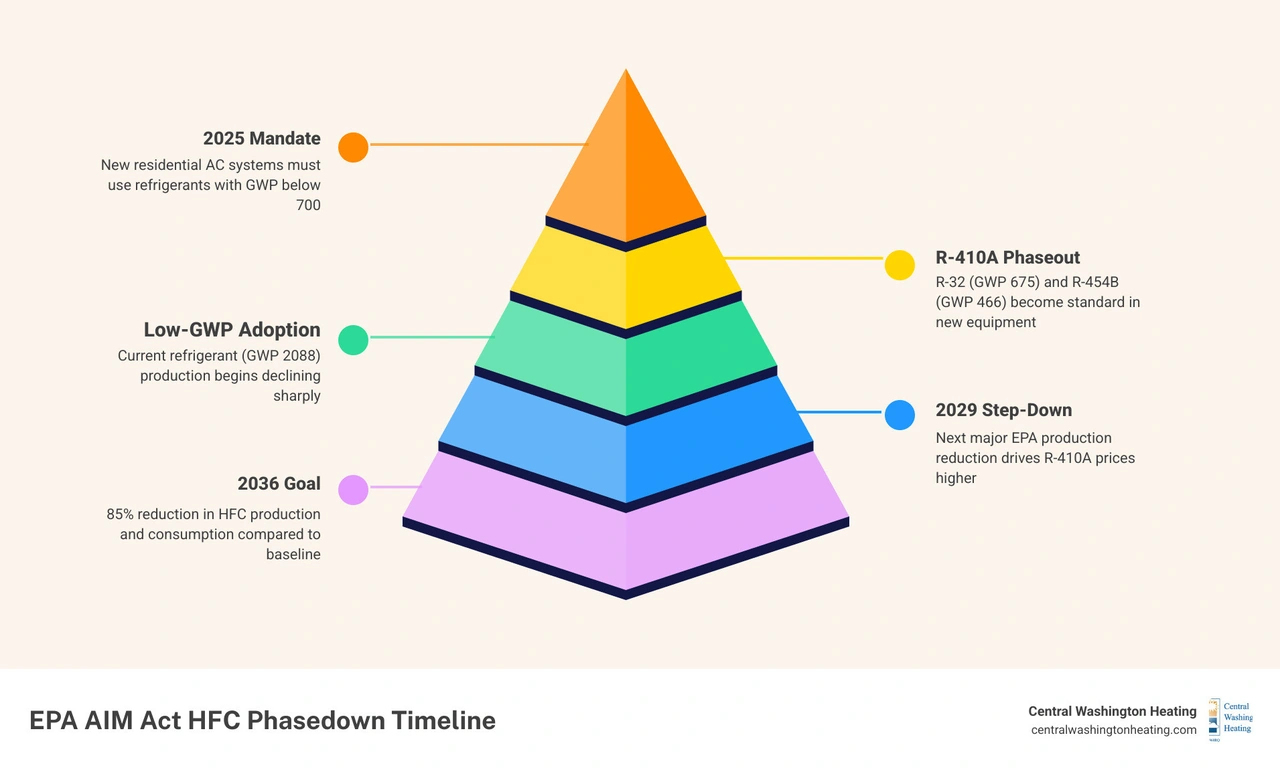
- Understand the 2025 rule – As of January 1, 2025, newly manufactured residential AC systems must use refrigerants with a GWP below 700.
- Learn your options – R-32 (GWP 675) and R-454B (GWP 466) are the primary low-GWP replacements for R-410A (GWP 2,088) in new residential equipment.
- Act before costs climb – R-410A bulk prices have risen sharply, and the next major EPA production step-down arrives in 2029, which will push prices higher.
- Schedule a professional assessment – A licensed HVAC technician can evaluate your system’s condition, remaining useful life, and best upgrade path.
If you own a home in the Wenatchee Valley, this transition is already underway. The U.S. Environmental Protection Agency’s AIM Act is systematically phasing down the production of high-GWP refrigerants like R-410A, the refrigerant found in most residential AC systems installed over the past two decades. The goal is an 85% reduction in HFC production and consumption by 2036 compared to baseline levels.
What does that mean in plain terms? The refrigerant keeping your home cool right now may become harder and more expensive to service with each passing year. Residential heat pumps are estimated to lose roughly 5% of their total refrigerant charge annually on average, which can add up to nearly 150% of the total charge over the lifetime of a system if leaks go unaddressed. With R-410A supply tightening, those service calls are only going to cost more.
The good news is that preparing now, before urgency sets in, puts you firmly in control of your timeline and your budget.
Glossary for how to prepare for the shift to low gwp refrigerants:
Understanding the EPA AIM Act and the 2025 Transition
The transition away from high Global Warming Potential (GWP) hydrofluorocarbons (HFCs) is driven by the American Innovation and Manufacturing (AIM) Act. Enacted by Congress, this federal law directs the EPA to phase down HFC production and consumption by 85% by the year 2036.
To achieve this ambitious target, the EPA established specific “technology transitions.” The most notable milestone for homeowners passed on January 1, 2025. As of this date, all newly manufactured residential and light commercial air conditioning and heat pump systems are required to use refrigerants with a GWP below 700.
For comparison, R-410A—the standard refrigerant for the past twenty years—has a massive GWP of 2,088. This means releasing one pound of R-410A into the atmosphere has the same warming impact as more than two thousand pounds of carbon dioxide. The new low-GWP alternatives, such as R-32 (GWP of 675) and R-454B (GWP of 466), cut this environmental footprint by 68% to 78%.
To learn more about how these regulatory milestones impact your household systems, take a look at our guide on how ac refrigerant changes affect homeowners.
What About Equipment Already in Stock?
The EPA built “sell-through” provisions into the regulations. These provisions allow distributors and contractors to sell and install pre-existing inventory manufactured before the January 1, 2025 deadline for a limited transition period. This ensures that existing equipment stock is not wasted. However, as of mid-2026, those legacy R-410A inventories are rapidly dwindling, and manufacturers have entirely shifted their production lines to low-GWP compatible systems.
The Local Impact on the Wenatchee Valley
In our local climate, our HVAC systems work incredibly hard. From scorching summer days in East Wenatchee, Chelan, and Entiat that push past 90°F, to freezing winter nights in Leavenworth, Cashmere, and Waterville, we rely heavily on our heat pumps and air conditioners. Because our local weather demands high-performing systems year-round, keeping an aging, leak-prone system running on a phased-out refrigerant is a risky financial gamble. As regional supplies of R-410A continue to tighten, proactive planning is the best way to safeguard your home comfort.
How to Prepare for the Shift to Low GWP Refrigerants: A Homeowner’s Action Plan
Waiting for your air conditioner or heat pump to break down in the middle of a July heatwave is never a good strategy. When a system fails during peak season, you are often forced to make a rushed decision based on whatever equipment is immediately available. By taking a proactive approach to planning, you can research your options, maximize your energy efficiency, and take advantage of valuable local incentives.
When looking at a system replacement, it is also the perfect time to optimize your system’s overall performance. Modern low-GWP systems are engineered to meet strict newer standards. Understanding what SEER2 rating to look for in a new AC will help you choose a system that dramatically lowers your monthly utility bills.
Additionally, upgrading to a modern, eco-friendly heat pump or high-efficiency electric heating system makes you eligible for substantial savings. By exploring heat pump incentive programs, Wenatchee Valley homeowners can offset a significant portion of their upgrade costs through regional utility rebates.
Step 1: Audit Your Current System and Know How to Prepare for the Shift to Low GWP Refrigerants
The first step in your preparation plan is to perform a basic audit of your existing home comfort equipment. You do not need to be an HVAC expert to gather this essential information:
- Locate the outdoor unit: Head outside to your air conditioner or heat pump condenser.
- Find the data plate: Look for a metal manufacturer’s plate or sticker on the side of the cabinet.
- Identify the refrigerant type: Look for the specific chemical designation. In most homes, this will be either R-22 (an older, fully phased-out HCFC) or R-410A (the HFC phased out for new builds in 2025). Learn more about these working fluids in our Glossary: Refrigerant.
- Note the manufacture date: The data plate will list the month and year the unit was built. If your system is more than 10 to 12 years old, it is approaching the end of its typical operational lifespan.
Understanding the remaining useful life of your system’s core components is critical. For instance, if your older R-410A system suffers a major failure in its Glossary: Compressor, investing in a costly repair and recharging it with expensive refrigerant may not be the wisest financial decision in 2026. Knowing these details ahead of time allows you to budget for a planned upgrade rather than facing an emergency replacement.
Step 2: Plan Your Upgrade and Learn How to Prepare for the Shift to Low GWP Refrigerants
Once you know what is currently running in your backyard, you can map out a transition timeline. If your system is relatively new (installed within the last five to eight years) and runs without issues, there is no need to panic. Your system can continue to run on R-410A, and we can maintain and service it using reclaimed refrigerant for years to come.
However, if your system is showing signs of aging, experiencing frequent leaks, or driving up your energy bills, planning an upgrade is the smart move. When planning your new system, look for modern electric heating systems, variable-capacity heat pumps, or multi-zone mini-split systems. These advanced systems utilize low-GWP refrigerants and offer exceptional seasonal efficiency ratings. To understand how efficiency is measured, refer to our Glossary: SEER guide.
To ensure your new high-efficiency system delivers the quietest and most reliable performance possible, we specialize in customized ductwork. Properly sized and sealed ducts prevent airflow restrictions, eliminate hot and cold spots in your home, and ensure your new low-GWP system operates at peak thermodynamic efficiency.
Comparing Legacy HFCs and New Low-GWP Refrigerants (R-410A vs. R-454B and R-32)
The transition to low-GWP alternatives represents a major technological leap forward. The industry has primarily settled on two main options to replace R-410A in residential applications: R-32 and R-454B.
To help visualize how these gases compare, let’s look at the key differences:
| Refrigerant Type | Global Warming Potential (GWP) | Safety Classification | Relative Charge Size | Primary Use Case |
|---|---|---|---|---|
| R-22 (Legacy HCFC) | 1,810 | A1 (Non-Flammable, Low Toxicity) | 100% | Older systems (completely phased out) |
| R-410A (Legacy HFC) | 2,088 | A1 (Non-Flammable, Low Toxicity) | 100% | Standard residential systems (pre-2025) |
| R-32 (Low-GWP HFC) | 675 | A2L (Mildly Flammable, Low Toxicity) | ~70% (Uses up to 30% less charge) | Modern split systems & mini-splits |
| R-454B (Low-GWP HFC Blend) | 466 | A2L (Mildly Flammable, Low Toxicity) | ~90% | Modern heat pumps & central AC systems |
For a deep dive into how these two primary replacements stack up against each other, check out our detailed comparison of R410A vs R454B Refrigerant: What You Need to Know.
Understanding the A2L Safety Classification
You might notice that both R-32 and R-454B carry an A2L safety classification. The “A” stands for low toxicity, which is the same as legacy R-410A. The “2L” indicates that these gases are mildly flammable.
While the word “flammable” can sound intimidating, A2L refrigerants are incredibly difficult to ignite. They have a very low burning velocity (less than 10 centimeters per second) and require an exceptionally high-energy electric heat startup source—such as an open flame—coupled with highly concentrated, stagnant conditions to ignite. They do not explode or catch fire easily like electric auxiliary heat (which is an A3 highly flammable refrigerant).
To meet strict safety standards, manufacturers build advanced mitigation controls directly into modern A2L HVAC units. These systems include integrated leak sensors that automatically shut down the system’s compressor and activate the indoor blower fan to safely disperse the gas if a leak is detected.
The Benefit of Charge Weight Reduction
Another major advantage of these new refrigerants is their chemical efficiency. For example, R-32 can use up to 30% less Glossary: Charge weight compared to R-410A to achieve the exact same amount of cooling. Using a smaller volume of refrigerant not only reduces the environmental impact if a leak occurs, but it also allows the system’s compressor to run more efficiently, translating directly into lower electricity bills for your home.
Frequently Asked Questions About the Refrigerant Transition
Can I use R-32 or R-454B in my existing R-410A system?
No. You cannot use low-GWP A2L refrigerants in an older system designed for R-410A. These gases operate under different pressures, require entirely different compressor lubricants, and have different expansion valve calibrations.
Additionally, older R-410A systems do not have the mandatory safety mitigation controls, spark-proof electrical components, or integrated leak sensors required to safely handle mildly flammable A2L gases. Attempting to cross-contaminate or “drop-in” an A2L gas into a legacy system will void your manufacturer warranty, ruin your compressor, and create serious safety hazards.
Are low-GWP A2L refrigerants safe for residential use?
Yes, they are exceptionally safe. Before these refrigerants were approved for residential use, they underwent years of rigorous testing by international safety organizations, including ASHRAE and Underwriters Laboratories (UL).
Because A2Ls have a high lower flammability limit (LFL), a massive amount of refrigerant would have to leak into a very confined space all at once to even reach a concentration capable of burning. When you combine this natural resistance to electric heat startup with the mandatory safety sensors and robust cabinet designs built into modern heat pumps and air conditioners, the risk of an accidental fire is incredibly low.
What happens if my current R-410A system leaks?
If your existing R-410A system develops a leak, it can still be legally repaired and recharged. However, you should expect the cost of these repairs to rise over time. Because the EPA is rapidly choking down the production of virgin R-410A, the supply of this gas is shrinking, which naturally drives up market prices.
If your system is losing refrigerant, we highly recommend reading our AC Refrigerant Leak Complete Guide to understand your repair options. If you are dealing with a heat pump specifically, our guide on how to resolve heat pump refrigerant leak issues outlines the step-by-step process we use to locate, seal, and test your system to prevent expensive refrigerant loss.
Over time, as R-410A becomes scarcer and more expensive, investing in a modern, leak-resistant low-GWP system becomes the most reliable and cost-effective path forward.
Conclusion
The transition to low-GWP refrigerants represents a positive step forward for both our local environment and your home’s energy efficiency. While regulatory shifts can feel overwhelming, preparing for them does not have to be complicated. By auditing your current system, keeping an eye on leak issues, and planning your next upgrade around modern, efficient heat pumps or electric heating systems, you can stay ahead of the transition and enjoy uninterrupted home comfort.
At Central Washington Heating, we bring more than 30 years of trusted HVAC expertise to homeowners across the Wenatchee Valley. As a family- and veteran-owned business, we pride ourselves on providing dependable, honest service to our neighbors in Wenatchee, East Wenatchee, Leavenworth, Cashmere, Chelan, Entiat, Dryden, Malaga, Monitor, Orondo, Peshastin, and Waterville.
Whether you need a routine maintenance tune-up to protect your current Glossary: Refrigerant charge, an emergency repair via our 24/7 service, or a professional consultation on a high-efficiency system upgrade, our licensed technicians are always here to help.
Ready to prepare your home for a cooler, more efficient future? Request Service Today to schedule your professional system assessment!

Written by the Central Washington Heating and Air team
The techs and comfort advisors who've kept the Wenatchee Valley heated, cooled, and breathing easy for 30+ years — family & veteran owned, with 40+ years of combined industry experience.
- Licensed & insured · LIC# CENTRWH742JN
- Daikin Comfort Pro certified
- Wenatchee, WA
Last updated July 7, 2026
Ready for comfort you can count on?
Schedule service, request a free estimate, or call now for 24/7 emergency help. Our team is standing by across the Wenatchee Valley.
Get started today
Free estimates on installs · no-pressure, written quotes
Schedule My ServiceCall (509) 776-0247Mon–Fri: 8:00 AM – 4:30 PM · 24/7 for emergencies
Already have a quote? Get a free second opinion →