
R410A Vs R454B Refrigerant What You Need To Know - R410A vs R454B Refrigerant: A Quick Start Guide
Wenatchee Valley's HVAC authority for over 30 years. Expert AC, electric air handler, heat pump, and mini-split installation, repair, and maintenance. Family & veteran owned. 24/7 emergency service.
What You Need to Know About R410A vs R454B Refrigerant Right Now
If you’re a homeowner in Central Washington trying to understand r410a vs r454b refrigerant what you need to know before buying or servicing an HVAC system, here’s the short version:
| Feature | R-410A | R-454B |
|---|---|---|
| Status | Being phased out | New standard (as of 2025) |
| Global Warming Potential (GWP) | 2,088 | 466 (78% lower) |
| Flammability Class | A1 (non-flammable) | A2L (mildly flammable) |
| Drop-in Replacement? | No | No |
| Energy Efficiency | Baseline | ~3-5% better COP |
| New Equipment Available? | No (banned after Jan 1, 2025) | Yes |
| Existing Systems Serviceable? | Yes | Yes |
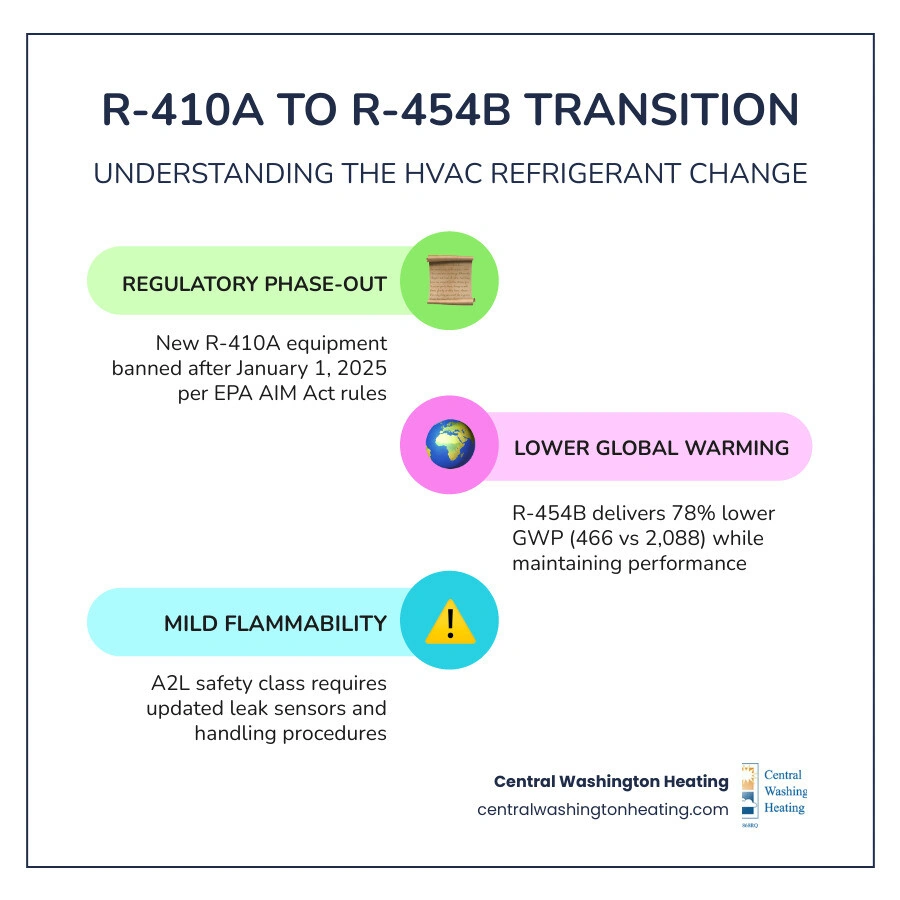
The HVAC world has been through a major shift. As of January 1, 2025, manufacturers can no longer produce new residential and light commercial HVAC equipment using R-410A. Every new system installed in the Wenatchee Valley — and across the country — now uses a lower-GWP refrigerant like R-454B instead.
That means if you’re shopping for a new air conditioner or heat pump, you’re getting an R-454B system whether you’ve heard of it or not. And if you already own an R-410A system, you have questions — like how long you can keep it running, whether it can be converted, and what this all means for your home comfort.
This guide breaks it all down in plain language, so you can make a confident decision about your home’s comfort in Wenatchee, East Wenatchee, Leavenworth, or anywhere across Central Washington.
Why the HVAC Industry is Transitioning to R-454B
The transition away from R-410A isn’t a random decision made by equipment manufacturers. It is a direct response to federal environmental regulations aimed at reducing greenhouse gas emissions.
Under the Environmental Protection Agency’s (EPA) AIM Act, the United States is phasing down the production and import of high-Global Warming Potential (GWP) hydrofluorocarbons (HFCs) by 85% over a 15-year period. In the HVAC industry, the primary target of this phasedown is R-410A.
As we navigate the regulatory landscape of June 2026, the manufacture and import of R-410A systems have been prohibited for over a year (since January 1, 2025), and the deadline to install pre-existing stock of R-410A systems passed on December 31, 2025. Today, any new central air conditioner or heat pump installed in our region must utilize a next-generation Refrigerant with a GWP of 700 or less.
R-454B has emerged as the clear industry-preferred successor for most major ducted residential HVAC brands. By transitioning to R-454B, the industry achieves a massive reduction in direct environmental impact while continuing to provide dependable, high-performance home cooling.
R410A vs R454B Refrigerant: What You Need to Know
To truly understand the transition, it helps to compare the physical and chemical properties of these two substances side-by-side.
| Property | R-410A | R-454B |
|---|---|---|
| Chemical Type | HFC Blend (R-32 / R-125) | HFC/HFO Blend (R-32 / R-1234yf) |
| ASHRAE Safety Class | A1 (Non-flammable, low toxicity) | A2L (Mildly flammable, low toxicity) |
| Ozone Depletion Potential | 0 | 0 |
| Global Warming Potential | 2,088 | 466 |
| Temperature Glide | Near-Zero (~0.2°F) | Zeotropic (~1.5°F) |
| Operating Pressure | High (~400 psig high side) | Slightly Lower (~370 psig high side) |
Unlike R-410A, which is a near-azeotropic blend, R-454B is a zeotropic blend consisting of 68.9% R-32 and 31.1% R-1234yf. Because it is a zeotropic blend, R-454B exhibits a temperature glide of approximately 1.5°F. This means the individual components of the liquid boil and condense at slightly different temperatures. For technicians servicing your system, this requires charging the system strictly as a liquid to prevent fractionation (uneven blending of the chemicals).
Crucially, both options have an Ozone Depletion Potential (ODP) of zero, meaning neither chemical will harm the Earth’s protective ozone layer. However, R-454B’s GWP of 466 represents an incredible 78% reduction compared to R-410A’s GWP of 2,088. This dramatic drop is why R-454B easily complies with the EPA’s 700-GWP limit.
No matter which chemical your system uses, maintaining a sealed system is vital. If you suspect your current system is running low on charge, consult our AC Refrigerant Leak Complete Guide to understand the warning signs and steps to take.
Performance and Efficiency Differences

Many homeowners worry that switching to an eco-friendly alternative means sacrificing comfort or efficiency. Fortunately, the opposite is true. R-454B actually outperforms R-410A in several key areas of thermodynamic efficiency.
In comparable equipment configurations, R-454B offers a 3% to 5% higher Coefficient of Performance (COP) than R-410A. This means the system converts electrical energy into heating or cooling more efficiently, which can translate directly to optimized energy usage during our hot Central Washington summers.
Furthermore, R-454B operates at approximately 5% lower pressures than R-410A (~370 psig vs ~400 psig on the high side). Lower operating pressures put less physical stress on the compressor and other system components, potentially extending the overall lifespan of your equipment. When shopping for a new system, these performance gains contribute to higher overall efficiency ratings. You can learn more about finding the sweet spot for your home in our guide on What SEER2 Rating to Look for in a New AC.
Key Performance Metrics: R410A vs R454B Refrigerant What You Need to Know
When comparing the technical performance metrics of r410a vs r454b refrigerant what you need to know is how these properties impact actual heating and cooling output:
- Latent Heat Capacity: R-454B possesses a 7% higher latent heat capacity than R-410A. This allows the system to carry heat more effectively per pound of chemical circulating through the lines.
- Coil Surface Requirements: Because R-454B has different thermodynamic properties, R-454B coils require 10% to 20% additional heat transfer surface area to match the exact capacity of older R-410A designs. This is why outdoor condenser units on newer systems may appear slightly larger.
- Low-Temperature Performance: For homes utilizing modern electric heat pumps, R-454B systems maintain an impressive 82% of their heating capacity at -15°C (5°F), compared to just 78% for R-410A systems.
These heating advantages make modern electric heat pumps an incredibly attractive option for year-round comfort in our region. If you are weighing your options, check out our comparison on Heat Pump vs AC.
Safety and System Compatibility Considerations
The most talked-about difference between these two options is safety classification. R-410A carries an ASHRAE A1 rating, meaning it is non-flammable. R-454B is classified as A2L, which denotes “mild flammability.”
While “flammable” sounds intimidating, A2L substances are exceptionally difficult to ignite. They require a very high minimum electric heat startup energy (more than 1,000 mJ) and have a slow burning velocity of only 5.2 cm/s. In real-world terms, a simple static spark or a discarded match will not ignite R-454B. It requires a highly concentrated, sustained direct flame to burn.
To meet updated building codes (such as ASHRAE Standard 15), new R-454B systems are engineered with advanced safety features. These include integrated leak detection sensors that automatically shut down the system and trigger the indoor blower to safely disperse any escaping gas if a leak is detected. When planning an upgrade, it is important to work with professionals who understand these safety standards. For local advice, see our guide on How to Choose the Right AC for Central Washington.
Retrofitting and Compatibility: R410A vs R454B Refrigerant What You Need to Know
If you are hoping to simply swap the chemical in your existing system, there is a clear answer: R-454B cannot be used as a drop-in replacement in an existing R-410A system.
Because R-454B is classified as an A2L mildly flammable substance, electrical components, compressors, and safety controls must be specifically designed and certified to handle it. Running an A2L chemical in a system designed for A1 safety violates building codes, voids your manufacturer warranty, and poses serious safety risks.
While both systems utilize compatible Polyolester (POE) oils, the structural differences in coil size, expansion valves, and safety sensors mean you must purchase a purpose-built system. Fortunately, leading AC Unit Brands have fully transitioned their product lines to offer reliable, factory-certified R-454B equipment.
Frequently Asked Questions About R-410A and R-454B
Can R-454B be used in an existing R-410A system?
No. R-454B requires A2L-compatible electrical components, spark-proof contactors, and specific safety sensors that are not present in older systems. Attempting to charge an R-410A system with R-454B will damage the compressor, reduce performance, void your warranty, and create safety hazards.
Is R-454B safe for residential use?
Yes, absolutely. A2L substances have been used safely across Europe and Asia for over a decade. The concentration required for R-454B to ignite is incredibly high (above 11.3% by volume), and modern systems are built with automatic leak detection shut-off switches to prevent concentrations from ever reaching that level inside your home.
How long will R-410A remain available for service?
You do not need to panic if you currently own an R-410A system. While new equipment can no longer be manufactured or installed, virgin and reclaimed R-410A will remain widely available to service existing systems for the next 15 to 20 years. However, as the EPA phasedown restricts supply, R-410A is expected to become increasingly difficult to source for leak repairs over time.
Conclusion
The transition from R-410A to R-454B represents a positive step forward for both home energy efficiency and environmental sustainability. While the safety classifications and engineering designs have evolved, the end result is a safer, more efficient, and future-proof way to keep your home comfortable.
At Central Washington Heating, we have spent over 30 years helping families across the Wenatchee Valley navigate technological shifts just like this one. Whether you live in Wenatchee, East Wenatchee, Leavenworth, Cashmere, Chelan, or Entiat, our licensed, highly trained team is here to ensure your home comfort systems run quietly and efficiently.
If you have questions about maintaining your current system’s Refrigerant charge or are ready to explore a high-efficiency electric heat pump upgrade, we are ready to help.
Request Service Today to speak with a local expert!

Written by the Central Washington Heating and Air team
The techs and comfort advisors who've kept the Wenatchee Valley heated, cooled, and breathing easy for 30+ years — family & veteran owned, with 40+ years of combined industry experience.
- Licensed & insured · LIC# CENTRWH742JN
- Daikin Comfort Pro certified
- Wenatchee, WA
Last updated July 7, 2026
Ready for comfort you can count on?
Schedule service, request a free estimate, or call now for 24/7 emergency help. Our team is standing by across the Wenatchee Valley.
Get started today
Free estimates on installs · no-pressure, written quotes
Schedule My ServiceCall (509) 776-0247Mon–Fri: 8:00 AM – 4:30 PM · 24/7 for emergencies
Already have a quote? Get a free second opinion →