
How the Refrigerant Transition Affects Your Next AC Purchase in 2026
Wenatchee Valley's HVAC authority for over 30 years. Expert AC, electric air handler, heat pump, and mini-split installation, repair, and maintenance. Family & veteran owned. 24/7 emergency service.
What the 2026 Refrigerant Transition Means for Your Next AC Purchase
How the refrigerant transition affects your next AC purchase is something every Central Washington homeowner needs to understand before signing off on a new system in 2026. Here is the short version:
- All new residential AC systems manufactured after January 1, 2025 must use refrigerants with a Global Warming Potential (GWP) of 700 or less
- R-410A — the refrigerant in most systems installed over the past two decades — is no longer used in new equipment
- The replacements are R-454B (GWP 466) and R-32 (GWP 675), both classified as A2L mildly flammable refrigerants
- You do not need to replace a working R-410A system right now — but repair costs are rising as supply tightens
- New A2L systems run 10–15% more efficiently than their R-410A predecessors and include built-in leak detection safety features
- You cannot retrofit an existing R-410A system to use the new refrigerants — a full replacement is required when the time comes
If you are shopping for a new AC in Wenatchee, East Wenatchee, Leavenworth, or anywhere in the Wenatchee Valley right now, every unit on the market already uses one of these new refrigerants. The transition is not coming — it is already here. Walk into any HVAC supply house today and the shelves tell the story: R-410A units in the back, marked up, fewer of them every month. The new A2L systems are front and center.
This guide walks you through everything you need to know — from what the new refrigerants actually are, to whether your current system needs replacing, to what questions to ask before you buy.
Understanding the 2025–2026 HVAC Refrigerant Shift
To understand why your next cooling system looks and operates a bit differently, we have to look at the science behind modern home comfort. For years, air conditioners relied on chemical compounds to absorb heat from inside your home and dump it outdoors.
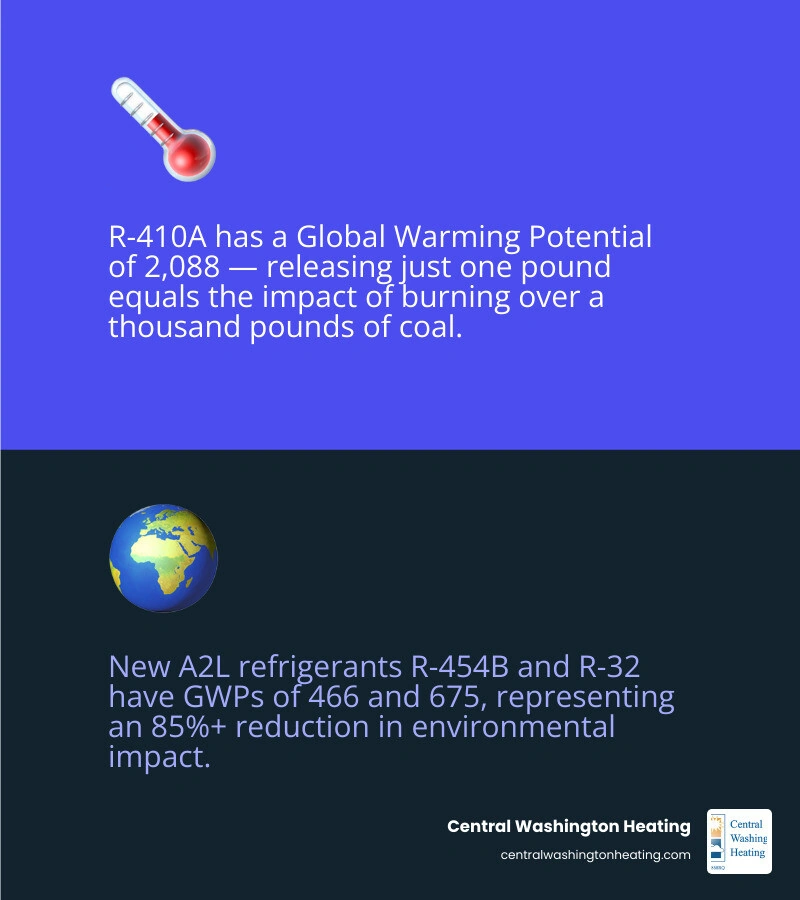
The industry measures the environmental impact of these chemicals using a metric called Global Warming Potential (GWP). The baseline comparison is carbon dioxide, which has a GWP of 1. For context, the outgoing refrigerant, R-410A, has a GWP of 2,088. This means releasing a single pound of R-410A into the air has the same environmental impact as burning over a thousand pounds of coal.
To address this, the federal government initiated a phase-down of hydrofluorocarbons (HFCs). The goal is to transition the country to next-generation refrigerants, specifically R-454B and R-32. To learn more about how these environmental rules translate directly to your home comfort, you can read our guide on How AC Refrigerant Changes Affect Homeowners.
Why R-410A is Disappearing
The decline of R-410A is not a sudden decision by manufacturers; it is a legally mandated phase-out driven by the EPA’s Technology Transitions Program under the AIM Act of 2020. This legislation outlines a strict timeline to reduce HFC production and consumption by 85% by the year 2036.
As of June 2026, we are well into this phase-down. The EPA prohibited the manufacture of new R-410A residential air conditioners, and production of the refrigerant itself has been cut by 40% of its historical baseline. Because supply is shrinking while millions of older systems still require servicing, R-410A has become increasingly scarce, driving up wholesale costs for service companies and homeowners alike.
The New Low-GWP Alternatives: R-454B vs. R-32
The HVAC industry has consolidated around two primary replacements that meet the federal requirement of a GWP under 700. Both belong to a class of refrigerants known as A2Ls, which offer a blend of high efficiency and low environmental impact.
- R-454B: Developed as a blend of R-32 and R-1234yf, this option has a GWP of just 466. That represents a massive 78% reduction in global warming potential compared to R-410A. It is the refrigerant of choice for many leading central air conditioner and heat pump manufacturers.
- R-32: A single-component refrigerant with a GWP of 675 (a 68% reduction compared to R-410A). Because it is not a blend, it is highly stable and can be topped off easily without risk of chemical separation. It is primarily used in ductless mini-split systems.
| Refrigerant Type | Global Warming Potential (GWP) | ASHRAE Safety Class | Relative Efficiency vs. R-410A |
|---|---|---|---|
| R-410A | 2,088 | A1 (Non-flammable) | Baseline |
| R-454B | 466 | A2L (Mildly Flammable) | 8% to 10% Higher |
| R-32 | 675 | A2L (Mildly Flammable) | 10% to 12% Higher |
How the Refrigerant Transition Affects Your Next AC Purchase
If your current cooling system is on its last legs, understanding how the refrigerant transition affects your next AC purchase is critical to making a smart investment.
First, let’s talk about availability. In Washington state, environmental regulations are interpreted even more strictly than the federal baseline. The state does not recognize outdoor units as simple service components. This means that full outdoor R-410A replacement units could only be legally installed if they were manufactured before January 1, 2025, and fully installed by January 1, 2026. Now that we are in June 2026, those legacy units are virtually gone. If you are buying a new air conditioner today, it will be an A2L-compliant system.
The good news is that these modern systems are paired with updated SEER2 (Seasonal Energy Efficiency Ratio) standards, meaning they use significantly less electricity to keep your home cool during our hot, dry Central Washington summers. For a deeper look at energy ratings, check out our resource on What SEER2 Rating to Look For in a New AC.
System Compatibility and Replacement Decisions
One of the most common questions we hear in Cashmere, Leavenworth, and Chelan is: “Can I just replace my outdoor condenser and keep my indoor coil?”
Unfortunately, the answer is no. A2L refrigerants operate under different pressures and require entirely different synthetic compressor oils than older R-410A systems. Mixing these components would cause immediate system failure and void your manufacturer’s warranty. Additionally, older indoor evaporator coils lack the mandatory safety sensors and mitigation electronics required for A2L systems.
When you upgrade, you must replace the entire matched system—both the outdoor condenser and the indoor coil or air handler. To help you evaluate whether your older unit is worth saving or if it is time to make the switch, refer to our comprehensive guide on When Should You Replace Your Air Conditioner.
Heat Pumps and Electric Heating Options
The refrigerant transition has also accelerated the adoption of all-electric heat pump systems. Because heat pumps provide both cooling in the summer and high-efficiency heating in the winter, they are an incredibly practical choice for the Wenatchee Valley’s climate.
Modern heat pumps using R-454B or R-32 are frequently paired with high-efficiency electric air handlers to provide a reliable, clean, and fully electric home comfort system. If you are considering moving away from fossil fuels or older, inefficient baseboard heaters, an A2L heat pump paired with an electric air handler is a future-proof solution. You can read all about how these systems handle our cold winters and hot summers in our Heat Pump Guide 2026 Explained.
Safety and Efficiency: What to Expect from A2L Systems
The term “mildly flammable” can sound intimidating at first, but A2L refrigerants are incredibly safe. In fact, many common household products, such as hairspray and cooking sprays, are significantly more flammable than R-454B or R-32.
Under ASHRAE Standard 34, A2L refrigerants have a very high lower-flammability limit and a exceptionally slow flame propagation speed. In plain English: it is incredibly difficult to ignite these gases, and even if they do catch fire, the flame spreads so slowly that it struggle to sustain itself. These refrigerants have been used safely across Europe and Asia for over a decade in millions of homes without issue.
Advanced Safety Features in A2L Equipment
To provide absolute peace of mind, manufacturers have engineered advanced safety mechanisms directly into every new A2L air conditioner and heat pump.
New systems feature integrated Refrigerant Detection Systems (RDS). These consist of highly sensitive leak sensors placed near the indoor evaporator coil and a specialized mitigation board. If a leak is detected, the system instantly:
- Shuts down the outdoor compressor to stop the flow of refrigerant.
- Activates the indoor blower fan at 100% capacity to safely dilute and dissipate the escaping gas into the home’s air volume, preventing it from ever reaching a concentration where electric heat startup is physically possible.
Efficiency Gains and Long-Term Operating Costs
While safety is paramount, the real win for homeowners in Waterville, Entiat, and Orondo is the efficiency boost. Because A2L refrigerants have superior thermodynamic properties compared to R-410A, they transfer heat much more effectively.
New A2L systems are engineered to be 10% to 15% more efficient than their predecessors. Specifically, systems utilizing R-32 show a 10% to 12% improvement, while R-454B systems deliver an 8% to 10% efficiency increase. Combined with redesigned, high-surface-area coils and advanced variable-speed compressors, these units use less electricity to cool your home, leading to lower monthly utility bills.
Navigating the Choice: Repairing R-410A vs. Upgrading to A2L
If you currently own an R-410A system that is starting to show its age, you may find yourself at a crossroads when a repair issue pops up. Should you patch up the old unit, or is it wiser to invest in a modern A2L system?
To help weigh your options, you can review our AC Unit Replacement Guide 2025 for a step-by-step breakdown of the decision-making process.
The Rising Cost of R-410A Recharges
The most immediate impact of the transition for existing homeowners is the cost of refrigerant recharges. Because of the federal production cuts, the price of R-410A has doubled over the last two years.
If your air conditioner has a slow leak, simply “topping it off” is no longer a viable long-term strategy. It is like putting air in a tire with a rusty nail stuck in it—the expensive gas will simply leak right back out. In 2026, a standard recharge of several pounds of R-410A can represent a significant financial setback. If your system is leaking, it is highly recommended to have a professional technician permanently locate and seal the leak rather than continuously adding expensive, disappearing refrigerant.
When to Choose Replacement Over Repair
While a minor electrical repair like a failed capacitor is always worth fixing, major issues on an older system require a more calculated approach.
The average lifespan of an air conditioner in Central Washington is typically 12 to 15 years, largely because our systems run incredibly hard during peak summer heat in places like Malaga, Peshastin, and Dryden. If your R-410A system is over a decade old and experiences a compressor failure or a major coil leak, pouring money into a temporary fix is often a poor financial decision. Investing those funds into a highly efficient, warrantied A2L system is generally the more cost-effective choice over the long run. Learn more about local equipment lifespans in our guide on How Long Does an AC Unit Last in Central Washington.
Frequently Asked Questions About the Refrigerant Transition
Can I retrofit my existing R-410A system to use R-454B or R-32?
No, you cannot. A2L refrigerants are completely incompatible with older R-410A systems. They operate at different pressures, require different synthetic POE lubricants, and older equipment lacks the necessary leak detection sensors and safety mitigation boards. Attempting to put an A2L refrigerant into an older system will destroy the compressor, void all warranties, and create safety hazards.
How the refrigerant transition affects your next ac purchase if you need a repair?
If your existing R-410A system needs a repair, it remains completely legal to service it. The EPA has not banned the use or repair of R-410A systems, only the manufacture of new units. However, you should expect the cost of R-410A refrigerant and compatible replacement parts to steadily rise as supply continues to decrease over the coming years.
How the refrigerant transition affects your next ac purchase when choosing a contractor?
Installing an A2L system requires specialized tools, including spark-resistant vacuum pumps, recovery machines, and A2L-rated manifold gauges. It also requires specific training in nitrogen-purge brazing to ensure leak-free connections. When hiring a contractor, always ensure they are fully trained in modern A2L handling and installation protocols. To see why choosing the right team matters, read about the Benefits of Professional AC Installation.
Conclusion
Navigating the 2026 refrigerant transition does not have to be overwhelming. While the regulations have changed the technology behind home cooling, the ultimate result is a generation of air conditioners and heat pumps that are safer, more environmentally friendly, and significantly more efficient to run.
At Central Washington Heating, we have spent over 30 years helping our neighbors throughout the Wenatchee Valley—from Cashmere and Leavenworth to Chelan and East Wenatchee—stay comfortable in every season. As a family- and veteran-owned business, we take pride in delivering honest advice, quiet and reliable installations, and expert craftsmanship.
If you are ready to explore your options for a modern, high-efficiency cooling system, or if you want to make sure your current system is running at its best, we are here to help. To learn more about modern cooling technology, browse our Glossary: Refrigerant, or contact our friendly team today to schedule a personalized home comfort consultation.

Written by the Central Washington Heating and Air team
The techs and comfort advisors who've kept the Wenatchee Valley heated, cooled, and breathing easy for 30+ years — family & veteran owned, with 40+ years of combined industry experience.
- Licensed & insured · LIC# CENTRWH742JN
- Daikin Comfort Pro certified
- Wenatchee, WA
Last updated July 7, 2026
Ready for comfort you can count on?
Schedule service, request a free estimate, or call now for 24/7 emergency help. Our team is standing by across the Wenatchee Valley.
Get started today
Free estimates on installs · no-pressure, written quotes
Schedule My ServiceCall (509) 776-0247Mon–Fri: 8:00 AM – 4:30 PM · 24/7 for emergencies
Already have a quote? Get a free second opinion →