
How Your Air Conditioner Works: 5 Essential Tips
Wenatchee Valley's HVAC authority for over 30 years. Expert AC, electric air handler, heat pump, and mini-split installation, repair, and maintenance. Family & veteran owned. 24/7 emergency service.
What Every Central Washington Homeowner Should Know About How Their Air Conditioner Works
Understanding how your air conditioner works is the first step to keeping your home comfortable all summer long — especially in Central Washington, where temperatures can climb well above 100°F.
Here is a quick answer:
How Your Air Conditioner Works — At a Glance
- Warm indoor air is pulled across a cold indoor coil (the evaporator).
- Refrigerant inside the coil absorbs the heat, turning from liquid to gas.
- The compressor pumps that gas to the outdoor unit.
- The outdoor coil (condenser) releases the heat outside your home.
- The refrigerant cools back to liquid and the cycle repeats.
- Moisture from the air condenses on the cold indoor coil, reducing humidity as a bonus.
The result: cooler, drier, more comfortable indoor air — continuously, as long as your system is running.
This process traces back to 1902, when engineer Willis Carrier first used chilled coils to control humidity at a Brooklyn printing plant — and discovered that cooling the air was an equally powerful side effect. More than 120 years later, the core principle remains the same, even as the technology has become dramatically more efficient.
In this guide, we walk through each stage of the cooling cycle, break down the key components, compare common system types, and share practical maintenance tips to help your system run at its best.
The Science of Cooling: How Your Air Conditioner Works
To truly understand how your air conditioner works, we first have to bust a very common myth: your air conditioner does not actually “create” cold air. Instead, it works on the principles of thermodynamics to remove heat from inside your home and dump it outdoors.
Think of your air conditioner less like an ice machine and more like a thermal sponge. When you press a sponge into water, it absorbs the liquid; when you squeeze it over the sink, the water is released. Your air conditioning system does the exact same thing, but instead of water, it absorbs and squeezes out heat.
This process relies heavily on the behavior of fluids and gases as they change states. When a liquid evaporates into a gas, it absorbs a massive amount of heat from its surroundings. This is known as latent heat. Conversely, when that gas condenses back into a liquid, it releases that stored heat.
At the same time, cool air cannot carry as much moisture as warm air. As your air conditioner pulls warm, humid air over its chilly internal components, the air drops below its dew point. This causes water vapor to condense out of the air, naturally dehumidifying your home.
This scientific dance is essential for modern living. According to the International Energy Agency (IEA), there were an estimated 1.6 billion air conditioning units in use globally in 2016. Today, air conditioning is responsible for averting roughly 190,000 heat-related deaths annually. In the United States, about 88% of homes have air conditioning, with 66% relying on whole-home central systems.
While cooling keeps us safe and comfortable, it does require a significant amount of energy. Air conditioners consume about 12% of the electricity used in U.S. households, which adds up to approximately $29 billion annually for homeowners. Globally, as of 2022, air conditioning accounted for roughly 7% of global electricity consumption and emitted 3% of global greenhouse gases. This is why understanding the mechanics of your system—and keeping it running efficiently—is so important for your wallet and the environment.
To dive deeper into the specific industry terms we use throughout this guide, explore our Air Conditioner Glossary and our comprehensive AC Glossary.
The Four Stages of the Refrigeration Cycle

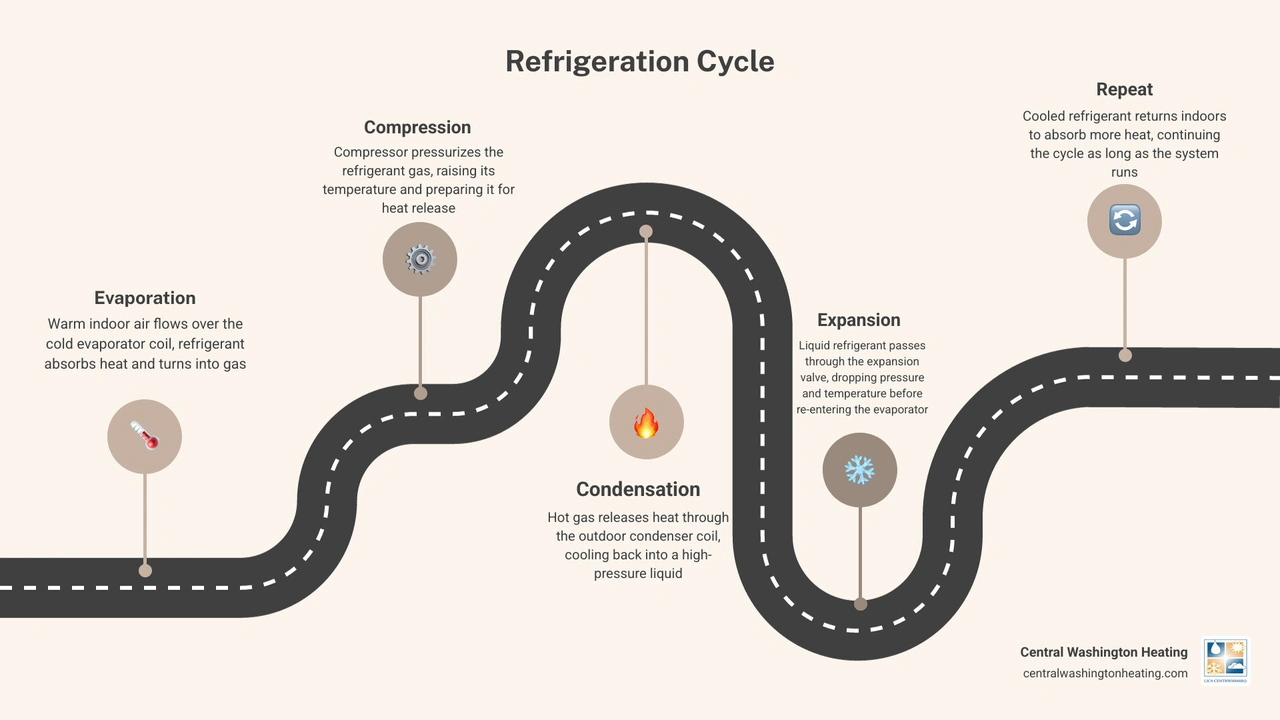
The magic of modern air conditioning happens within a closed loop called the vapor-compression refrigeration cycle. Within this loop, a chemical compound known as refrigerant continuously circulates, transforming from a low-pressure liquid to a high-pressure gas and back again.
Let’s break down this continuous cycle into its four distinct, highly synchronized stages.
Evaporation and Expansion: How Your Air Conditioner Works Indoors
The cooling process begins inside your home. The main player here is the evaporator coil, which is typically installed inside your indoor air handler or electric air handler cabinet.
- The Expansion Valve: Before the chemical refrigerant enters the evaporator coil, it passes through the expansion valve. This valve acts like a narrow nozzle. It restricts the flow of the high-pressure liquid refrigerant, causing its pressure to drop instantly. As the pressure drops, the temperature of the refrigerant plummets to about 40°F to 50°F, turning it into a cold, misty mixture of liquid and vapor.
- The Evaporator Coil: This freezing-cold refrigerant flows into the copper tubing of the evaporator coil. At the same time, your indoor blower fan pulls warm, humid air from your living spaces through the return ducts and pushes it across the outer fins of the evaporator coil.
- Heat Absorption: Because heat naturally moves from warmer objects to colder ones, the heat in your indoor air is quickly absorbed by the cold refrigerant inside the coil. As the air passes over the coil, it exits about 15°F to 25°F cooler than it entered. The blower fan then distributes this chilled air back into your home through your supply ductwork.
- Phase Change: As the refrigerant inside the coil absorbs this indoor heat, it warms up and evaporates entirely, transforming from a cold liquid-vapor mix into a low-pressure, lukewarm gas.
To learn more about the chemical fluids that make this process possible, take a look at our Refrigerant Glossary. If you want to know how your system knows when to start this cycle, check out our Thermostat Glossary.
Compression and Condensation: How Your Air Conditioner Works Outdoors
Now that the refrigerant has absorbed the heat from your home, it needs to get rid of it. The system must transport this heat outside, which is where the outdoor unit comes into play.
- The Compressor: The lukewarm, low-pressure refrigerant gas travels through insulated copper lines out to the outdoor unit. Here, it enters the compressor, which is often called the “heart” of the air conditioner. The compressor squeezes the gas, packing the molecules tightly together. This dramatic increase in pressure causes the temperature of the refrigerant to spike significantly, rising to between 120°F and 170°F. It is now a highly concentrated, hot, high-pressure gas. To learn more about this vital component, check out our Compressor Glossary.
- The Condenser Coil: This super-heated gas enters the condenser coil, which is the large metal coil wrapped around the outdoor unit.
- Heat Rejection: A powerful outdoor fan draws outdoor ambient air through the sides of the outdoor cabinet and blows it across the condenser coil. Because the refrigerant inside the coil is much hotter (up to 170°F) than the outdoor air (even on a scorching 100°F Wenatchee summer day), the heat rapidly transfers from the refrigerant to the outdoor air. If you stand over your outdoor AC unit while it is running, you will feel the hot air blowing out of the top—this is the actual heat from inside your living room being rejected into the atmosphere!
- Condensation: As the refrigerant releases its heat, it cools down below its boiling point and condenses back into a high-pressure liquid.
- The Cycle Repeats: This high-pressure liquid refrigerant flows back toward your home through the liquid line, ready to pass through the expansion valve once again and repeat the entire process.
Comparing System Types and Efficiency Ratings
While all air conditioners rely on the same fundamental vapor-compression cycle, they package these components differently to suit various home layouts, architectural styles, and cooling needs.
| System Type | Indoor Components | Outdoor Components | Best Suited For | Key Advantages |
|---|---|---|---|---|
| Split-System AC | Evaporator coil, blower fan, electric air handler/air handler | Compressor, condenser coil, fan | Homes with existing ductwork | Centralized, even cooling; highly efficient |
| Packaged AC | None (all components housed together outside) | Compressor, condenser, evaporator, blower | Homes with limited indoor space or flat roofs | Saves indoor square footage; easy to service |
| Ductless Mini-Split | Individual wall- or ceiling-mounted blower units | Compressor, condenser coil | Older homes, additions, or zoned cooling | No duct energy loss; highly customizable |
| Portable AC | Entire system housed in one mobile cabinet | None (uses flexible exhaust hose out a window) | Temporary cooling, single rooms, or renters | No permanent installation; easy to move |
When choosing or upgrading a system, energy efficiency is a major consideration. In the HVAC industry, seasonal efficiency is measured by the SEER2 (Seasonal Energy Efficiency Ratio 2) rating. Introduced in January 2023, SEER2 is a more stringent standard than the older SEER rating because it tests systems under more realistic duct pressure conditions.
A higher SEER2 rating means the air conditioner uses less electricity to deliver the same amount of cooling. Upgrading an old, inefficient system can yield massive energy savings. According to the Department of Energy (DOE), replacing a 10-year-old air conditioner with a modern, high-efficiency model can reduce your cooling energy use by up to 50%.
Additionally, many homeowners in Central Washington are opting for heat pumps instead of traditional air conditioners. A heat pump works exactly like an air conditioner in the summer, but it features a reversing valve that allows it to run the refrigeration cycle in reverse during the winter, pulling heat from the outdoor air to warm your home.
To see how these systems compare side-by-side, read our AC vs Heat Pump Comparison or learn more about the mechanics in our guide on How Heat Pumps Work.
Homeowner Maintenance and Longevity Tips
An air conditioner is a significant investment in your home comfort. To keep it running smoothly through the hot Wenatchee Valley summers, regular maintenance is absolutely essential. Proper care not only extends the lifespan of your system to its full 15 to 20 years but also keeps your utility bills low by maintaining peak operating efficiency.
Here are the most critical maintenance steps you should take:
- Change Your Air Filters Regularly: This is the single most important task a homeowner can perform. Clogged, dusty filters restrict airflow, forcing your blower fan to work harder and reducing the system’s ability to absorb heat. In worst-case scenarios, restricted airflow can cause your evaporator coil to freeze into a solid block of ice! Check your filters monthly and replace them at least every 90 days (or more frequently if you have pets or allergies).
- Keep the Outdoor Unit Clear: Your outdoor condenser unit needs plenty of breathing room to reject heat efficiently. Clear away weeds, grass, leaves, and debris from around the cabinet. Maintain at least a two-foot clearance zone around the entire unit, and never stack items on top of it.
- Keep Your Home Airtight: When your air conditioner is running, keep all doors and windows closed. Leaving doors or windows open allows hot, humid air to pour inside, forcing your AC to run continuously, driving up your energy bills, and accelerating wear and tear.
- Schedule Professional Maintenance: While changing filters is an easy DIY task, complex components like electrical connections, refrigerant levels, and internal coils require professional attention. You should have your central air system serviced by a professional at least once a year, ideally in the spring before the summer heat hits.
For a deeper look into why professional upkeep is so beneficial, check out our article on the Benefits of Regular AC Maintenance. To understand what a professional technician does during a visit, read about our Annual AC Service and review our detailed AC Service Checklist.
Frequently Asked Questions
How does an air conditioner dehumidify the air?
Dehumidification is a natural byproduct of the cooling process. Warm air holds more moisture than cold air. When your home’s warm, humid air is pulled across the freezing-cold evaporator coil, the air temperature drops rapidly. As it cools, the air loses its ability to hold moisture, causing water vapor to condense onto the cold surface of the coil—much like water droplets forming on a cold glass of iced tea on a hot day. This moisture drips down into a collection pan and flows out of your home through a condensate drain line.
Why is the compressor called the heart of the AC?
The compressor is called the heart of the system because it is responsible for pumping and circulating the refrigerant through the entire closed-loop system. Just as your heart pumps blood to keep your body functioning, the compressor applies mechanical pressure to the refrigerant, driving the physical state changes that allow heat to be absorbed indoors and released outdoors. Because it does the heaviest lifting, the compressor is also the most energy-intensive and loudest component in your system, and it is typically the most expensive part to replace if it fails.
How long do modern central air systems typically last?
With proper maintenance and regular annual servicing, a high-efficiency modern central air conditioner can easily last between 15 and 20 years. Neglecting regular maintenance, operating the system with dirty filters, or ignoring minor repairs can lead to premature component failure, reducing the system’s lifespan to 10 years or less.
Conclusion
Understanding how your air conditioner works helps you make informed decisions about your home’s energy efficiency, comfort, and maintenance needs. From the indoor evaporator coil to the outdoor compressor, every component must work in perfect harmony to keep your home cool when the Central Washington summer heat peaks.
When you need reliable, expert care for your home’s cooling system, Central Washington Heating is here to help. We are a family- and veteran-owned business with over 30 years of trusted HVAC expertise serving homeowners throughout the Wenatchee Valley. Our fully licensed technicians are dedicated to keeping your home comfortable with fast response times, custom craftsmanship, and dependable service. We proudly serve families in Cashmere, Chelan, Dryden, East Wenatchee, Entiat, Leavenworth, Malaga, Monitor, Orondo, Peshastin, Waterville, and Wenatchee.
Don’t wait for a summer heatwave to find out if your air conditioner is up to the task. Keep your system running quietly, efficiently, and reliably all summer long.
Request Service Today to schedule your professional AC maintenance or system upgrade!

Written by the Central Washington Heating and Air team
The techs and comfort advisors who've kept the Wenatchee Valley heated, cooled, and breathing easy for 30+ years — family & veteran owned, with 40+ years of combined industry experience.
- Licensed & insured · LIC# CENTRWH742JN
- Daikin Comfort Pro certified
- Wenatchee, WA
Last updated July 7, 2026
Ready for comfort you can count on?
Schedule service, request a free estimate, or call now for 24/7 emergency help. Our team is standing by across the Wenatchee Valley.
Get started today
Free estimates on installs · no-pressure, written quotes
Schedule My ServiceCall (509) 776-0247Mon–Fri: 8:00 AM – 4:30 PM · 24/7 for emergencies
Already have a quote? Get a free second opinion →