
How Airflow Affects Your Air Conditioners Performance: 5 Proven Fixes
Wenatchee Valley's HVAC authority for over 30 years. Expert AC, electric air handler, heat pump, and mini-split installation, repair, and maintenance. Family & veteran owned. 24/7 emergency service.
Why Airflow Is the Hidden Key to Your AC’s Cooling Power
How airflow affects your air conditioner’s performance is one of the most important things a Central Washington homeowner can understand — especially when summer heat hits the Wenatchee Valley hard. Simply put, when air moves through your system correctly, your AC cools efficiently, controls humidity, and runs without excess strain. When it doesn’t, everything suffers.
Here’s a quick look at the core effects:
| Airflow Condition | What Happens to Your AC |
|---|---|
| Proper airflow | Efficient heat transfer, even cooling, lower energy bills |
| Restricted airflow | Longer run times, higher energy use, uneven temperatures |
| Severely restricted | Frozen evaporator coils, blower motor strain, system damage |
| Leaky ductwork | Up to 30% of cooled air lost before reaching living spaces |
| Dirty air filters | Reduced airflow, dirt buildup on coils, premature equipment wear |
Your AC doesn’t generate cold air — it removes heat from the air inside your home. That process depends entirely on a steady, balanced flow of air moving across the evaporator coil. When that flow is interrupted — by a clogged filter, a leaky duct, a blocked vent, or a dirty coil — the whole system works harder to deliver less comfort.
Research shows that restricted airflow can reduce an AC system’s efficiency by up to 15%, and leaky ductwork alone can account for up to 30% of airflow loss in some homes. For homeowners in Wenatchee, East Wenatchee, and across the Wenatchee Valley, where summer temperatures can climb quickly, these losses translate directly into higher energy bills and a home that never quite feels cool enough.
In this guide, we’ll walk through exactly what’s happening inside your system, how to spot the warning signs, and five proven methods to restore proper airflow and keep your AC running at its best.
How Airflow Affects Your Air Conditioners Performance
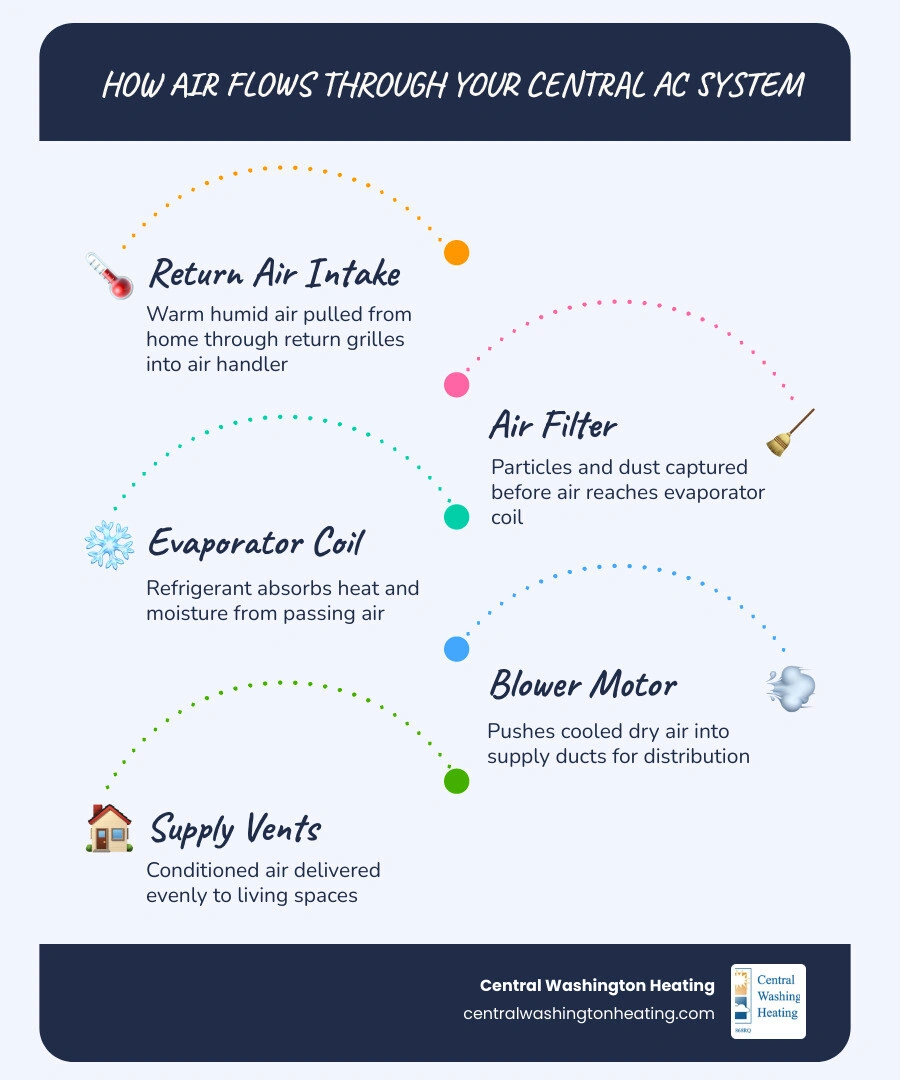
To truly appreciate how airflow affects your air conditioner’s performance, it helps to understand the refrigeration cycle. Your air conditioner relies on a precise balance of refrigerant flow and airflow to transfer heat. The indoor Air Handler draws warm, humid air from your living spaces through return grilles. This air passes over the freezing-cold evaporator coil, where the refrigerant absorbs the heat and moisture. The cooled, dried air is then pushed back into your home through the supply ducts.
If the airflow is restricted, this heat transfer process breaks down. Without enough warm air passing over the evaporator coil, the refrigerant cannot absorb heat efficiently. This leads to several major problems:
- Decreased Cooling Capacity: Your system will run for much longer cycles trying to lower the indoor temperature to match your thermostat setting. In places like Chelan or Leavenworth during a July heatwave, an AC with restricted airflow might run continuously without ever reaching the target temperature.
- Skyrocketing Energy Consumption: When your AC runs longer, it consumes significantly more electricity. Studies show that even a moderate reduction in indoor airflow can increase seasonal energy consumption by 8% to 12%.
- Accelerated Wear and Tear: Longer run times put immense strain on critical components, particularly the compressor and the blower motor. This extra work shortens the overall lifespan of your equipment.
- Compromised System Sizing: If your system was not sized correctly from the start, airflow issues are magnified. You can read more about this in our guide on How Incorrect Sizing During Installation Wastes Energy.
When airflow is optimized, the heat transfer is rapid, the cycles are short and efficient, and your home stays perfectly comfortable.
Warning Signs of Compromised AC Airflow
How do you know if your air conditioning system is struggling with poor airflow? Fortunately, your system will usually drop several hints before it breaks down completely. Recognizing these warning signs early can save you from an unexpected system failure during the hottest week of the year.
- Weak Airflow from Vents: If you hold your hand up to a supply register and feel only a gentle whisper of cool air rather than a strong breeze, your system is struggling to push air through. If you are experiencing this, check out our troubleshooting tips on Fixing Low Airflow From Your AC Vents.
- Hot and Cold Spots: Do you have one room that feels like a sauna while the hallway is ice-cold? This is a classic sign of uneven air distribution and unbalanced airflow.
- Rising Utility Bills: If your energy bills are creeping up compared to the same month last year (June 2026), but your daily usage habits haven’t changed, your system is likely running longer and harder to compensate for poor airflow.
- Frequent Short-Cycling: If your AC turns on, runs for just a few minutes, shuts off, and then turns back on shortly after, it may be overheating or reacting to pressure imbalances caused by restricted airflow.
- Stale or Humid Indoor Air: Because proper airflow is essential for pulling moisture out of the air, a system with restricted flow won’t dehumidify your home effectively. Your indoor air may feel clammy, heavy, or stale.
How Airflow Affects Your Air Conditioners Performance and Causes Frozen Coils
Perhaps the most dramatic consequence of restricted airflow is a frozen evaporator coil. Many homeowners find it hard to believe that an air conditioner can freeze up when it is 95°F outside in Cashmere or Malaga, but it happens frequently.
The evaporator coil relies on the constant warmth of return air to keep its temperature above freezing. When airflow drops below a critical threshold, the temperature of the coil drops below 32°F. Any moisture condensed out of the indoor air instantly freezes onto the coil’s metal fins.
Once a thin layer of ice forms, it acts as an insulator, further blocking airflow. The ice accumulation quickly snowballs, completely encasing the coil in a block of ice and stopping all heat transfer. When this happens, the blower Fan works under extreme stress, and liquid refrigerant can flood back into the compressor, causing catastrophic and expensive mechanical failure.
The Science of Airflow: Static Pressure and CFM Calculations
To solve complex airflow problems, professional HVAC technicians don’t guess—they use physics. Two main metrics govern the health of your system’s airflow: CFM (Cubic Feet per Minute) and Static Pressure.
CFM measures the volume of air moving through your system. As a general industry standard, a typical air conditioning system requires 350 to 400 CFM of airflow per ton of cooling capacity. For example, a 3-ton air conditioner (which provides 36,000 BTUs of cooling) needs to move between 1,050 and 1,200 CFM of air to operate efficiently.
If your home’s Ductwork is undersized, restricted, or poorly designed, it simply won’t allow that volume of air to pass. Technicians calculate the required CFM for each room based on room size, solar heat gain, and local climate factors to ensure every space receives its fair share of conditioned air.
Understanding Static Pressure and How Airflow Affects Your Air Conditioners Performance
Think of static pressure as the HVAC equivalent of blood pressure. It is the measure of resistance the blower motor must overcome to push air through your ductwork, air filter, and coils. Static pressure is measured in Inches of Water Column (IWC).
- Ideal Static Pressure: A well-designed, clean residential system typically operates with a total external static pressure of 0.3 to 0.5 IWC.
- High Static Pressure: When filters are dirty, ducts are pinched, or vents are closed, static pressure rises. If static pressure climbs above 0.8 or 1.0 IWC, the system is in serious trouble.
When static pressure is too high, the blower motor must spin faster and work significantly harder to move the same amount of air. This increases electricity usage, generates excess heat within the air handler, and can cause the blower motor to burn out prematurely. High static pressure also forces more conditioned air out of any existing leaks in your ductwork, compounding your energy losses.
5 Proven Methods to Improve AC Airflow Efficiency
Fortunately, poor airflow is not a permanent death sentence for your air conditioner. There are highly effective steps you can take to restore balance, lower your energy bills, and maximize your indoor comfort.

Before diving into the detailed methods, it is helpful to understand the difference between quick DIY adjustments and professional intervention:
| Action | DIY Vent Adjustments | Professional Airflow Balancing |
|---|---|---|
| What is done | Opening/closing register slates manually | Measuring CFM and adjusting internal duct dampers |
| Impact on Static Pressure | Often increases pressure, straining the system | Lowers and balances system-wide static pressure |
| Result | Temporary, localized, often causes issues elsewhere | Permanent, even comfort across all rooms |
| Equipment Used | Hands | Calibrated manometers, flow hoods, anemometers |
Here are the five proven methods to optimize your AC’s airflow efficiency.
1. Replace Dirty Air Filters Regularly
The single most common—and preventable—cause of restricted airflow is a dirty air filter. Your air filter’s job is to trap dust, pet dander, pollen, and wild-fire smoke particles before they can enter your HVAC system. Over time, the filter becomes loaded with debris, transforming from a protective barrier into a solid wall that restricts air from returning to the system.
- Understand MERV Ratings: Minimum Efficiency Reporting Value (MERV) ratings range from 1 to 16 for residential systems. While higher MERV filters trap smaller particles, they also create more natural resistance to airflow. Always consult with a professional to ensure your system’s blower can handle a high-MERV filter without raising static pressure to dangerous levels.
- Establish a Schedule: During the peak cooling months of July and August in the Wenatchee Valley, or when regional wildfire smoke is present, check your filter every 30 days. Replace standard 1-inch pleated filters every 30 to 45 days if you have pets or allergies, and at least every 90 days during milder seasons.
2. Schedule Professional Air Duct Sealing
Many homeowners don’t realize that their ductwork behaves like a giant straw. If the straw has tiny cracks or holes in it, you have to suck much harder to get a drink.
In the average home, leaky ductwork accounts for up to 30% of total airflow loss. These leaks usually occur at joints, seams, and connections in unconditioned spaces like attics, crawlspaces, or basements.
- Loss of Conditioned Air: Leaks in the supply ducts let cold air escape into your attic before it ever reaches your living spaces.
- Infiltration of Dirty Air: Leaks in the return ducts can pull hot, dusty, or moldy air from your crawlspace directly into your breathing air, bypassing the filter entirely.
Investing in professional Air Duct Sealing ensures that every cubic foot of air your system cools actually makes it to your rooms. You can learn more about how your ducts impact your system choices by reading How Your Existing Ductwork Affects Your AC Choices.
3. Keep Vents and Registers Unobstructed
It sounds simple, but you would be surprised how often poor airflow is caused by furniture, drapes, or rugs blocking return and supply vents.
- The “Closed Door” and Closed Vent Myth: Many homeowners believe they can save money by closing vents in unused guest rooms. However, residential HVAC systems are designed as closed loops. Closing vents does not redirect air to other rooms efficiently; instead, it increases static pressure, forces air out of duct leaks, and places extra strain on the blower motor.
- Maintain Clearance: Keep a minimum of two feet of clear space around all supply registers and return grilles. Avoid placing large couches, bookshelves, or thick rugs directly over or in front of vents. This keeps the air circulating freely and maintains the pressure balance your system needs to function.
4. Clean Dirty Evaporator and Condenser Coils
Your air conditioner has two sets of coils that must remain clean to facilitate heat exchange: the indoor evaporator coil and the outdoor condenser coil.
- Indoor Evaporator Coil: Even with a filter, fine dust can settle on the wet surface of the evaporator coil over time. This dust creates an insulating barrier, reducing heat transfer and restricting the physical space air has to flow through the coil fins.
- Outdoor Condenser Coil: Your outdoor unit is constantly exposed to the elements. Cottonwood seeds, grass clippings, dirt, and leaves can clog the delicate aluminum fins on the condenser. If the outdoor unit cannot exhaust heat because of blocked airflow, the entire system’s efficiency plummets, and operating pressures rise.
- Maintain Outdoor Clearance: Keep shrubs, weeds, and landscaping trimmed back at least two feet from all sides of your outdoor condenser unit to ensure it can breathe freely.
5. Invest in Professional HVAC Airflow Balancing
If you have persistent hot or cold spots in your home, simple DIY adjustments won’t cut it. You likely need professional airflow balancing.
Airflow balancing is the scientific process of testing, adjusting, and balancing your HVAC system to deliver the exact designed CFM of air to each room. During a professional balancing service, a licensed technician will:
- Measure the total airflow output of the air handler.
- Use a specialized flow hood to measure the exact CFM coming out of every single supply register.
- Test static pressure at key points in the system.
- Adjust internal branch dampers located inside your ductwork to redirect air from over-performing rooms to under-performing rooms.
- Recommend solutions for return air restrictions, such as installing transfer grilles or undercutting bedroom doors to allow air to escape when doors are closed.
Key Benefits of Airflow Balancing:
- Eliminates Hot and Cold Rooms: Achieves consistent, even temperatures across your entire home.
- Lowers Energy Bills: Stops your system from overcooling some rooms just to make others tolerable.
- Reduces Equipment Wear: Brings system-wide static pressure back into the safe, ideal operating range.
- Improves Indoor Air Quality: Prevents negative pressure zones that pull in dust and outdoor pollutants.
Frequently Asked Questions About AC Airflow
Why is my AC blowing weak air from the vents?
Weak airflow is usually caused by a severe restriction in the system. The most common culprits are a heavily clogged air filter, dirty evaporator coils, crushed or disconnected ductwork, or a failing blower motor capacitor. Start by checking your air filter. If replacing a dirty filter doesn’t restore strong airflow, you likely have an internal issue or duct damage that requires professional diagnostics.
Will closing vents in unused rooms help balance my system?
No. Closing vents is highly discouraged. Modern HVAC systems are engineered to move a specific volume of air against a designed amount of resistance. Closing registers restricts that path, raising static pressure and forcing your blower motor to work much harder. This can lead to frozen coils, premature blower failure, and increased duct leakage. It is always better to keep all vents open and have a professional adjust internal duct dampers instead.
When should I call a professional for airflow issues?
You should call an HVAC professional if you notice persistent hot and cold spots, if your AC coils are freezing up, if you hear unusual whistling or rattling noises from your ductwork, or if your energy bills remain high after you’ve replaced your air filter. Complex issues like ductwork redesign, static pressure testing, and airflow balancing require specialized tools and training to perform safely and effectively.
Conclusion
Understanding how airflow affects your air conditioner’s performance is the key to maintaining a cool, comfortable, and energy-efficient home throughout our hot Central Washington summers. By staying on top of simple tasks like changing your air filters and keeping vents clear, you can protect your system from unnecessary wear and tear.
When those simple steps aren’t enough to solve uneven cooling or weak airflow, the team at Central Washington Heating is here to help. With over 30 years of trusted HVAC expertise serving Wenatchee, East Wenatchee, Leavenworth, Cashmere, Chelan, and the surrounding communities, our licensed technicians can diagnose and resolve even the most complex airflow and ductwork issues.
Don’t let poor airflow compromise your comfort or drive up your utility bills this summer. Request Air Conditioning Services in Wenatchee, WA today to schedule your comprehensive system tune-up and comfort audit!

Written by the Central Washington Heating and Air team
The techs and comfort advisors who've kept the Wenatchee Valley heated, cooled, and breathing easy for 30+ years — family & veteran owned, with 40+ years of combined industry experience.
- Licensed & insured · LIC# CENTRWH742JN
- Daikin Comfort Pro certified
- Wenatchee, WA
Last updated July 3, 2026
Ready for comfort you can count on?
Schedule service, request a free estimate, or call now for 24/7 emergency help. Our team is standing by across the Wenatchee Valley.
Get started today
Free estimates on installs · no-pressure, written quotes
Schedule My ServiceCall (509) 776-0247Mon–Fri: 8:00 AM – 4:30 PM · 24/7 for emergencies
Already have a quote? Get a free second opinion →