
Heat pump benefits for wenatchee valley homeowners #1
Wenatchee Valley's HVAC authority for over 30 years. Expert AC, electric air handler, heat pump, and mini-split installation, repair, and maintenance. Family & veteran owned. 24/7 emergency service.
Why Heat Pump Benefits for Wenatchee Valley Homeowners Matter More Than Ever in 2026
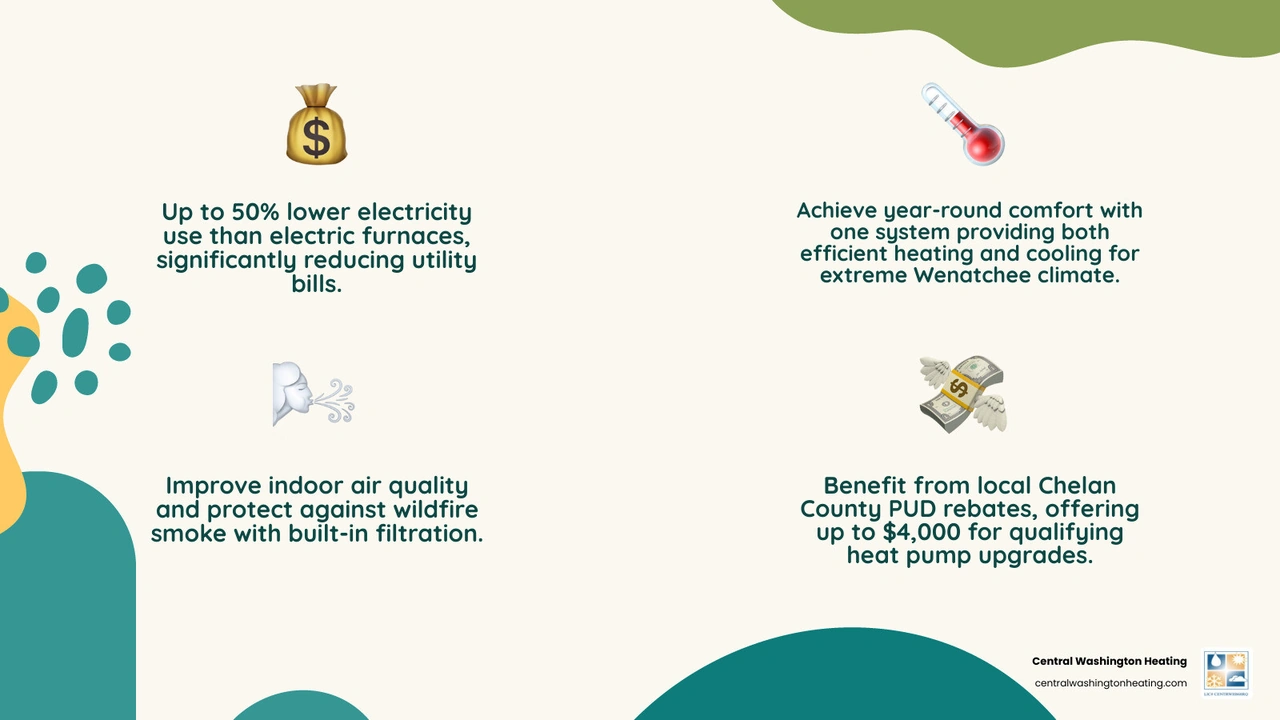
Heat pump benefits for Wenatchee Valley homeowners include lower energy bills, year-round heating and cooling from one system, improved indoor air quality during wildfire season, and access to significant Chelan County PUD rebates.
Quick answer — top heat pump benefits for Wenatchee Valley homeowners:
- Lower energy costs — heat pumps use roughly 50% less electricity than electric air handlers
- One system, two seasons — heat and cool your home with a single unit
- Wildfire smoke protection — built-in filtration helps keep indoor air clean during smoke events
- Cold-weather capable — modern cold-climate models work down to -15°F
- Local rebates available — Chelan County PUD offers substantial incentives for qualifying upgrades
- Eco-friendly — no fossil fuel electric heating means a smaller carbon footprint
- Quiet, consistent comfort — variable-speed technology avoids the on/off blast cycle of older systems
Living in the Wenatchee Valley means dealing with real extremes. Summers regularly push past 100°F. Winters bring freezing temperatures, wind, and snow — especially heading toward Leavenworth and Cashmere. And in recent years, wildfire smoke has become a serious seasonal concern for the whole region.
Most older electric heating and cooling systems simply were not built for that kind of range. They work hard, wear out fast, and keep energy bills climbing. That leaves a lot of homeowners stuck choosing between staying comfortable and keeping costs under control.
Heat pumps change that equation. By moving heat instead of generating it, they deliver far more output per dollar of electricity than traditional electric systems. And because they handle both heating and cooling, they replace two separate systems with one efficient unit — purpose-built for exactly the kind of climate Central Washington throws at you.
In this guide, we break down everything Wenatchee Valley homeowners need to know: how heat pumps work, why they perform so well here, what rebates are on the table right now, and how to make sure your system is set up for the long haul.
Understanding Heat Pump Technology for Central Washington Homes
To understand the heat pump benefits for wenatchee valley homeowners, you first have to understand that a heat pump doesn’t actually “create” heat the way an electric air handler does. Instead, it acts like a heat transporter.
Think of it as a “Swiss Army knife” for your home’s climate. In the summer, it works exactly like an air conditioner, pulling heat out of your house and dumping it outside. In the winter, it flips a “reversing valve” and does the opposite: it finds ambient heat in the outdoor air (yes, even when it’s cold!) and pumps it into your living room.
This process is handled through a refrigerant cycle. Because it is moving existing heat rather than burning fuel or using high-resistance electric coils, it is incredibly efficient. When comparing a Heat Pump vs AC, the biggest difference is that the AC is a one-trick pony, while the heat pump provides year-round comfort.
If you are currently using an electric forced-air air handler or baseboard heaters, you are likely using a lot more electricity than necessary. To learn more about the terminology, check out our Heat Pump Glossary or dive deeper into How Heat Pumps Work. Choosing from the Best Heat Pump Brands ensures you get a system with a high SEER2 (cooling) and HSPF2 (heating) rating, maximizing your return on investment.
Why heat pump benefits for wenatchee valley homeowners are essential in 2026
As of April 2026, the push for energy efficiency in Washington State has never been stronger. For homeowners in Wenatchee, East Wenatchee, and surrounding areas like Malaga and Monitor, the financial argument for heat pumps is undeniable.
| Heating System Type | Efficiency Rating | Estimated Energy Reduction |
|---|---|---|
| Electric Resistance / Air handler | 100% (1:1 ratio) | Baseline |
| Air-Source Heat Pump | 300% – 400% | ~50% reduction |
Because heat pumps can produce 3 to 4 times more heat energy than the electricity they consume, they are up to 75% more efficient than conventional electrical heating systems. This leads to significantly lower utility bills, which is a major part of the Heat Pumps Services Wenatchee WA we provide.
Beyond the wallet, there is the “comfort factor.” Modern units use variable-speed compressors. Instead of a loud “blast” of hot or cold air that shuts off once the thermostat is hit, these systems run at lower, steadier speeds. It’s like a marathon runner versus a sprinter—steady, quiet, and much better at maintaining a consistent temperature throughout your home.
Maximizing heat pump benefits for wenatchee valley homeowners through PUD rebates
One of the most compelling heat pump benefits for wenatchee valley homeowners is the local financial support. Chelan County PUD and Douglas County PUD are national leaders in encouraging energy efficiency.
Currently, Chelan County PUD offers substantial rebates for residents who switch from electric forced-air heating to a high-efficiency heat pump. For our neighbors in East Wenatchee, Douglas County PUD also provides substantial incentives. These programs are designed to lower the “upfront” hurdle of Heat Pump Installation Wenatchee WA.
Additionally, Washington State programs—often funded by the Climate Commitment Act—can further offset your investment. For local businesses, commercial PUD rebates are available when upgrading from old electric heating. When you combine these incentives, the “payback period” for a new system is shorter than it has ever been.
How heat pump benefits for wenatchee valley homeowners extend to wildfire protection
In Central Washington, “Summer” often brings “Smoke.” Wildfire season is a reality we all have to manage. Traditional HVAC systems often struggle to filter out the fine particulate matter found in wood smoke, but a modern heat pump system is a powerful ally for your health.
Modern Heat Pump Systems East Wenatchee WA are designed to work with high-MERV or HEPA-grade filtration. Because these systems circulate air more consistently, they are constantly scrubbing the air inside your home. They also provide superior humidity control, which prevents that “heavy” feeling in the air during our hot, dry July and August afternoons. Keeping your family safe from outdoor pollutants is a benefit that goes far beyond energy savings.
Adapting to Wenatchee’s Extreme Climate and Cold Winters
A common question we hear in Leavenworth and Waterville is: “Can it really keep me warm when it’s snowing?” Ten years ago, the answer might have been “maybe.” In 2026, the answer is a resounding “yes.”
Modern “cold-climate” heat pumps are specifically engineered for the Inland Northwest. These units can extract heat from outdoor air at temperatures as low as -15°F. They feature advanced defrost cycles to prevent ice buildup on the outdoor coils and are often installed on elevated stands to stay clear of Wenatchee’s snow levels.
For those rare nights when temperatures plummet even further, we often recommend a “dual-fuel” or hybrid setup. This pairs your high-efficiency heat pump with an electric backup heat source. The system automatically chooses the most cost-effective way to heat your home based on the outdoor temperature. Regular Heat Pump Maintenance East Wenatchee WA ensures these sensors and reversing valves are ready for the first frost.
Choosing the Right System: Ducted vs. Ductless Mini-Splits
Not every home in the Wenatchee Valley is built the same. We have beautiful historic homes in South Wenatchee that lack ductwork, and newer builds in Sunnyslope with complex central systems.
If your home has existing ducts in good condition, a central air-source heat pump is often the best Heat Pump Replacement Wenatchee WA. However, if you are dealing with hot/cold spots, a garage conversion, or an older home with baseboard heat, ductless mini-splits are a game-changer.
Mini-splits allow for “zoning.” You can keep your bedroom cool while leaving the guest room at a different temperature, saving even more on your power bill. If you are seeing Signs It’s Time to Replace Heat Pump—like rising bills or frequent repairs—we use Manual J load calculations to ensure your new system is sized perfectly for your specific square footage and insulation levels.
Long-Term Maintenance and Performance in Central Washington
A heat pump is a year-round workhorse. Because it works during both the summer and winter, it doesn’t get the “seasonal breaks” that a standalone AC unit might. This makes Heat Pump Maintenance Wenatchee WA essential for reaching that 15+ year lifespan.
In our region, dust from nearby orchards and fields can clog outdoor coils, and winter ice can put a strain on the fan motor. Our NATE-certified technicians focus on:
- Filter Changes: Replacing filters every 1-3 months to maintain airflow.
- Coil Cleaning: Ensuring the outdoor unit can “breathe” efficiently.
- Refrigerant Checks: Identifying tiny leaks before they lead to a Heat Pump Repair Wenatchee WA.
- Electrical Inspections: Tightening connections to prevent “short-cycling.”
We offer 24/7 emergency service because we know that HVAC systems never seem to break down on a Tuesday afternoon at 2:00 PM—it’s always the coldest night of the year or the hottest Sunday in July.
Frequently Asked Questions about Wenatchee Heat Pumps
Can a heat pump really handle Wenatchee’s sub-zero winter nights?
Yes! Modern cold-climate heat pumps are designed for temperatures well below zero. In the Wenatchee Valley, where we occasionally see extreme cold snaps, these systems use advanced compressors and, if necessary, backup electric heat to ensure your home stays toasty even when it’s -15°F outside.
How much can I expect to save when switching from an electric air handler?
While every home is different, air-source heat pumps typically use about 50% less electricity for heating than traditional electric resistance air handlers. Chelan PUD customers often see an average annual energy cost saving of around 20% when looking at their total utility bill over the course of a year.
What is the difference between a standard heat pump and a cold-climate model?
A standard heat pump is great for milder climates, but its efficiency drops off significantly as it approaches freezing. A cold-climate model (often called a “Hyper-Heat” or similar term) uses variable-speed technology and specialized refrigerants to maintain high heating capacity even when the mercury drops deep into the negatives.
Conclusion
At Central Washington Heating, we’ve spent over 30 years helping our neighbors across the Wenatchee Valley stay comfortable. As a family- and veteran-owned business, we take pride in providing honest, expert advice tailored to our unique local climate. Whether you are in Leavenworth, Cashmere, or East Wenatchee, we have the local expertise to ensure you maximize all the heat pump benefits for wenatchee valley homeowners.
From navigating PUD rebates to custom ductwork and 24/7 emergency support, our licensed technicians are here to help. Don’t let another season of high energy bills or poor air quality go by.
Ready to experience the difference?Heat Pumps Services Wenatchee WA
Request Service Today
Written by the Central Washington Heating and Air team
The techs and comfort advisors who've kept the Wenatchee Valley heated, cooled, and breathing easy for 30+ years — family & veteran owned, with 40+ years of combined industry experience.
- Licensed & insured · LIC# CENTRWH742JN
- Daikin Comfort Pro certified
- Wenatchee, WA
Last updated July 7, 2026
Ready for comfort you can count on?
Schedule service, request a free estimate, or call now for 24/7 emergency help. Our team is standing by across the Wenatchee Valley.
Get started today
Free estimates on installs · no-pressure, written quotes
Schedule My ServiceCall (509) 776-0247Mon–Fri: 8:00 AM – 4:30 PM · 24/7 for emergencies
Already have a quote? Get a free second opinion →